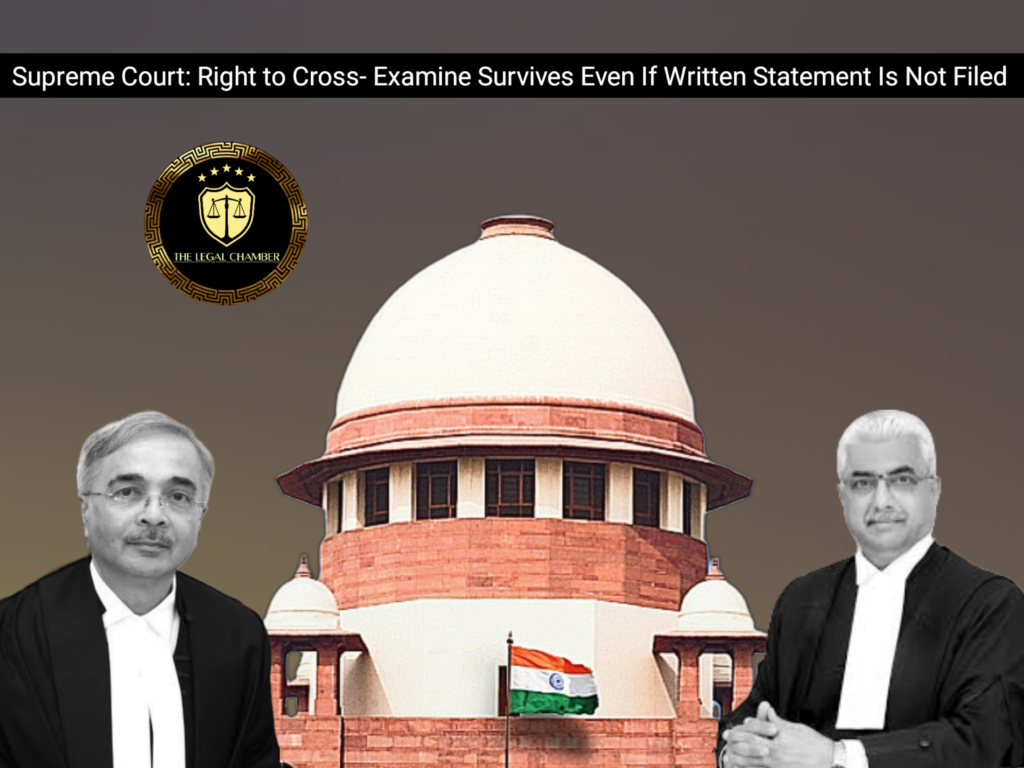
The Supreme Court held that the mandatory 120-day period for filing a written statement in a commercial suit was extended by its COVID-19 limitation orders. Crucially, it ruled that even if a written statement is not filed, the defendant’s fundamental right to cross-examine the plaintiff’s witnesses is not forfeited, as procedural rules must serve substantive justice.
Facts Of The Case:
In 2019, M/s Anvita Auto Tech Works Pvt. Ltd. appointed M/s Aroush Motors as a dealer for CFMOTO motorcycles. The plaintiff invested significant sums in security deposits, showroom setup, and initial stock. The business was disrupted when a government ban on BS-IV vehicles took effect in April 2020, and the defendant failed to supply promised upgrade kits. Consequently, the plaintiff terminated the dealership in September 2020 and filed a commercial suit for recovery of approximately ₹1.78 crore.The core procedural dispute arose when Defendant No. 1 (Anvita) repeatedly failed to file its written statement within the statutory 120-day period, which expired in November 2021. Despite filing applications for extension and later submitting the written statement in January 2022, the trial court rejected it for being time-barred. Subsequently, the court also recorded the defendant’s cross-examination as “Nil” due to the non-filing of the written statement. The suit was decreed in favour of the plaintiff, a decision upheld by the High Court, leading to the present appeal before the Supreme Court.
Procedural History:
The procedural history of this case began with the filing of Commercial Original Suit No. 372 of 2021 by the plaintiff-respondent, M/s Aroush Motors, before the Additional City Civil & Sessions Judge (Commercial Court) in Bengaluru. The defendant-appellant, M/s Anvita Auto Tech, failed to file its written statement within the mandated 120-day period, culminating in the trial court’s order dated 22 March 2022, which rejected its belated written statement. Subsequently, the trial court, on 19 August 2022, recorded the defendant’s cross-examination as “Nil” due to this failure and ultimately passed a decree against the defendant on 15 November 2022. The defendant’s Commercial Appeal No. 189 of 2021 against the rejection of the written statement was dismissed as withdrawn after the decree. A subsequent Commercial Appeal No. 19 of 2023 before the High Court of Karnataka, challenging the final decree, was dismissed by the impugned order dated 20 May 2025, which affirmed that the right to cross-examination was forfeited. This dismissal led to the present civil appeal before the Supreme Court of India.
READ ALSO:Evidence Wholly Unreliable: Supreme Court Overturns High Court’s Conviction for Power Pilferage
Court Observation:
The Supreme Court made key observations on two pivotal legal aspects. Firstly, it held that the mandatory 120-day period for filing a written statement in a commercial suit fell within the COVID-19 limitation extension period (15 March 2020 to 28 February 2022) as established in In Re: Cognizance for Extension of Limitation. Therefore, the trial court erred in rejecting the appellant’s written statement as time-barred. Secondly, and fundamentally, the Court clarified that even in the absence of a filed written statement, a defendant’s right to cross-examine the plaintiff’s witnesses is not extinguished. Relying on Ranjit Singh v. State of Uttarakhand, it emphasized that this right is a core component of the right to a fair defense, and its denial amounts to a failure of substantive justice. The Court concluded that procedural rigidity must yield to ensure a meaningful opportunity to be heard.
Final Decision & Judgement:
The Supreme Court allowed the appeal and set aside the impugned judgment of the High Court as well as the decree of the trial court against the appellant. The Court remanded the matter back to the trial court with specific directions: the appellant is permitted to file its written statement on record subject to payment of costs of ₹1,00,000, and is granted the right to cross-examine the plaintiff’s witnesses. The trial court was requested to dispose of the commercial suit expeditiously, preferably within six months from the date of the Supreme Court’s order.
Case Details:
Case Title: M/S Anvita Auto Tech Works Pvt. Ltd. vs. M/S Aroush Motors & Anr.
Citation: 2025 INSC 1202
Appeal Number: (Arising out of Special Leave Petition (Civil) No. 21917 of 2025)
Date of Judgement: October 08, 2025
Judges/Justices Name: Justice Aravind Kumar and Justice N.V. Anjaria
Download The Judgement Here