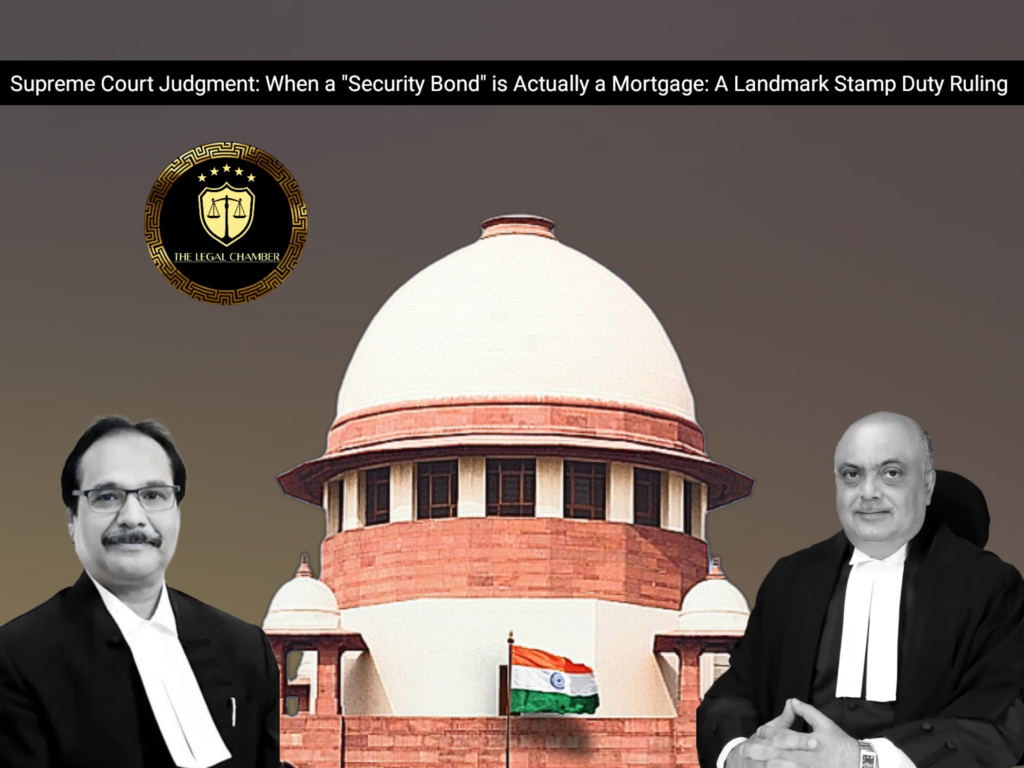
In this judgment, the Supreme Court clarified the distinction between a mortgage deed and a security bond for stamp duty under the Indian Stamp Act, 1899. The Court held that the substance of an instrument, not its nomenclature, determines its character. For Article 57 (security bond) to apply, a third-party surety distinct from the principal debtor must be involved. Since the deeds were executed by the principal debtors themselves to secure their own obligations, they were rightly classified as mortgage deeds chargeable under Article 40.
Facts Of The Case:
In Civil Appeal No. 7661 of 2014, M/s Godwin Construction Pvt. Ltd. executed a “Security Bond cum Mortgage Deed” on 19.12.2006 in favour of the Meerut Development Authority (MDA). This was done to secure performance of its obligations, including payment of external development charges for a colony project. The deed mortgaged specified plots of land. The appellant paid a stamp duty of ₹100 under Article 57 of the Stamp Act. However, the stamp authorities issued a notice demanding deficient duty of ₹4,61,660, contending the instrument was a mortgage deed chargeable under the higher rates of Article 40. This demand was upheld by the Deputy Commissioner, the Commissioner (Appeals), and finally the Allahabad High Court, leading to the Supreme Court appeal.In the connected Civil Appeal arising from SLP (C) No. 36434 of 2014, the appellant executed a similarly titled “Security Bond or Mortgage Deed” on 04.12.1995 in favour of Allahabad Bank, mortgaging immovable property to secure a business loan. A stamp duty of ₹100 was paid under Article 57. The Sub-Registrar and Deputy Collector (Stamp) held it was a simple mortgage deed chargeable under Article 40, indicating a stamp deficit. This conclusion was affirmed through revision and a dismissed writ petition before the High Court, prompting the appeal to the Supreme Court.
Procedural History:
The procedural history of this case began when the stamp authorities issued notices to the appellants, holding that the “Security Bond cum Mortgage Deed” instruments were chargeable as mortgage deeds under Article 40 of the Stamp Act, and demanding payment of deficient stamp duty with penalty and interest. The appellants filed objections before the Deputy Commissioner (Stamps) in the first case and a stamp revision in the second, but these were dismissed. Subsequently, they preferred appeals under Section 56 of the Indian Stamp Act before the Commissioner (Meerut Division) and the Chief Controlling Revenue Authority, respectively, which were also rejected. Aggrieved by these orders, the appellants filed writ petitions before the High Court of Judicature at Allahabad. The High Court, in separate judgments, dismissed both writ petitions, affirming the findings of the revenue authorities. This led the appellants to file the present civil appeals before the Supreme Court of India, which were heard together and ultimately dismissed, upholding the decisions of the High Court.
Court Observation:
In its observations, the Supreme Court emphasized that for determining stamp duty, the substance and operative legal effect of an instrument govern its character, not its assigned nomenclature. The Court meticulously analyzed the definition of a “mortgage-deed” under Section 2(17) of the Indian Stamp Act, 1899, and found that both deeds in question, by transferring an interest in specified property to secure an obligation, fulfilled its essential characteristics. Crucially, the Court interpreted Article 57, noting that its second limb applies only to instruments executed by a surety—a third party guaranteeing the debt of another—as defined in the Indian Contract Act. Since the deeds were executed by the principal debtors themselves (the companies), mortgaging their own property to secure their own liabilities, no distinct surety was involved. Consequently, Article 57 was held inapplicable, and the instruments were rightly classified as mortgage deeds chargeable to duty under Article 40 of Schedule 1-B.
Final Decision & Judgement:
The Supreme Court dismissed both civil appeals, upholding the impugned orders of the Allahabad High Court. The Court ruled that the instruments titled “Security Bond cum Mortgage Deed” and “Security Bond or Mortgage Deed” were, in substance, mortgage deeds as defined under Section 2(17) of the Indian Stamp Act, 1899. It held that Article 57 of Schedule 1-B, which prescribes duty for a security bond, was inapplicable as it requires execution by a third-party surety, a condition absent in these cases where the principal debtors themselves executed the deeds. Therefore, the instruments were correctly held to be chargeable to stamp duty under Article 40 for a mortgage deed. The Court found no infirmity in the High Court’s judgments and affirmed the demands for deficient stamp duty, penalty, and interest.
Case Details:
Case Title:M/s Godwin Construction Pvt. Ltd. vs. Commissioner, Meerut Division & Anr.
Appeal Number: Civil Appeal No. 7661 of 2014
Date of Judgment:October 08, 2025
Judges/Justices Name: Justice Prashant Kumar Mishra  & Justice Ahsanuddin Amanullah
Download The Judgement Here