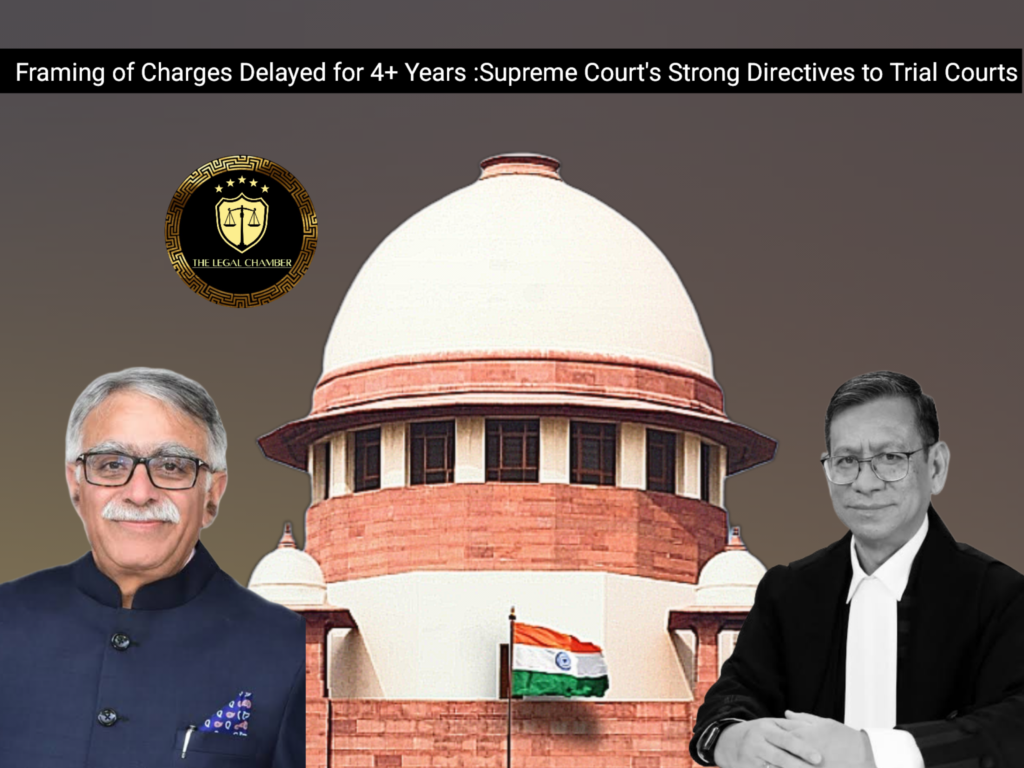
The appellant initially filed Criminal Bail Application No. 2678 of 2024 before the High Court of Judicature at Bombay seeking regular bail under Section 439 of the Code of Criminal Procedure, 1973. The High Court, after perusing the charge-sheet, witness statements, and recovery of weapons, passed its judgment on August 22, 2024, rejecting the bail application on the grounds that ample incriminating material existed prima facie connecting the appellant with the crime and that the nature of the offence was serious. Aggrieved by this decision, the appellant approached the Supreme Court by filing Special Leave Petition (Criminal) No. 7964 of 2025. The Supreme Court granted leave on October 7, 2025, converting the petition into Criminal Appeal No. 5685 of 2025. During the proceedings, the Court took cognizance of the fact that despite the charge-sheet being filed on July 8, 2021, charges had not been framed against the appellant for over four years. The Court sought a report from the learned District Judge and Additional Sessions Judge, Pune, dated September 16, 2025, explaining this delay. It further directed the Registrar General of the Bombay High Court to file an affidavit regarding the status of cases pending at the stage of framing of charges across the state, leading to the issuance of comprehensive directions both for the individual case and for systemic reform.
READ ALSO:Can In-Laws Be Summoned for Murder if Not Named in the Chargesheet? Supreme Court Answers
Court Observation:
The Supreme Court made several significant observations regarding the critical nature of the stage of framing of charges in criminal trials. The Court observed that framing of charges represents the transition point in a trial from a preliminary stage to a full-fledged trial, and when this determination is delayed without justification, the process of trial itself becomes uncertain. From the perspective of the accused, the Court noted that such delay has serious consequences including anxiety, stigma, and direct impact on defence preparation, sometimes even leading to witness unavailability and prolonged incarceration. The Court further observed that even when an accused is on bail, prolonged pendency can cause reputational harm, professional setbacks, and psychological stress. Significantly, the Court observed that delay in framing charges is closely linked to the fundamental guarantee of speedy trial under Article 21 of the Constitution of India, which may be impacted when the delay is attributable to the prosecution or even to systemic inefficiencies. While examining the report submitted by the District Judge, the Court observed that reasons such as non-production of accused from jail, pendency of bail applications, absence of co-accused, and changes in presiding officers, though explaining the chronology, could not be treated as justifiable grounds for an inordinate delay of more than four years, particularly when the accused remained in custody throughout. The Court firmly observed that the absence of a rigid statutory timeline under the Cr.P.C. cannot be construed as a licence for indefinite postponement of this crucial stage of proceedings. Regarding the systemic data presented, the Court observed that reasons such as “Non-production of accused from Jail” and “Presiding Officer on deputation” reflected a sorry state of affairs, and found it disturbing that such grounds were furnished to explain delays extending to four years. The Court also observed that the present matter could not be treated as an open and shut case as the evidence collected during investigation would require to be weighed before any culpability could be fastened on the appellant.
Final Decision & Judgement:
The Supreme Court dismissed the criminal appeal, thereby upholding the High Court’s decision to reject the appellant’s bail application. However, the Court issued comprehensive directions both in personam (specifically for this case) and in rem (of general application). For the instant case, the Court directed the concerned Trial Court to complete the stage of framing of charges within six weeks from the date of receipt of the order, and upon framing of charges, to ensure examination of crucial prosecution witnesses, including eyewitnesses, within six months thereafter, subject to no deliberate delay from either side. The Court further directed the Trial Court to secure regular production of the accused either physically or through electronic means. For cases generally, the Court directed that in all 588 cases pending at the stage of framing of charge before the Bombay High Court, the concerned courts shall complete this procedure within three months, with the delay to be recorded in detail in respective orders. The Court directed that cases be taken up chronologically from earliest to latest, and that administrative Judges for respective districts take periodic updates and facilitate the process. The Court further directed examination of cases pending for three years or more, with a timeline of six months for such cases to move forward from the framing stage. Significantly, the Court clarified that if no significant progress occurs in the trial within six months from the date of framing of charges, it would be open to the appellant to file a fresh bail application before the appropriate court. The Court also directed that a copy of the order be placed before the Chief Justice of the Bombay High Court and the Director General of Police, Maharashtra, for necessary action and compliance. All pending applications were disposed of.
Case Details:
Case Title: Shubham Ganpati @ Ganesh Rathod vs. The State of Maharashtra
Citation: 2025 INSC 1509
Criminal Appeal No.: 5685 of 2025
Date of Judgment:December 4, 2025
Judges/Justice Name: Justice Sanjay Karol and Justice Nongmeikapam Kotiswar Singh