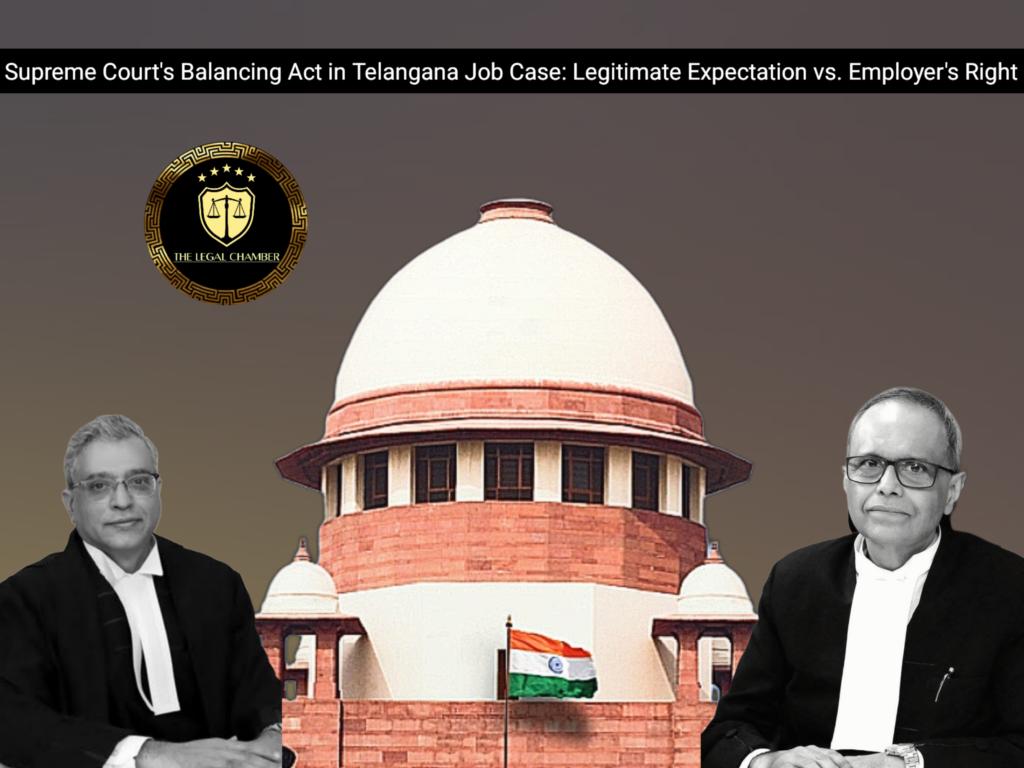
This Supreme Court judgment reaffirms that candidates in a select list possess no vested right to appointment. An employer’s decision to cancel a recruitment process is valid if based on bona fide reasons like administrative changes (e.g., state bifurcation) and altered requirements. The Court’s role is limited to examining the decision-making process, not substituting its own view on the sufficiency of accommodations like age relaxation offered to affected candidates.
Facts Of The Case:
Procedural History:
The recruitment process began with notifications issued by the erstwhile AP-Transco in 2011-2012. The initial legal challenge was against the marks weightage for in-service candidates, which was adjudicated by a Single Judge and later a Division Bench of the High Court, culminating in orders in 2014 that were upheld by the Supreme Court. Following the state’s bifurcation, review petitions were filed by the newly formed distribution companies and some candidates before the Division Bench. The High Court, through orders in December 2014 and October 2017, clarified that its earlier directives were not a mandamus to continue the old selection process. Subsequently, when TS-Transco cancelled the old process and initiated a fresh recruitment in 2017, the affected candidates filed writ petitions. A Division Bench of the Telangana High Court allowed these petitions in March 2020, quashing TS-Transco’s new notifications and directing appointments from the old select list. This judgment of the High Court was then challenged by TS-Transco and others through Special Leave Petitions (SLPs) in the Supreme Court, leading to the present judgment which set aside the High Court’s order
READ ALSO:Supreme Court Slashes NGT’s ₹50 Crore Fine, Rules Turnover Can’t Dictate Environmental Penalty
Court Observation:
In its observations, the Supreme Court emphasized the settled legal principle that candidates on a select list do not have an indefeasible vested right to appointment. The Court found that the decision of TS-Transco to cancel the 2011-12 recruitment process was based on bona fide and reasonable grounds, including the significant delay caused by protracted litigation and the fundamental administrative changes resulting from the state’s bifurcation. It held that the High Court erred in substituting its own judgment for the employer’s policy decision, which was taken after considering the altered requirements of the new state and the liberty granted by the High Court’s own 2017 order. The Supreme Court further observed that the authority had adequately addressed the candidates’ legitimate expectation by providing age relaxation to participate in the new process, and the sufficiency of such accommodation falls outside the scope of judicial review.
Final Decision & Judgement:
The Supreme Court allowed the appeals filed by the Transmission Corporations, setting aside the impugned judgment of the Telangana High Court. It held that the decision of TS-Transco to cancel the pre-bifurcation recruitment process and initiate a fresh one was legal, bona fide, and based on valid reasons including the long delay and changed administrative circumstances after the state’s reorganization. The Court directed that it shall be open for TS-Transco to proceed with making appointments in accordance with its fresh notification dated December 28, 2017. Consequently, the direction of the High Court to appoint candidates from the old select list was quashed. A connected appeal seeking to club vacancies from the old and new notifications was dismissed.
Case Details:
Case Title: The Transmission Corporation of Telangana State Limited & Anr. vs. Chukkala Kranthi Kiran & Ors.
CITATION: 2025 INSC 1029
Civil Appeal No:  (@ SLP (C) No. 11149/2020)
Date of Judgement: August 22, 2025
Judges/Justice Name: Justice PAMIDIGHANTAM SRI NARASIMHA and  Justice JOYMALYA BAGCHI
Download The Judgement Here