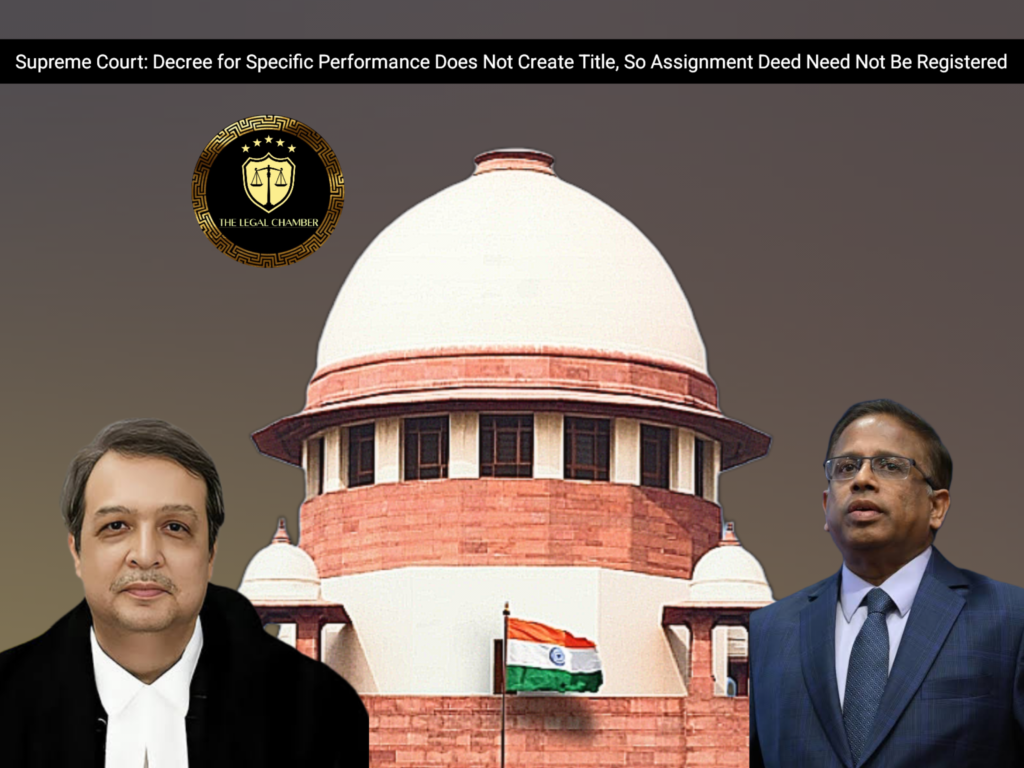
The Supreme Court held that a deed assigning a decree for specific performance of a sale agreement concerning immovable property does not require mandatory registration under Section 17(1)(e) of the Registration Act, 1908. This is because such a decree does not itself create, assign, or extinguish any right, title, or interest in the immovable property; it merely confers a right to seek performance through court execution.
Facts Of The Case:
The appellants are the legal heirs of a judgment-debtor against whom an ex-parte decree for specific performance of a sale agreement concerning immovable property was passed on 13.09.1993. The first respondent, Shanmugam, claimed to be the assignee of this decree by virtue of an assignment deed dated 17.07.1995. In 2004, the assignee filed an execution petition to enforce the decree. The executing court ordered the execution of the sale deed in his favour in 2008. Subsequently, in 2009, the appellants filed an application under Section 47 of the CPC seeking to set aside the execution, primarily contending that the assignment deed was invalid for want of compulsory registration under the Registration Act, 1908. The executing court allowed their application in 2010, holding the assignment deed unenforceable due to non-registration. However, the High Court, in revision, set aside this order, ruling that the assignment of a mere right to execute a decree does not require registration. The legal heirs then appealed to the Supreme Court, leading to the present judgment on the core question of whether such an assignment deed mandates registration.
Procedural History:
The procedural history began when the first respondent, as assignee of the decree, filed Execution Petition No. 150 of 2004 seeking execution. The Executing Court ordered the execution of the sale deed on 13.03.2008. Subsequently, the appellants (legal heirs of the judgment-debtor) filed E.A. No. 180 of 2009 under Section 47, CPC to set aside this execution, which was allowed by the Executing Court on 08.04.2010, holding the assignment deed required compulsory registration and was thus invalid. The first respondent’s revision before the High Court was allowed, reversing the Executing Court’s order and holding the assignment deed did not require registration. The appellants’ appeal to the Supreme Court culminated in the dismissal of the appeal, thereby upholding the High Court’s judgment.
READ ALSO:Supreme Court Orders Assam to Provincialise Services of Music Teachers
Court Observation:
The Supreme Court observed that a decree for specific performance of a sale agreement does not, by itself, create, assign, or extinguish any right, title, or interest in the immovable property. It merely confers a right to obtain performance through the court’s process. Consequently, an instrument assigning such a decree does not purport or operate to transfer an interest in immovable property. Therefore, the mandatory registration requirement under Section 17(1)(e) of the Registration Act, 1908, is not attracted, as the provision applies only to decrees that themselves create or assign an interest in property. The contract between the original parties subsists even after the decree, and the assignee steps into the shoes of the decree-holder to enforce the contractual right to specific performance.
Final Decision & Judgement:
Case Details:
Case Title: Rajeswari & Ors. vs. Shanmugam & Anr.
Citation: 2025 INSC 1329
Appeal Number: Civil Appeal No. 13835 of 2025
Date of Judgement: 19th November, 2025
Judges/Justice Name: Justice K.V. Viswanathan and Justice J.B. Pardiwala
Download The Judgement Here