The procedural history of this case began with the trial court’s judgment in May 2007, which acquitted the respondent, Amit Jogi. Challenging this acquittal, the State of Chhattisgarh, the de-facto complainant, and later the Central Bureau of Investigation (CBI) filed separate applications for leave to appeal before the High Court of Chhattisgarh at Bilaspur. In 2011, the High Court dismissed all three applications. It held the State’s appeal was not maintainable under Section 378 of the CrPC, following the precedent set in Lalu Prasad Yadav. It also ruled the victim’s appeal under the proviso to Section 372 CrPC was not maintainable as the right was not retrospective. Furthermore, it rejected the CBI’s belated application seeking condonation of delay. These dismissals by the High Court culminated in the appeals being filed before the Supreme Court, which led to the present judgment.
READ ALSO:Mere Use of Word “Arbitration” Doesn’t Bind Parties: Key Business Contract Lesson from Supreme Court
Court Observation:
In its observations, the Supreme Court affirmed the legal framework established in Lalu Prasad Yadav, holding that the right of a State Government to appeal an acquittal is expressly excluded in cases investigated by the CBI, as such authority rests solely with the Central Government under Section 378(2) of the CrPC. The Court also clarified that the victim’s right to appeal under the proviso to Section 372 CrPC is prospective, applying only to orders of acquittal passed after December 31, 2009. However, exercising its discretionary power to secure substantive justice, the Court condoned the CBI’s significant delay in filing its appeal, emphasizing that grave allegations should not be dismissed on mere technicalities. It remanded the CBI’s application for leave to appeal back to the High Court for a fresh consideration on merits, while dismissing the appeals filed by the State and the de-facto complainant.
Final Decision & Judgement:
The Supreme Court allowed the CBI’s appeal, condoned its delay in filing, and remanded its application for leave to appeal against the acquittal back to the High Court for a fresh consideration on merits. The appeals filed by the State of Chhattisgarh and the de-facto complainant were dismissed. The Court upheld that the State Government cannot appeal in a CBI-investigated case and that a victim’s right to appeal is not retrospective. It directed that the respondent (acquitted accused), the de-facto complainant, and the State be heard in the High Court proceedings on the CBI’s application.
Case Details:
Case Title: State of Chhattisgarh vs. Amit Aishwarya Jogi & connected matters
Citation:  2025 INSC 1305
Criminal Appeal No.: Criminal Appeal No. 1927 of 2014,
Date of Judgement: November 06, 2025
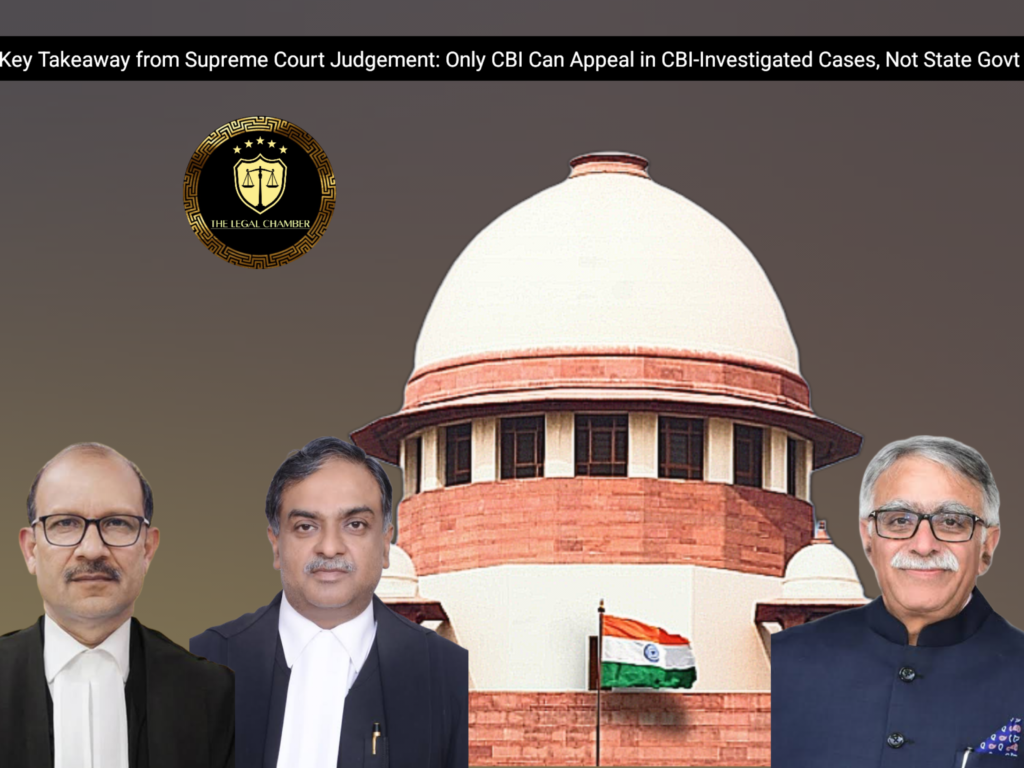
Judges/Justices Name:  Justice Vikram Nath, & Justice Sanjay Karol, and Justice Sandeep Mehta