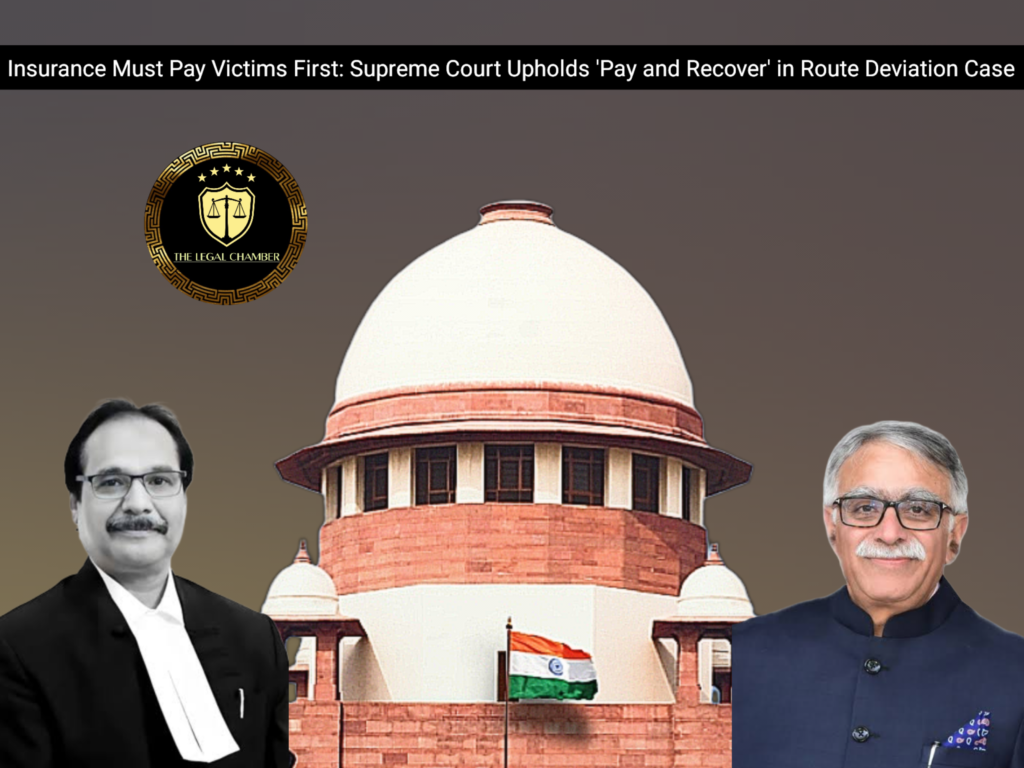
Insurance Must Pay Victims First: Supreme Court Upholds ‘Pay and Recover’ in Route Deviation Case

This Supreme Court judgment affirms the application of the “pay and recover” principle where an insured vehicle deviates from its permitted route. While the insurer remains statutorily liable to compensate accident victims, it is entitled to subsequently recover the paid amount from the policyholder for breaching the contract’s geographical terms.

Facts Of The Case:

On October 7, 2014, the deceased Srinivasa (alias Murthy) died on the spot after his motorcycle was hit by a rashly and negligently driven bus (KA-52-9099). His dependents filed a claim petition before the Motor Accidents Claims Tribunal (MACT) seeking compensation. The Tribunal awarded ₹18,86,000. Dissatisfied, the claimants appealed to the High Court for enhanced compensation, while the insurance company also appealed, contending that the bus was being operated in violation of its permit conditions. The permit only authorized travel from Bengaluru to Mysore, but the accident occurred within Channapatna City, a clear route deviation. The High Court partially allowed both appeals. It enhanced the total compensation to ₹31,84,000 for the claimants after reassessing the deceased’s income. Regarding the insurer’s liability, the Court applied the “pay and recover” principle, directing the insurance company to first pay the compensation to the claimants and then recover the amount from the bus owner. The insurance company challenged this direction before the Supreme Court, leading to the present appeal.

Procedural History:

The procedural history of this case began with the filing of a claim petition by the deceased’s dependents before the Motor Accidents Claims Tribunal (MACT) in Channapatna. The Tribunal awarded compensation, which led to cross-appeals before the High Court of Karnataka by both the claimants (seeking enhancement) and the insurance company (contesting liability due to a permit violation). The High Court, via a common judgment, enhanced the compensation amount and applied the “pay and recover” principle against the insurer. Aggrieved by this direction to pay despite the breach, the insurance company appealed to the Supreme Court, which granted leave and ultimately dismissed the appeal, thereby upholding the High Court’s judgment and the application of the “pay and recover” principle.

READ ALSO:Lawyer’s Unconditional Apology Convinces Supreme Court to Delete Adverse Remarks and Penalty

Court Observation:

The Supreme Court observed that while the insurance contract’s coverage was limited to the permitted route, and the accident occurred due to a clear geographical deviation, the victim’s right to compensation was paramount. Denying relief solely based on this technical breach would be unjust to the blameless victim. To balance the interests of the victim and the insurer, the Court upheld the “pay and recover” principle. It held the insurer statutorily liable to compensate the victim immediately, while preserving its contractual right to subsequently recover the paid amount from the insured vehicle owner for violating the permit condition.

Final Decision & Judgement:

The Supreme Court dismissed the appeals and upheld the judgment of the High Court. It affirmed the application of the “pay and recover” principle, thereby making the insurance company primarily liable to pay the enhanced compensation of ₹31,84,000 to the claimants. Concurrently, the insurer was granted the right to recover this entire amount from the bus owner, as the accident occurred on a route that deviated from the permit, constituting a breach of the policy conditions. No order was made as to costs.

Case Details:

Case Title: K. Nagendra vs. The New India Insurance Co. Ltd. & Ors.
Citation: 2025 INSC 1270
Civil Appeal No.: Civil Appeal Nos. (Arising out of SLP (C) Nos. 7139-7140 of 2023)
Date of Judgement: October 29, 2025
Judges/Justice Name: Justice Sanjay Karol and Justice Prashant Kumar Mishra
Download The Judgement Here

Leave a Reply

Your email address will not be published. Required fields are marked *