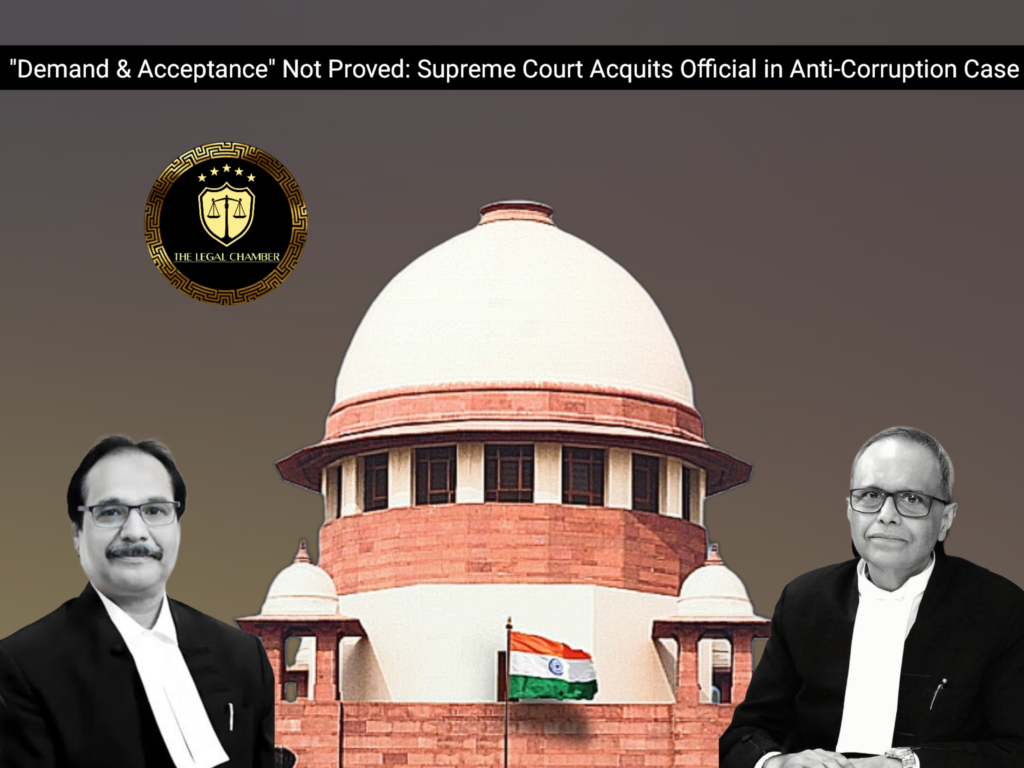
“Demand & Acceptance” Not Proved: Supreme Court Acquits Official in Anti-Corruption Case

The Supreme Court reiterated the established principle that an appellate court should not reverse an acquittal unless the trial court’s view is perverse or based on a manifest misreading of evidence. The prosecution must prove the foundational facts of demand and acceptance of a bribe beyond reasonable doubt, and mere recovery of money is insufficient for conviction under the Prevention of Corruption Act.

Facts Of The Case:

The appellant, an Assistant Commissioner of Labour, was accused of demanding a bribe of ₹9,000 from a labour contractor for renewing three licences. The prosecution alleged that a partial payment of ₹3,000 was made on 25.09.1997, with the balance demanded the next day. The complainant reported this to the Anti-Corruption Bureau (ACB), which laid a trap on 26.09.1997. According to the prosecution, the complainant entered the appellant’s office alone and, upon a repeated demand, placed tainted currency notes totalling ₹3,000 in a table drawer as instructed. The appellant then allegedly signed the licences. The trap party recovered the money, and a swab of the drawer tested positive for phenolphthalein. However, the appellant’s hand-wash test was negative. The Trial Court acquitted the appellant, citing material inconsistencies in the complaint, the lack of independent corroboration for the demand, and serious procedural lapses, including the key mediator being kept outside the room during the alleged transaction. The High Court reversed this acquittal and convicted the appellant. The Supreme Court ultimately set aside the High Court’s judgment and restored the acquittal.

Procedural History:

The procedural history of this case commenced with the filing of a chargesheet on 16.08.1999 after obtaining sanction for prosecution. The Trial Court (Principal Special Judge for SPE & ACB Cases, Hyderabad) framed charges on 11.07.2000, but after trial, acquitted the appellant on 28.11.2003, holding that the prosecution failed to prove the demand and acceptance of a bribe beyond reasonable doubt. The State of Andhra Pradesh appealed this acquittal to the High Court, which reversed the Trial Court’s order and convicted the appellant vide judgment dated 08.07.2011. The appellant then appealed to the Supreme Court, which, in its judgment dated 28.10.2025, allowed the appeal, set aside the High Court’s conviction, and restored the Trial Court’s order of acquittal.

READ ALSO:Investment vs. Debt: Supreme Court Explains Why Preference Shares Don’t Trigger IBC

Court Observation:

The Supreme Court observed that the High Court erred in reversing the acquittal without demonstrating that the Trial Court’s view was perverse or unreasonable. It held that the prosecution’s case suffered from fatal infirmities, including the lack of independent corroboration for the alleged demand of a bribe, material contradictions in the complainant’s version, and serious procedural lapses such as the deliberate exclusion of the independent witness from the room during the alleged transaction. The Court emphasized that the sole testimony of the complainant, an interested witness, was insufficient for conviction and that mere recovery of money, without proof of voluntary acceptance pursuant to a demand, could not establish guilt under the Prevention of Corruption Act. The defence version, supported by two independent witnesses, was found to be probable and consistent, creating reasonable doubt in the prosecution’s narrative.

Final Decision & Judgement:

The Supreme Court allowed the appeal, set aside the impugned judgment of the High Court dated 08.07.2011, and restored the Trial Court’s order of acquittal dated 28.11.2003. The Court held that the prosecution failed to prove the essential ingredients of demand and acceptance of illegal gratification beyond reasonable doubt. Consequently, the appellant’s conviction under Sections 7 and 13(1)(d) read with Section 13(2) of the Prevention of Corruption Act, 1988 was quashed, and his bail bonds were discharged.

Case Details:

Case Title: P. Somaraju vs. State of Andhra Pradesh
CITATION: 2025 INSC 1263
Criminal Appeal No: Criminal Appeal No. 1770 of 2014
Date of Judgement: October 28, 2025
Judges/Justice Name: Justice Prashant Kumar Mishra and Justice Joymalya Bagchi

Leave a Reply

Your email address will not be published. Required fields are marked *