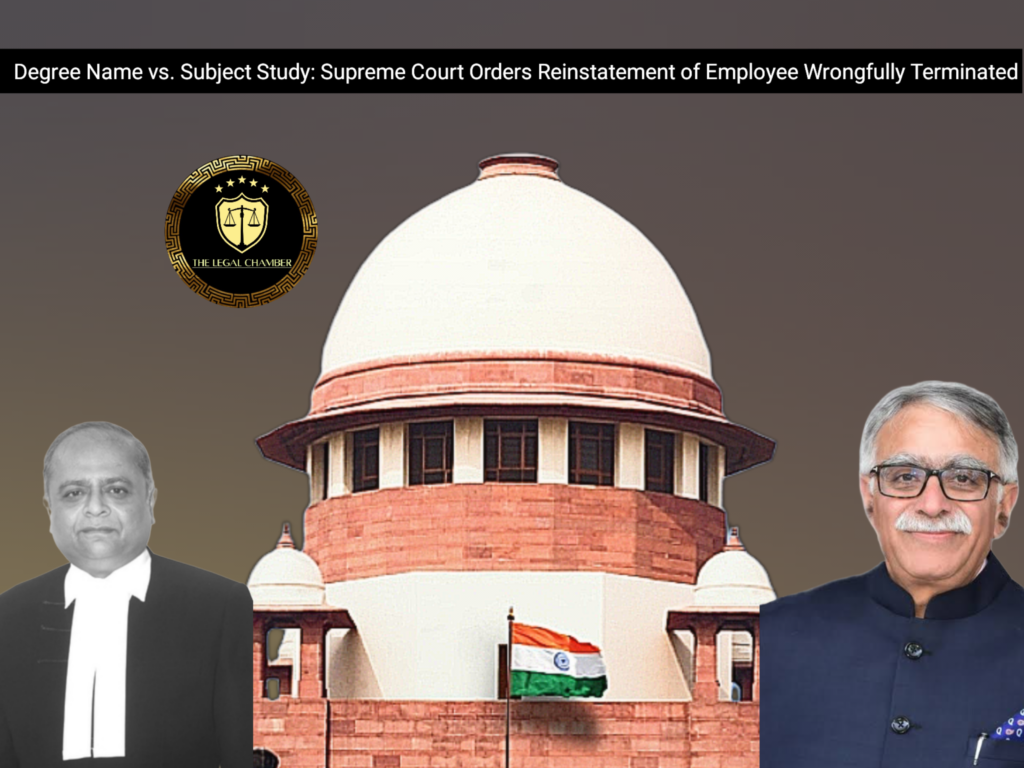
The Supreme Court held that employer decisions cannot be purely mechanical, insisting only on a degree’s title while ignoring the actual curriculum studied. Relying on a committee report prepared without affording a hearing violates natural justice. Furthermore, an expert authority’s eligibility opinion must be considered; ignoring it renders a termination order arbitrary and unsustainable.
Facts Of The Case:
The appellant, Laxmikant Sharma, was appointed on a contractual basis as a Monitoring and Evaluation Consultant in Madhya Pradesh’s Public Health & Engineering Department on April 26, 2013, after responding to an advertisement that required a “Postgraduate degree in Statistics.” He held an M.Com. degree, completed in 1999, which included Business Statistics and Indian Economic Statistics as principal subjects. Following physical verification of his documents, he joined and served satisfactorily for nearly one year. However, in September 2013, an eight-member committee reported that he lacked the required qualification, leading to his termination on October 10, 2013. This sparked multiple rounds of litigation. The High Court repeatedly set aside the termination orders and remanded the matter for fresh consideration with a proper hearing. During these proceedings, the appellant obtained a certificate from his university confirming his M.Com. degree included Statistics as principal subjects. Furthermore, the Director of his department, acting as an expert authority, issued an opinion on November 23, 2019, stating the appellant did possess the requisite statistical components in his curriculum and recommended restoring his services. Despite this, the State again terminated his services in 2018 and 2020, leading to the present appeal before the Supreme Court.
Procedural History:
The appellant initially challenged his first termination order dated October 10, 2013, by filing Writ Petition (Civil) No. 19149 of 2013 before the Madhya Pradesh High Court, which granted a stay on December 13, 2013, and subsequently set aside the termination on November 25, 2014, remanding the matter to the State for fresh consideration after affording the appellant a proper hearing. Despite this direction, the State again terminated the appellant on February 18, 2015, prompting a second round of litigation through Writ Petition (Civil) No. 5023 of 2013. The Single Bench of the High Court, by order dated September 27, 2018, again set aside the termination and directed a fresh, reasoned decision. Pursuant to this remand, the departmental expert authority issued a favorable opinion on November 23, 2019, yet the State issued fresh termination orders on November 2, 2018, and May 14, 2020. The appellant then filed Writ Petition (Civil) No. 4933 of 2021, which was dismissed by the Single Bench on January 29, 2024. Aggrieved, the appellant filed Writ Appeal No. 1536 of 2024 before the Division Bench of the High Court, which affirmed the Single Bench’s order on September 20, 2024. Finally, the appellant approached the Supreme Court by filing Special Leave Petition (Civil) No. 18907 of 2025, which was granted leave and treated as a Civil Appeal, leading to the present judgment dated December 4, 2025.
READ ALSO:Supreme Court: Disputed No-Dues Certificate Can’t Be Ground to Quash Criminal Proceedings
Court Observation:
The Supreme Court observed that insisting solely on the title of a degree, without considering the actual curriculum studied by the candidate, amounts to elevating form over substance and renders the decision-making process arbitrary. The Court noted that the report of the eight-member inquiry committee, which formed the basis of the termination, was vitiated by two significant infirmities: first, the committee’s conclusion that none of the subjects in the appellant’s mark sheet related to Statistics was objectively incorrect in light of the subsequent university certificate confirming he studied Business Statistics; and second, the report was prepared without affording the appellant an opportunity of being heard, thereby violating the fundamental principles of natural justice. The Court further observed that the State’s continued reliance on this defective report, while completely ignoring the subsequent expert opinion dated November 23, 2019, issued by the Director of the department who categorically certified the appellant’s eligibility, rendered the termination orders uninformed and unsustainable in law. The Court also observed that the doctrine of negative equality under Article 14 had no application, as the appellant was not seeking parity with unqualified persons but rather contended he was similarly situated to other candidates possessing degrees with Statistics subjects who were retained in service, and singling him out without any rational basis violated the guarantee of equal protection. Finally, the Court observed that even in contractual employment, the State does not shed its constitutional obligations, and judicial review is entitled to examine whether a termination ground is factually correct and whether relevant material was properly considered.
Final Decision & Judgement:
The Supreme Court allowed the appeal and set aside the impugned judgment dated September 20, 2024, passed by the Division Bench of the Madhya Pradesh High Court, as well as the Single Bench order dated January 29, 2024. The Court held that the appellant possessed the requisite academic qualification when the advertisement dated November 7, 2012, was reasonably construed in the context of the surrounding circumstances, particularly given that no university in the State offered a postgraduate course exclusively titled “Statistics.” The Court directed the respondents to restore the appellant to service on the post of Monitoring and Evaluation Consultant within four weeks from the date of the judgment, provided he was not otherwise disqualified, with all consequential benefits to follow. However, the Court explicitly clarified that this judgment was rendered in the peculiar facts and circumstances of the present case and the conclusions therein shall not be treated as a precedent in any other matter. The Court also disposed of all pending applications. The judgment was delivered on December 4, 2025, by a bench comprising Justice Sanjay Karol and Justice Vipul M. Pancholi.
Case Details:
Case Title: Laxmikant Sharma v. State of Madhya Pradesh & Ors.
Citation: 2025 INSC 1385
Civil Appeal No.:  (@ Special Leave Petition (Civil) No. 18907 of 2025)
Date of Judgment: December 4, 2025
Judges/Justice Name: Justice Vipul M. Pancholi and Justice Sanjay Karol
Download The Judgement Here