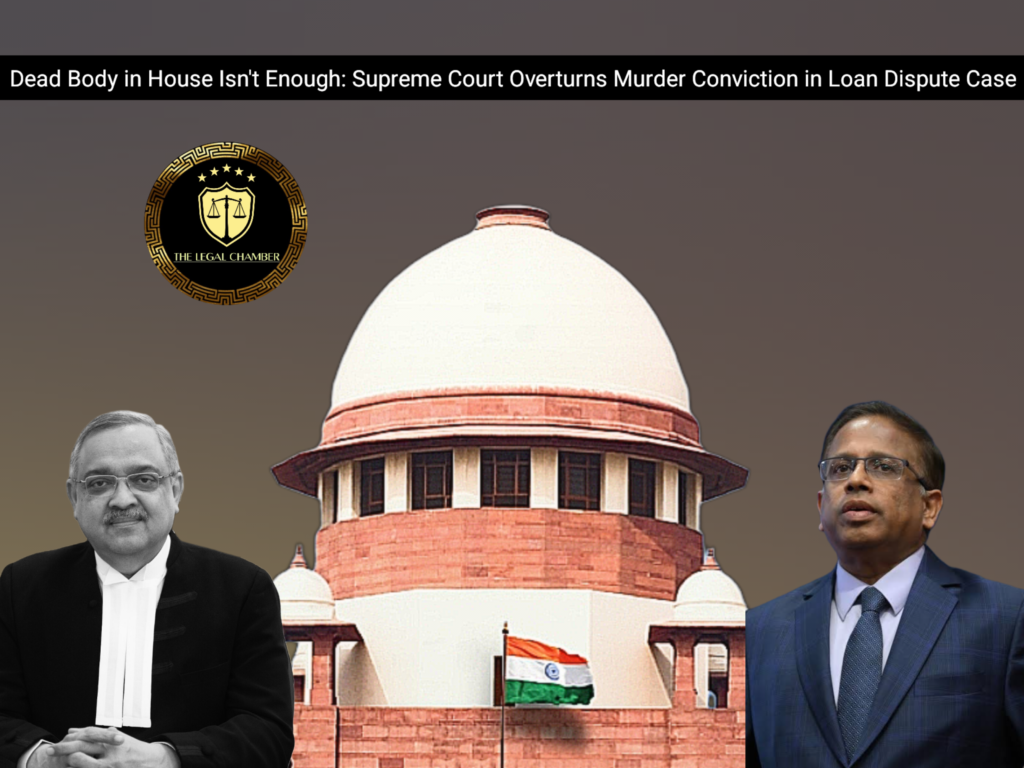
In a case based solely on circumstantial evidence, the Supreme Court acquitted the accused, ruling that the prosecution failed to establish an unbroken chain of circumstances pointing exclusively to their guilt. The Court found the evidence—including motive, recovery of weapons, and extra-judicial confessions made in a police station—to be unreliable, insufficient, and lacking credible corroboration to sustain a conviction.
Facts Of The Case:
The case originated from the brutal murder of a police driver on the night of 10th-11th March 2006. The prosecution alleged that the murder was instigated by a fellow policeman, A1, due to his inability to repay a loan of ₹1 lakh to the deceased. The deceased was lured to the house of A1 and A2 (A1’s wife) on the false pretext of repaying the debt. There, around 2 AM, he was immobilised by chilli powder thrown in his face and subsequently hacked to death with choppers by A2, A3 (A2’s brother), and A4 (A2’s brother-in-law). The following morning, A2 went to the police station and confessed the crime to the Station House Officer, leading the police to the deceased’s body at her residence. While the trial court acquitted A1 due to a lack of evidence for instigation and an alibi, it convicted A2 to A4 under Section 302 read with Section 34 of the IPC, sentencing them to life imprisonment. The High Court later upheld this conviction. The appellants then appealed to the Supreme Court, challenging the verdict primarily on the grounds of the evidence being circumstantial, unreliable, and insufficient to form a complete chain of guilt.
Procedural History:
The procedural history of this case began with the trial court convicting accused persons A2 to A4 under Section 302 read with Section 34 of the Indian Penal Code and sentencing them to life imprisonment, while acquitting A1. This conviction was subsequently challenged before the High Court of Karnataka, which, upon appeal, affirmed the trial court’s findings and upheld the conviction and sentence. Dissatisfied with the High Court’s decision, the convicted appellants (A2 to A4) then exercised their statutory right to appeal by filing a criminal appeal before the Supreme Court of India. The Supreme Court, in its appellate jurisdiction, heard the matter and delivered the final judgment, setting aside the convictions, acquitting all the appellants, and ordering their release if not required in any other case.
READ ALSO:No Redemption After Auction Notice: Supreme Court Major Ruling on Bank Loan Recovery
Court Observation:
The Supreme Court made critical observations, ruling that the prosecution failed to establish a complete and unbroken chain of circumstantial evidence. It found the alleged motive of a loan dispute unproven and deemed the extra-judicial confessions, made within a police station, wholly inadmissible under Sections 25 and 26 of the Indian Evidence Act. The Court further held that the mere presence of the dead body at the accused’s house, without a conclusive chain of circumstances, was insufficient to convict, and the recovery of a weapon, based on a joint disclosure statement without forensic linkage, was unreliable. The evidence of key witnesses was discredited, creating reasonable doubt and failing to prove guilt beyond a reasonable doubt.
Final Decision & Judgement:
In its final judgment, the Supreme Court allowed the criminal appeal and set aside the convictions of the appellants (A2 to A4). The Court acquitted all the accused of all charges, finding that the prosecution had failed to prove its case beyond a reasonable doubt. It ordered that if the appellants were in custody, they were to be released forthwith, provided they were not wanted in any other case. Furthermore, the Court directed that their bail bonds stand cancelled and disposed of any pending applications.
Case Details:
Case Title: Nagamma @ Nagarathna & Ors. vs. The State of Karnataka
Criminal/Civil Appeal No.: Criminal Appeal No. 425 of 2014
Date of Judgement: September 22, 2025
Judges/Justice Name: Justice K. Vinod Chandran and Justice K.V. Viswanathan
Download The Judgement Here