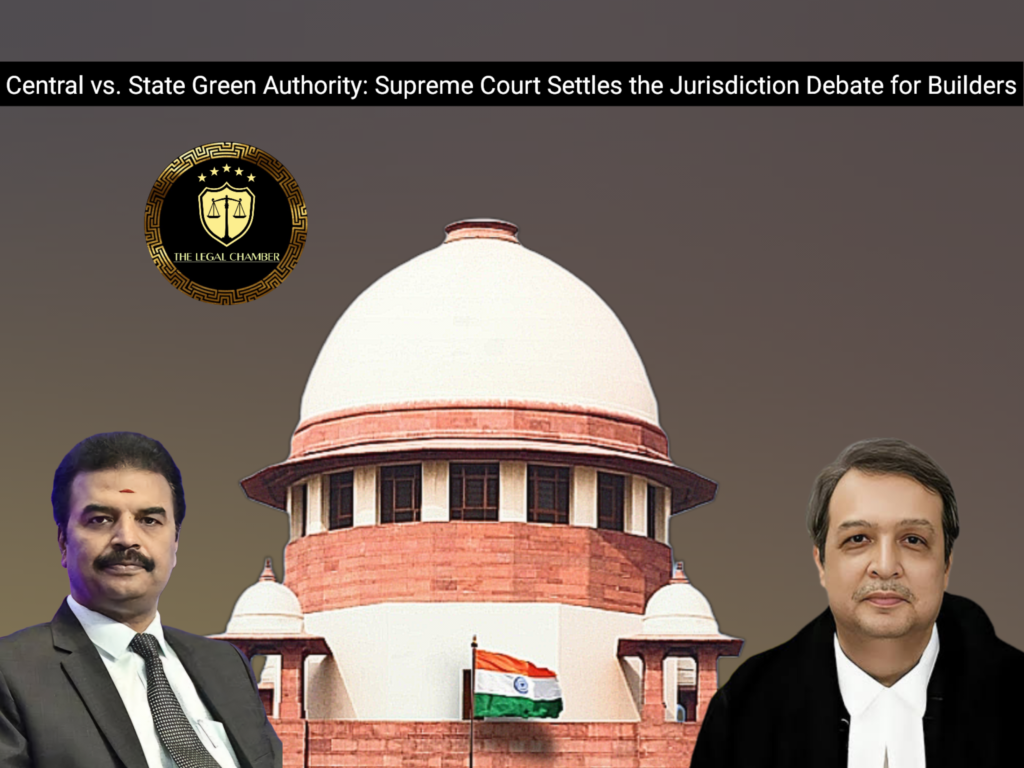
In a significant ruling, the Supreme Court upheld the validity of the 2025 EIA Notification, clarifying that the “General Conditions” under the EIA 2006 Notification do not apply to building and construction projects. Consequently, such projects will continue to be appraised and granted environmental clearance by State-level authorities (SEIAA/SEAC) and not be automatically elevated to the Central level for approval.
Facts Of The Case:
The case originated from an order dated 09.08.2024 passed by the National Green Tribunal (NGT). The NGT had directed that all building and construction projects falling within 5 km of protected areas, critically polluted areas, or other eco-sensitive zones must be treated as ‘Category A’ projects. This meant they would require environmental clearance from the Central Government’s Expert Appraisal Committee, not from State-level authorities. The NGT based its order on the reasoning that the “General Conditions” of the 2006 Environmental Impact Assessment (EIA) Notification applied to these projects, especially after a 2014 notification that had explicitly excluded them was quashed by the Kerala High Court. This decision directly impacted real estate developers, who appealed to the Supreme Court, arguing that the NGT’s interpretation was flawed. They contended that the legislative intent, as reflected in the original 2006 EIA Notification and affirmed by the Supreme Court in the Okhla Bird Sanctuary case, was always to exempt building projects from these General Conditions to ensure decentralized and timely approvals at the State level. The appeals highlighted that the NGT’s order had created a regulatory vacuum and stalled numerous projects across the country, affecting developers and homebuyers alike.
Procedural History:
The procedural history of this case began when an environmental group filed Original Application No. 93 of 2024 before the National Green Tribunal (NGT), Central Zone Bench, Bhopal. By its order dated 09.08.2024, the NGT allowed the application, directing that building and construction projects near sensitive areas be treated as Category ‘A’ and appraised by the central government. Aggrieved by this order, real estate developers’ bodies and companies, including CREDAI and Godrej Properties, filed appeals before the Supreme Court under Section 22 of the NGT Act, 2010. During the pendency of these appeals, the Ministry of Environment issued a fresh notification in 2025 to clarify the legal position. This 2025 notification was itself challenged in a separate writ petition (Vanashakti v. Union of India), which was partly decided by the Supreme Court on 05.08.2025. The Supreme Court, in the present judgment, disposed of the developers’ appeals in light of its final decision in the connected writ petition.
READ ALSO:Supreme Court Landmark Ruling: 12-Year Limit to Reclaim Property Applied in Forgery Case
Court Observation:
The Supreme Court made pivotal observations, firmly anchoring its reasoning in the literal interpretation of the EIA 2006 Notification. It observed that the Schedule’s Column 5, which lists “Conditions, if any,” expressly mentions the application of “General Conditions” for numerous other project categories, but deliberately omits any such stipulation for Items 8(a) and 8(b). This deliberate omission, the Court held, unmistakably reflected the legislative intent to exclude building and construction projects from the ambit of the General Conditions. It further noted that the State-Level Expert Appraisal Committees (SEIAAs) are expert bodies constituted by the Central Government itself and are fully competent to appraise such projects, thereby upholding the principle of decentralized decision-making. The Court also emphasized the need to balance environmental protection with sustainable development, concluding that the NGT’s order was based on a flawed interpretation of the statutory scheme.
Final Decision & Judgement:
Based on its observations and in light of its prior judgment in the connected Vanashakti case, the Supreme Court allowed the appeals and set aside the impugned NGT order dated 09.08.2024. The Court held that the “General Conditions” under the EIA 2006 Notification are not applicable to building, construction, and township projects listed under Items 8(a) and 8(b) of the Schedule. Consequently, the legal position was restored, meaning such projects will continue to be appraised for environmental clearance by the State-Level Authorities (SEIAA/SEAC) and will not be automatically elevated to the Central Government for approval. The 2025 EIA Notification, which explicitly reaffirmed this position, was upheld as the governing law.
Case Details:
Case Title: Confederation of Real Estate Developers Association of India (CREDAI) & Ors. vs. Union of India & Ors.
Citation: 2025 INSC 1112
Civil Appeal No: Civil Appeal No. 10043 of 2024
Date of Judgement: September 12, 2025
Judges/Justice Name: Justice J.B. Pardiwala and Justice R. Mahadevan
Download The Judgement Here