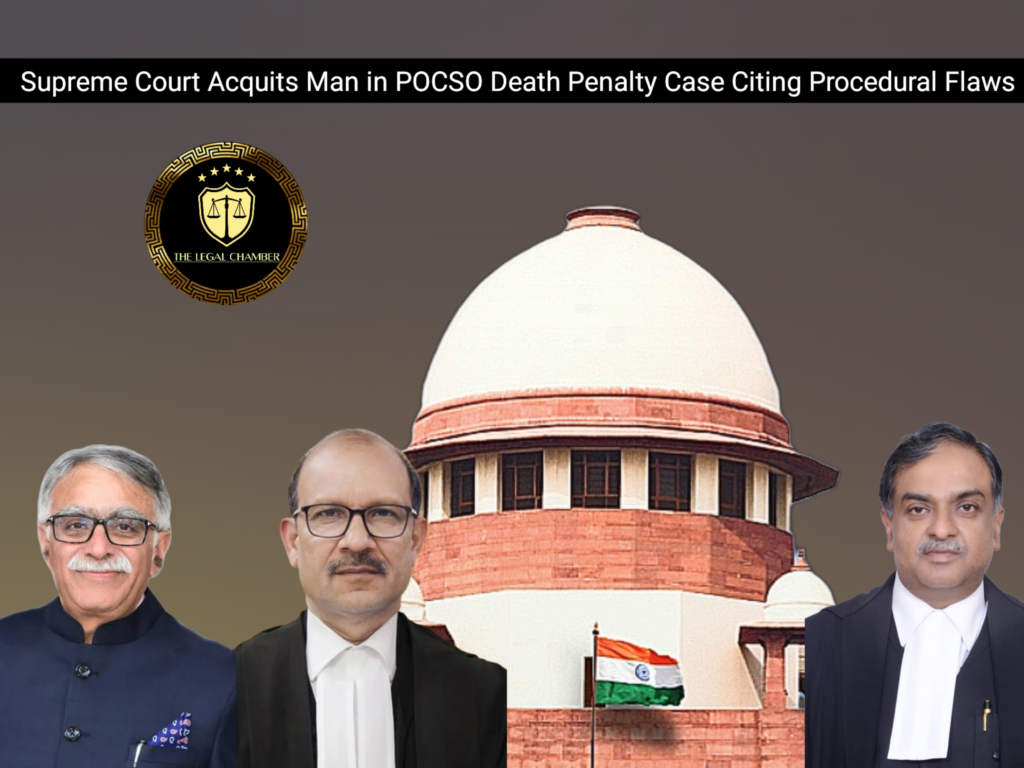
This Supreme Court judgment sets aside the appellant’s conviction and death sentence, holding that the trial was vitiated due to a denial of fair trial rights, including inadequate legal representation and failure to provide documents. The prosecution’s circumstantial evidence—last seen, CCTV footage, disclosure statements, and DNA reports—was found unreliable and unproven beyond reasonable doubt.
Facts Of The Case:
A seven-year-old girl went missing on February 5, 2017, from her residence in Chengalpet, Tamil Nadu, while her parents were out shopping. After an unsuccessful search, a missing persons report was filed. Investigations, including reviewing CCTV footage from a nearby temple, led the police to suspect the appellant, Dashwanth, a neighbour residing in the same building. He was arrested on February 8, 2017. Based on his alleged disclosure statement, the police claimed to have recovered the charred body of the child, her undergarments from a travel bag, and her ornaments from his flat. The prosecution case was built on circumstantial evidence, including a last-seen theory from a witness, suspicious CCTV movements, recoveries pursuant to the disclosure statement, and DNA reports matching the appellant’s profile with a semen stain on the victim’s clothing. The trial court convicted him under various sections of the IPC and the POCSO Act, sentencing him to death. The High Court confirmed the conviction and sentence. In appeal, the Supreme Court acquitted the appellant, citing fatal procedural lapses, a denial of a fair trial, and the prosecution’s failure to prove the chain of circumstantial evidence beyond reasonable doubt.
Procedural History:
The case originated in the Sessions Court (Mahila Court, Chengalpet), which convicted the appellant for offences including murder and POCSO violations and sentenced him to death on February 19, 2018. The appellant challenged this before the Madras High Court, which dismissed his appeal and confirmed the death sentence via a common judgment dated July 10, 2018. Subsequently, the appellant filed Criminal Appeals by special leave before the Supreme Court of India. The Supreme Court, in its judgment dated October 8, 2025, allowed the appeals, set aside the convictions and sentences, and acquitted the appellant, citing a vitiated trial and unproven circumstantial evidence.
READ ALSO:Supreme Court Clarifies: Licensee Must Pay Arrears, Not Liquidated Damages, at Interim Stage
Court Observation:
The Supreme Court observed a gross violation of the appellant’s right to a fair trial. The trial was conducted with undue haste: charges were framed without providing the accused with necessary documents or legal aid counsel, who was appointed only four days before the commencement of evidence, depriving him of effective defence preparation. Furthermore, the sentencing, including the imposition of the death penalty, was carried out on the same day as the conviction without a proper inquiry into mitigating and aggravating circumstances. On merits, the Court found the prosecution’s circumstantial evidence wholly unreliable. The last-seen witness testimony was deemed concocted and delayed, the purported CCTV footage was neither procured nor exhibited, the disclosure statements and consequent recoveries appeared planted and lacked credibility, and the DNA evidence was rendered inadmissible due to a broken chain of custody and unexplained delays in sample collection. Consequently, the prosecution failed to establish an unbroken chain of circumstances proving guilt beyond reasonable doubt.
Final Decision & Judgement:
Case Details:
Case Title: Dashwanth vs. State of Tamil Nadu
CITATION: 2025 INSC 1203
Appeal No.: Criminal Appeal No(s). 3633-3634 of 2024
Date of Judgement: October 08, 2025
Judges/Justices: Justice Vikram Nath & Justice Sanjay Karol and Justice Sandeep Mehta
Download The Judgement Here