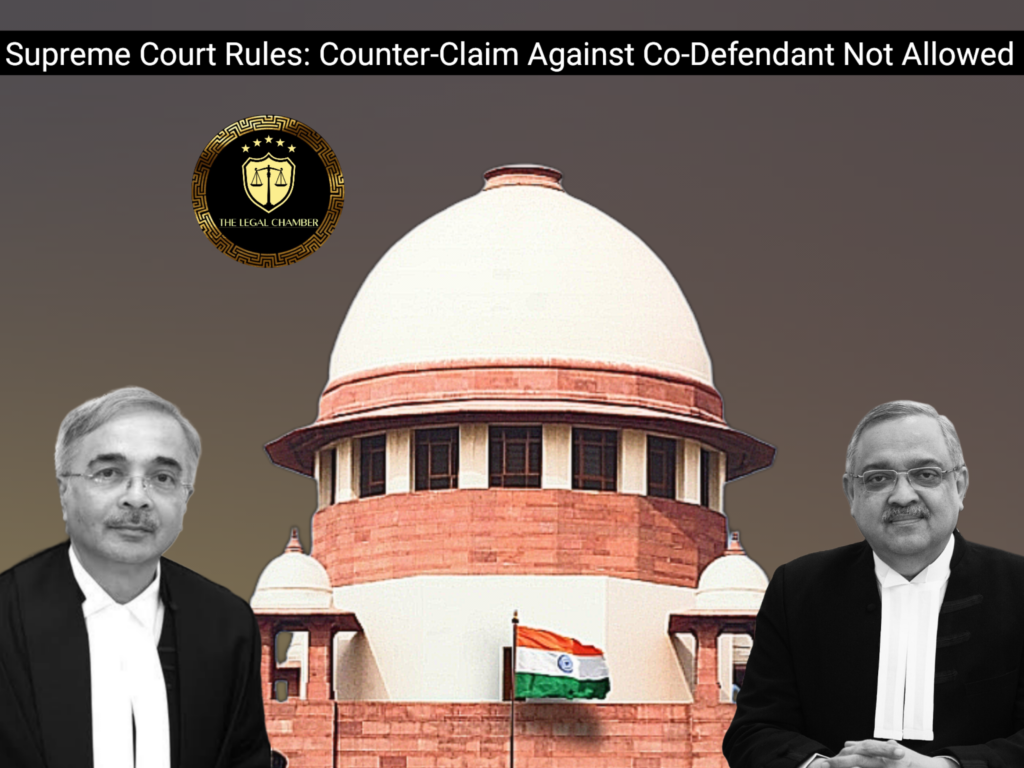
Supreme Court Rules: Counter-Claim Against Co-Defendant Not Allowed

The Supreme Court held that a counter-claim by impleaded defendants against a co-defendant is not maintainable in a suit for specific performance. Such a claim must be incidental to the original suit’s cause of action and cannot be independently raised against another defendant. The Court set aside the admitted counter-claim.

Facts Of The Case:

The appellant, Sanjay Tiwari, filed a suit for specific performance against the first respondent, Yugal Kishore Prasad Sao, based on an alleged oral agreement dated 02.12.2002 for the sale of 0.93 acres of land. The plaintiff claimed full payment was made and he was put in possession. The first defendant, in his written statement, contended that defendants 2 and 3 were in possession of part of the property, making the suit defective for non-joinder. Subsequently, defendants 2 and 3 were impleaded. They filed a written statement asserting their own agreement to purchase the entire land from the first defendant, claiming a prior part-payment. They also raised a counter-claim specifically against the first defendant, seeking conveyance of the property. The Trial Court admitted this counter-claim, a decision upheld by the High Court to avoid multiplicity of proceedings. The appellant challenged this before the Supreme Court, arguing a counter-claim cannot lie against a co-defendant in a suit filed by the plaintiff.

Procedural History:

The procedural history begins with the appellant’s suit for specific performance before the Trial Court. Upon application, the Trial Court impleaded respondents 2 & 3 as defendants and subsequently admitted their counter-claim against the first defendant. The appellant challenged this order under Article 227 of the Constitution before the High Court, which dismissed the petition, affirming the Trial Court’s decision to allow the counter-claim to avoid multiplicity of litigation. The appellant then filed a Special Leave Petition before the Supreme Court, which granted leave and culminated in the present civil appeal.

READ ALSO:Supreme Court Decides Long-Running Property Dispute on Mortgage Redemption

Court Observation:

The Supreme Court observed that a counter-claim, even if based on a different cause of action, must be incidental or connected to the subject matter of the original suit. It found the counter-claim by defendants 2 & 3 against their co-defendant (defendant 1) to be an independent claim not arising from the plaintiff’s cause of action and therefore not maintainable. The Court noted the defendants’ claim was inconsistent, lacked a concrete foundation, and was barred by limitation at its inception. While their impleadment cured the defect of non-joinder, it did not validate the impermissible counter-claim.

Final Decision & Judgement:

The Supreme Court allowed the civil appeal and set aside the counter-claim filed by defendant nos. 2 & 3 against defendant no. 1. The Court held that such a counter-claim against a co-defendant was not maintainable in law. All parties were left to agitate their remaining contentions before the Trial Court, with the suit to proceed on its merits excluding the invalidated counter-claim.

Case Details:

Case Title: Sanjay Tiwari vs. Yugal Kishore Prasad Sao & Ors.
Appeal Number:  [arising out of SLP (C) No. 11050 of 2025]
Date of Judgement: November 12, 2025
Judges/Justices Name: Justice K. Vinod Chandran and Justice N. V. Anjaria

Leave a Reply

Your email address will not be published. Required fields are marked *