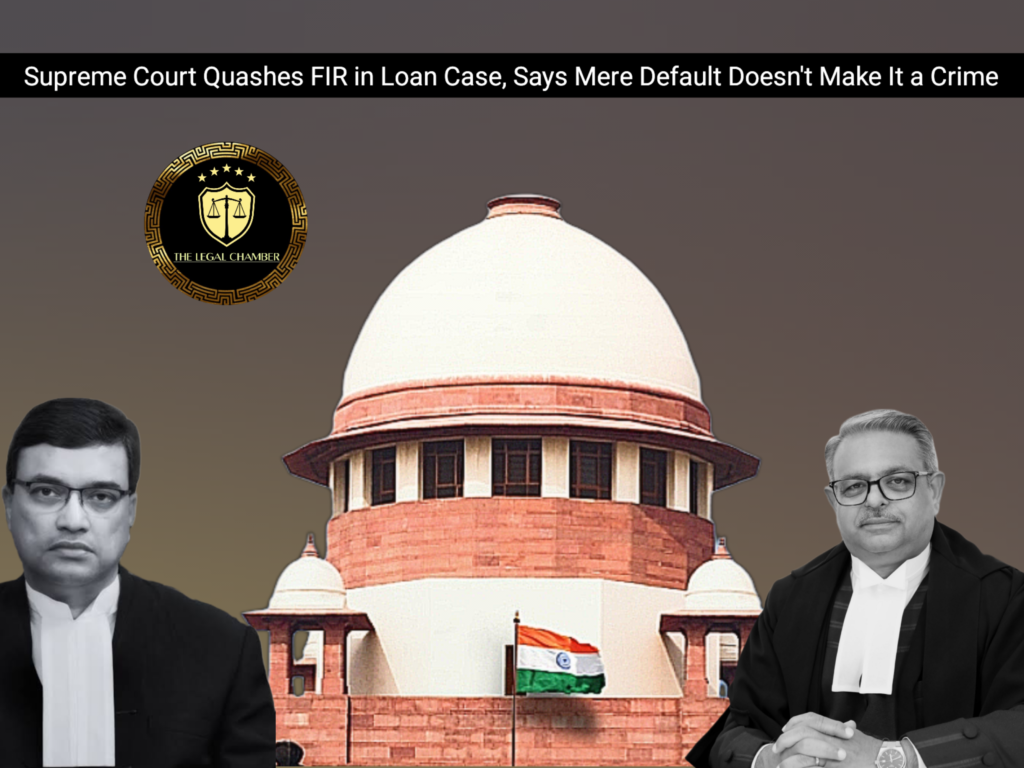
The Supreme Court held that a loan transaction creates a debtor-creditor relationship, and a mere breach of its terms does not automatically constitute criminal breach of trust under Section 405 IPC without evidence of dishonest intention. The Court clarified that such disputes, arising from commercial transactions, are primarily civil in nature and a preliminary inquiry is permissible before registering an FIR.
Facts Of The Case:
The appellant, a director of M/s Benlon India Ltd., availed three loans from the first respondent, Hero Fincorp, for purchasing machinery. While the first two loans were used for the intended purpose, a fire destroyed the plant shortly after the disbursement of the third loan. Consequently, this third loan was converted into an unsecured corporate loan. Benlon regularly repaid instalments until May 2018 when corporate insolvency proceedings were initiated by another creditor. Subsequently, Hero Fincorp lodged a criminal complaint alleging criminal breach of trust, claiming the loan was misappropriated as the machinery was not purchased. The Magistrate and Sessions Court rejected the application for FIR registration after a police status report found no cognizable offence. However, the Delhi High Court, invoking its power under Section 482 CrPC, directed the registration of an FIR, applying the principles from Lalita Kumari v. State of U.P.. The appellant challenged this order in the Supreme Court.
Procedural History:
The procedural history began with the first respondent (Hero Fincorp) lodging a complaint under Section 156(3) CrPC before the Chief Metropolitan Magistrate (CMM) seeking registration of an FIR for criminal breach of trust. The CMM, relying on a detailed status report from the Economic Offences Wing which found no cognizable offence, rejected the application and posted the matter for pre-summoning evidence under Section 202 CrPC. This order was upheld by the District and Sessions Judge in revision. However, the Delhi High Court, in a petition under Section 482 CrPC, set aside these orders and directed the police to register an FIR. This impugned order of the High Court was then challenged before the Supreme Court, which granted leave and ultimately allowed the appeal, setting aside the High Court’s direction.
READ ALSO:Supreme Court Slams Trend of “Transfer Culture” and Baseless Criticism of Judges
Court Observation:
The Supreme Court observed that the core of an offence under Section 405 IPC is a dishonest intention to misappropriate entrusted property, which is absent in a standard creditor-debtor relationship. The Court emphasized that the beneficial ownership of a loaned amount transfers to the borrower, and its utilization contrary to the agreement, without dishonest intent, constitutes a civil breach, not a criminal one. It further noted that the High Court erred in its application of the Lalita Kumari precedent, as a preliminary inquiry is expressly permissible for commercial disputes and the police report in this case, which found no cognizable offence, was not infirm. The continuation of criminal proceedings in such a scenario was deemed an abuse of the process of law.
Final Decision & Judgement:
The Supreme Court allowed the appeal and set aside the impugned judgment of the Delhi High Court. It held that no offence of criminal breach of trust was made out against the appellant on the established facts, as the dispute was essentially of a civil nature arising from a commercial transaction. The Court concluded that directing the registration of an FIR in such circumstances was unjustified and that the continuation of criminal proceedings would amount to an abuse of the process of law. Consequently, the order of the Magistrate, which had relegated the respondent to the remedy of pursuing the complaint under Section 202 CrPC, was restored. No costs were awarded.
Case Details:
Case Title: Sunil Sharma vs. M/S Hero Fincorp Limited & Another
Criminal Appeal No: Criminal Appeal No. 3467 of 2025
Date of Judgement: August 12, 2025
Judges/Justice Name: Justice Dipankar Datta and Justice Augustine George Masih