Facts Of The Case:
On June 3, 2000, an altercation occurred between appellants Rajendra Singh, his son Bhupender Singh, and Diler Singh after the appellants began digging Diler Singh’s field. Later that day, at around 1:30 PM, Diler Singh’s son, Pushpendra Singh (the deceased), was sitting at Jogither diversion. The three appellants arrived on a motorcycle, armed with swords and a ‘kanta’. Upon seeing them, the deceased fled towards northern fields, raising alarms. The appellants chased him. The deceased sought refuge in the house of Mukhtyar Singh, but the appellants followed him inside. According to Amarjeet Kaur (PW-7), the lady of the house, three unknown assailants attacked the deceased with weapons inside her home, causing his death. The appellants were arrested days later, and weapons were recovered based on their disclosures. The Trial Court acquitted them, but the High Court reversed this, convicting them under Section 302 IPC. The Supreme Court, however, ultimately set aside the conviction, granting the appellants the benefit of doubt due to major inconsistencies in witness testimonies and a failure to conclusively prove their identity as the assailants.
Procedural History:
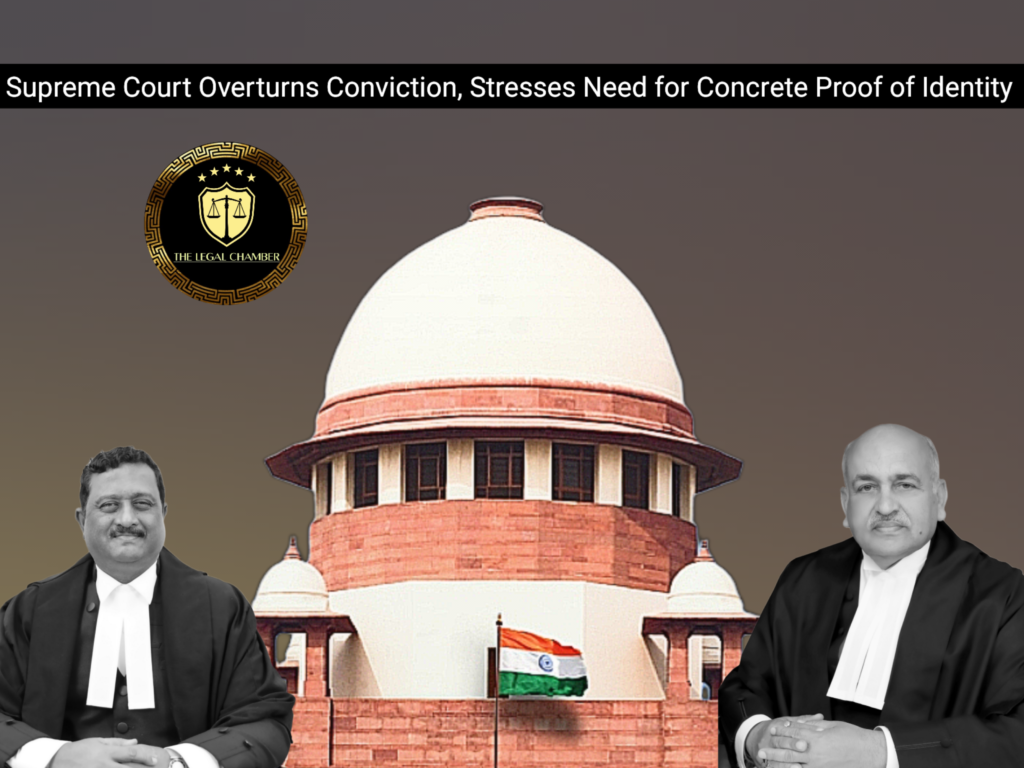
The case originated with the acquittal of all three accused by the Trial Court in Session Trial No. 215 of 2000. The State, dissatisfied with this verdict, filed a Government Appeal, upon which the High Court of Uttaranchal (now Uttarakhand) reversed the acquittal. In its judgment dated January 2, 2013, the High Court convicted the appellants under Section 302 of the Indian Penal Code and sentenced them to life imprisonment. The appellants then challenged this conviction before the Supreme Court of India by filing Criminal Appeal Nos. 476-477 of 2013. The Supreme Court, in its judgment dated October 7, 2025, allowed the appeals, set aside the High Court’s order, and restored the acquittal, granting the appellants the benefit of doubt.
READ ALSO:Supreme Court Rules on Remission: “Family Prestige” Murder Qualifies for Early Release After 22 Years
Court Observation:
The Supreme Court observed critical flaws in the prosecution’s case, primarily the failure to establish the identity of the appellants as the perpetrators. It noted that the sole eyewitness, Amarjeet Kaur (PW-7), was a reliable and independent witness but could not identify the assailants, and no identification parade was conducted. The Court found the testimonies of Diler Singh (PW-1) and Jwala Singh (PW-2) to be unreliable as they were chance witnesses whose presence at the scene was doubtful and whose accounts contradicted PW-7’s testimony. Furthermore, the Court held that the recovery of weapons was inadmissible as proof of their use in the crime, as the accompanying confessional statements were barred under Sections 25 and 26 of the Indian Evidence Act, and the forensic report did not link the weapons to the deceased. Consequently, the High Court was found to have erred in reversing the Trial Court’s acquittal without establishing that its findings were perverse.
Final Decision & Judgement:
In its final judgment, the Supreme Court allowed the appeals and set aside the conviction and life imprisonment sentence imposed by the High Court. The Court held that the prosecution failed to prove the guilt of the appellants beyond a reasonable doubt, primarily due to the inability to establish their identity as the assailants. Consequently, the Court restored the Trial Court’s order of acquittal, granting the appellants the benefit of doubt. The bail bonds of the appellants, who were on bail, were discharged, and they were acquitted of the offence under Section 302 of the Indian Penal Code.
Case Details:
Case Title: Rajendra Singh and Ors. vs. State of Uttaranchal etc.
Citation: 2025 INSC 1193
Criminal Appeal No: Criminal Appeal Nos. 476-477 of 2013
Date of Judgement: October 7, 2025
Judges/Justice Name: Justice Pankaj Mithal and Justice Prasanna B. Varale
Download The Judgement Here