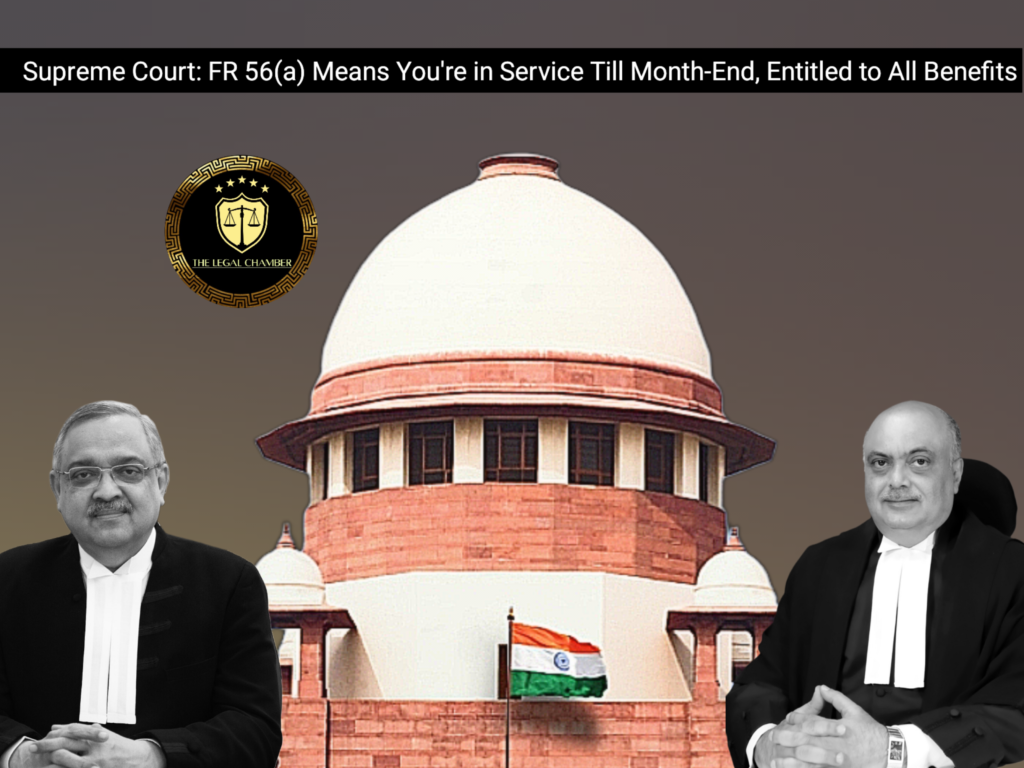
The Supreme Court held that employees retiring on March 31st due to FR 56(a) are deemed “in service” on that date, entitling them to pay revisions effective from that day. Relying on Rule 5(2) of CCS (Pension) Rules and a three-Judge Bench precedent, the Court clarified that such retirement dates are working days for salary purposes, not mere formalities.
Facts Of The Case:
The appellants were employees of the Assam Power Generation Corporation Ltd. who both attained the age of superannuation (60 years) during the month of March 2016. By virtue of Fundamental Rule 56(a), which provides that every government servant shall retire on the afternoon of the last day of the month in which they attain the age of sixty years, their date of retirement was extended to March 31, 2016. Subsequently, the ‘Assam State Electricity Board and its Successor Companies Revised Pay Rules, 2017’ were introduced, which explicitly stated that the revised pay structure would apply to “all employees who were in services on 31st March 2016 or who may have been appointed on or after 1st April 2016.” The appellants claimed entitlement to this pay revision. The learned Single Judge of the High Court allowed their writ petition, holding that since they were in service on March 31, 2016, they were covered under the Rules. However, the Division Bench reversed this decision in writ appeal, leading the appellants to approach the Supreme Court. The respondents contended that the revision applied only to those appointed and continuing on or after April 1, 2016, and that pension revision provisions indicated exclusion of those who retired before April 1, 2016.
Procedural History:
The appellants initially filed writ petitions before the Gauhati High Court seeking entitlement to the benefits under the Assam State Electricity Board and its Successor Companies Revised Pay Rules, 2017. The learned Single Judge of the High Court allowed the writ petitions, holding that by virtue of Fundamental Rule 56(a), the appellants retired on March 31, 2016, and therefore were “in service” on that date, making them eligible for the pay revision benefits. Aggrieved by this decision, the respondents filed writ appeals before the Division Bench of the same High Court. The Division Bench reversed the finding of the learned Single Judge and dismissed the claims of the appellants. Challenging the Division Bench’s judgment, the appellants approached the Supreme Court by filing Special Leave Petitions. The Supreme Court granted leave and heard the appeals, ultimately allowing them and restoring the judgment of the learned Single Judge.
READ ALSO:Degree Name vs. Subject Study: Supreme Court Orders Reinstatement of Employee Wrongfully Terminated
Court Observation:
The Supreme Court observed that Fundamental Rule 56(a) clearly and unambiguously provides that every government servant shall retire on the afternoon of the last day of the month in which he attains the age of sixty years. The Court noted that this rule does not contain any provision suggesting that such extension is merely for the purpose of pay and allowances, nor can there be a deemed legal termination of the employer-employee relationship on the date of attaining sixty years. The Court further observed that Rule 5(2) of the CCS (Pension) Rules, 1972 expressly provides that the day on which a government servant retires shall be treated as his last working day, ensuring that employees retiring on March 31st are entitled to salary for that day and are legally in service. The Court expressed its inability to agree with the finding in K. J. George v. Chief General Manager that continuance after the last day of the month is only for pay and allowance purposes, noting that this decision failed to notice the three-Judge Bench precedent in S. Banerjee v. Union of India. The Court also observed that the Rules of 2017 were distinctly different from Central Pay Commission recommendations, as they specifically provided benefits to all employees in service on March 31, 2016. Regarding the respondents’ contentions based on Rule 32 of the Pay Revision Rules, the Court observed that the provisions regarding pension revision for those who retired before April 1, 2016 were merely enabling provisions to ensure minimum pension and could not alter the date of effect of the pay revision rules for those actually in service on the cut-off date.
Final Decision & Judgement:
The Supreme Court allowed both appeals and set aside the judgment of the Division Bench of the High Court, restoring the decision of the learned Single Judge. The Court declared that the appellants, having retired on March 31, 2016 by virtue of Fundamental Rule 56(a), were legally “in service” on that date and therefore entitled to the pay revision brought in by the Assam State Electricity Board and its Successor Companies Revised Pay Rules, 2017. The Court directed that the appellants’ pay for the month of March 2016 shall be determined in the revised scales, and such revised pay shall be reckoned for computing the pension payable to them. The respondents were ordered to pay the arrears of pay and pension within a period of six months, with the revised pension to commence from February 2026. The Court further directed that if the arrears were not paid within the stipulated six-month period, they shall carry interest at the rate of 6% per annum, and in the event of such interest liability arising due to delayed payment, the respondents were entitled to recover the same from the officers responsible for causing the delay. The judgment was delivered on December 4, 2025 by a bench comprising Justice Ahsanuddin Amanullah and Justice K. Vinod Chandran.
Case Details:
Case Title: Mukut Das v. The Assam Power Generation Corporation Ltd. & Ors.
Citation: 2025 INSC 1403
Civil Appeal Nos.: 14559 of 2025
Date of Judgment: December 4, 2025
Judges/Justice Name: Justice K. Vinod Chandran and Justice Ahsanuddin Amanullah
Download The Judgement Here