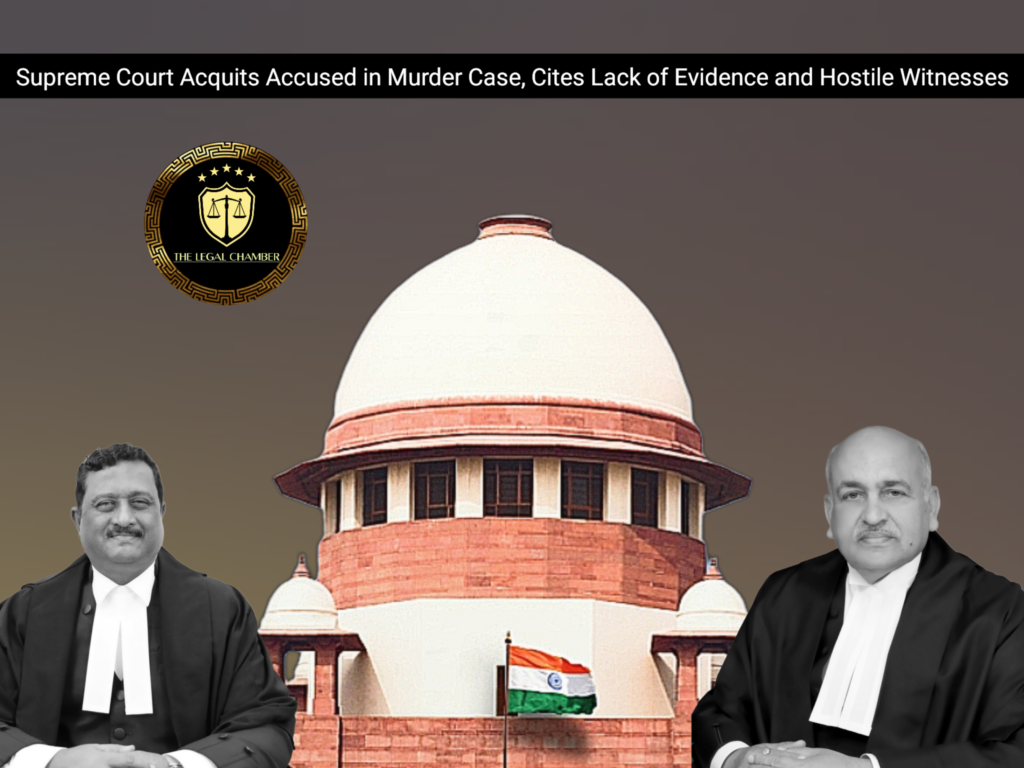
The Supreme Court acquitted the accused, holding that the prosecution failed to prove guilt based on circumstantial evidence. Key eyewitnesses turned hostile and their testimonies did not establish kidnapping or the ‘last seen’ theory. The Court emphasized that the foundational principles for convicting on circumstantial evidence were not satisfied, rendering the conviction unsustainable.
Facts Of The Case:
The case concerns the kidnapping and murder of Bhoominadhan, an auto-rickshaw driver from Nellore. The prosecution’s case was that on the evening of 26th March 2016, the appellant-accused, Thammineni Bhaskar (A-1), along with his associates, forcibly dragged the deceased from his auto-rickshaw near a banyan tree in Talpagiri Colony and kidnapped him. The incident was allegedly witnessed by PW-5 and PW-6, who informed the deceased’s father (PW-1). Subsequently, the deceased’s body with multiple injuries was discovered the next day. The prosecution alleged a motive stemming from a prior police complaint filed by the deceased’s mother (PW-2) against A-1 for passing obscene remarks. The conviction by the Trial Court, upheld by the High Court, was primarily based on the testimony of PW-5 and PW-6. However, in their court testimonies, these witnesses turned hostile, stating they only saw a commotion (‘galata’) but could not identify any individuals involved and did not testify to witnessing the kidnapping. This formed the crux of the appeal before the Supreme Court.
Procedural History:
The procedural history of this case began with the conviction of the appellant (A-1) by the Trial Court under Sections 302 (murder), 364 (kidnapping), and 201 (causing disappearance of evidence) of the Indian Penal Code, sentencing him to life imprisonment. This conviction was subsequently challenged before the High Court, which, in its judgment dated June 19, 2024, confirmed the Trial Court’s decision and upheld the conviction and sentence. The appellant then exercised his statutory right by filing a criminal appeal before the Supreme Court of India, challenging the High Court’s order. The Supreme Court, in its judgment dated September 17, 2025, allowed the appeal, set aside the impugned judgments of both the courts below, and acquitted the appellant of all charges.
READ ALSO:Co-accused’s Acquittal Leads to Supreme Court Setting Aside Another’s Conviction
Court Observation:
The Supreme Court made crucial observations centered on the failure of the prosecution to prove its case beyond a reasonable doubt. It noted that the two key eyewitnesses (PW-5 and PW-6), whose statements were the foundation of the prosecution’s story, had turned hostile during the trial. The Court observed that their testimonies did not establish the alleged kidnapping, as they only mentioned witnessing an unidentified commotion (‘galata’) and failed to identify the accused or corroborate the deceased being taken away. Consequently, the Court held that the essential “last seen” theory could not be invoked. It emphasized that while a prior dispute provided a possible motive, it was insufficient to secure a conviction without credible evidence linking the accused to the crime. The Court concluded that the prosecution had miserably failed to satisfy the “panchsheel” principles required for a conviction based solely on circumstantial evidence
Final Decision & Judgement:
The Supreme Court allowed the appeal and set aside the judgments of the Trial Court and the High Court. It acquitted the appellant-accused, Thammineni Bhaskar (A-1), of all charges, including murder and kidnapping. The Court held that the prosecution had completely failed to prove the chain of circumstantial evidence against him. It directed that the appellant be released forthwith, provided he is not required in connection with any other case.
Case Details:
Case Title: Thammineni Bhaskar vs. The State of Andhra Pradesh
Citation: 2025 INSC 1124
Criminal Appeal No.: Criminal Appeal No. 4623 of 2024
Date of Judgement: September 17, 2025
Judges/Justice Name: Justice Pankaj Mithal and Justice Prasanna B. Varale
Download The Judgement Here