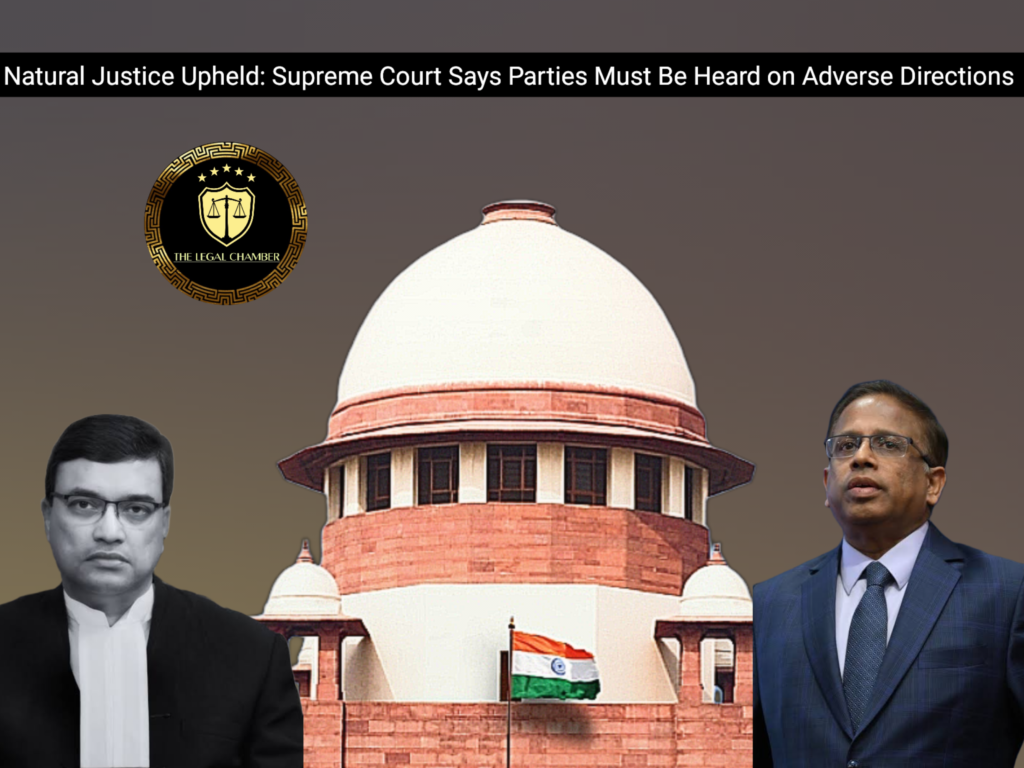
The Supreme Court ruled that a writ court cannot travel beyond the reliefs sought in the petition and pass adverse orders that render a petitioner worse off. Such directions, issued without notice, violate principles of natural justice. A litigant cannot be penalized for approaching the court, as it would seriously impact access to justice.
Facts Of The Case:
The case involved the Cochin Devaswom Board and the Chinmaya Mission Trust. The Trust had been allotted land in 1974 near the Vadakkunnathan Temple in Thrissur to build a hall for marriages and cultural activities, for an annual license fee of Rs. 101. After subsequent allotments, the total fee was fixed at Rs. 227.25 per annum. In 2014, the Board unilaterally enhanced this fee to Rs. 1,50,000 per annum. The Trust challenged this drastic hike before the Kerala High Court, arguing it was arbitrary and without notice. The High Court upheld the fee enhancement but went further. It directed the Board to fix a new license fee based on a different legal precedent and, more significantly, ordered a vigilance inquiry into the original land leasing transaction. The Trust appealed to the Supreme Court, arguing these additional directions were beyond the scope of their original petition and rendered them worse off for having approached the court. The Supreme Court agreed, setting aside the High Court’s directions for a new fee fixation and the vigilance inquiry, ruling they were passed in violation of natural justice.
Procedural History:
The procedural history of this case began with the Chinmaya Mission Trust filing a writ petition before the Kerala High Court, challenging the Cochin Devaswom Board’s order that unilaterally enhanced the annual license fee from Rs. 227.25 to Rs. 1,50,000. The High Court, while dismissing the petition and upholding the fee enhancement, exceeded the scope of the relief sought by issuing two additional directions: one for a fresh fixation of the license fee based on a different legal precedent and another for a vigilance inquiry into the original land lease. Aggrieved by these directions, the Trust filed a special leave petition in the Supreme Court, which granted leave and stayed the operation of the High Court’s directions. The Supreme Court, in its final judgment, partly allowed the appeal by expunging the two directions, holding that they were passed in violation of natural justice as they were beyond the petition’s scope and rendered the petitioner worse off.
READ ALSO:How a Missing TIP and a Delayed FIR Led to Acquittal: Breaking Down a Supreme Court Judgment
Court Observation:
The Supreme Court made crucial observations on the limits of judicial power in writ jurisdiction. It firmly held that a court cannot travel beyond the reliefs sought in a writ petition and pass orders that put the petitioner in a worse position than before filing the case. The Court condemned the High Court’s directions for a fresh license fee fixation and a vigilance inquiry as a “fishing and roving enquiry” that seriously impinged upon the appellants’ reputation, especially since they were issued without any notice. It emphasized that such surprise orders, passed in violation of natural justice, create a chilling effect and discourage access to justice. The Court reiterated the fundamental principle that a litigant cannot be penalized for approaching the court.
Final Decision & Judgement:
The Supreme Court partly allowed the appeal. It set aside and expunged the two specific directions issued by the Kerala High Court that ordered a fresh fixation of the license fee based on a different legal precedent and a vigilance inquiry into the land lease. The Court held these directions were beyond the scope of the writ petition and violated principles of natural justice, as they were passed without notice and rendered the appellants worse off. However, the Court upheld the High Court’s decision validating the enhancement of the license fee to Rs. 1,50,000 per annum. It directed the appellants to pay the arrears of the enhanced fee to the Cochin Devaswom Board within three months, as they had voluntarily undertaken to do so.
Case Details:
Case Title: P. Radhakrishnan & Anr. vs Cochin Devaswom Board & Ors.
Citation: 2025 INSC 1183
Appeal Number: Civil Appeal No. 11902 of 2025
Date of Judgement: October 6, 2025
Judges/Justice Name: Justice K.V. Viswanathan and Justice Dipankar Datta