Facts Of The Case:
The Madras Bar Association challenged the constitutional validity of the Tribunal Reforms Act, 2021, before the Supreme Court of India. The Act sought to govern the appointment, tenure, qualifications, and service conditions of members across various tribunals. Its key provisions included a minimum age of 50 for appointment, a fixed four-year tenure, a requirement for selection committees to recommend two names per vacancy, and the alignment of members’ allowances with central government officers. The petitioners argued that these provisions directly contradicted a series of binding Supreme Court judgments—collectively known as the Madras Bar Association cases—which had established strict constitutional safeguards to ensure the independence and effective functioning of tribunals. The Union of India defended the Act as a legitimate exercise of legislative policy-making power. The core dispute centered on whether Parliament could enact a law that effectively nullified specific judicial directives aimed at protecting tribunals from executive influence, thereby testing the boundaries of constitutional supremacy and the separation of powers between the legislature and the judiciary.
Procedural History:
The case originates from a series of constitutional challenges concerning tribunal reforms, culminating in the 2021 Act. Following the Supreme Court’s decision in Madras Bar Association (V) in 2021, which struck down the Tribunal Reforms Ordinance for violating judicial independence, Parliament enacted the substantively identical Tribunal Reforms Act, 2021. The Madras Bar Association promptly filed a Writ Petition directly before the Supreme Court under Article 32, challenging the new Act’s validity. During hearings, the Union of India applied to refer the matter to a larger Constitutional Bench, a plea the Court rejected. The two-judge bench then proceeded to a final hearing, extensively examining the Act’s provisions against the backdrop of the established jurisprudence from S.P. Sampath Kumar (1987) to the most recent MBA rulings, ultimately delivering the impugned judgment.
READ ALSO:Key Ruling: Supreme Court Upholds NGT’s Decision, Stresses Strict Timelines for Environment Appeals
Court Observation:
The Supreme Court made several critical observations, firmly rejecting the Union’s arguments. It reaffirmed the supremacy of the Constitution over Parliament, stating that while the legislature could cure defects identified by the judiciary, it could not simply re-enact provisions already declared unconstitutional, terming such action an “impermissible legislative override.” The Court held that principles like judicial independence and separation of powers are not abstract but justiciable constitutional mandates, especially for bodies performing judicial functions like tribunals. It found the 2021 Act to be a verbatim reproduction of the earlier struck-down Ordinance, merely “old wine in a new bottle,” which failed to address the constitutional infirmities regarding arbitrary age limits, truncated tenure, and executive-dominated appointment processes. The bench emphasized that such repetitive defiance consumes valuable judicial time and undermines the rule of law.
Final Decision & Judgement:
The Supreme Court allowed the writ petitions and struck down the key provisions of the Tribunal Reforms Act, 2021 as unconstitutional. It declared that the Act’s stipulations on minimum age, four-year tenure, and the requirement for selection committees to recommend two names per vacancy violated the principles of separation of powers, judicial independence, and Article 14 of the Constitution. The Court directed that the binding principles and directions laid down in its earlier judgements, Madras Bar Association (IV) and (V), would continue to govern all matters relating to tribunal appointments and service conditions. Furthermore, it mandated the Union of India to constitute a National Tribunals Commission within four months and protected the service conditions of tribunal members appointed under the previous legal regime.
Case Details:
Case Title: Madras Bar Association v. Union of India and Another
Citation: 2025 INSC 1330
Case Number: Writ Petition (C) No. 1018 of 2021
Date of Judgement: November 19, 2025
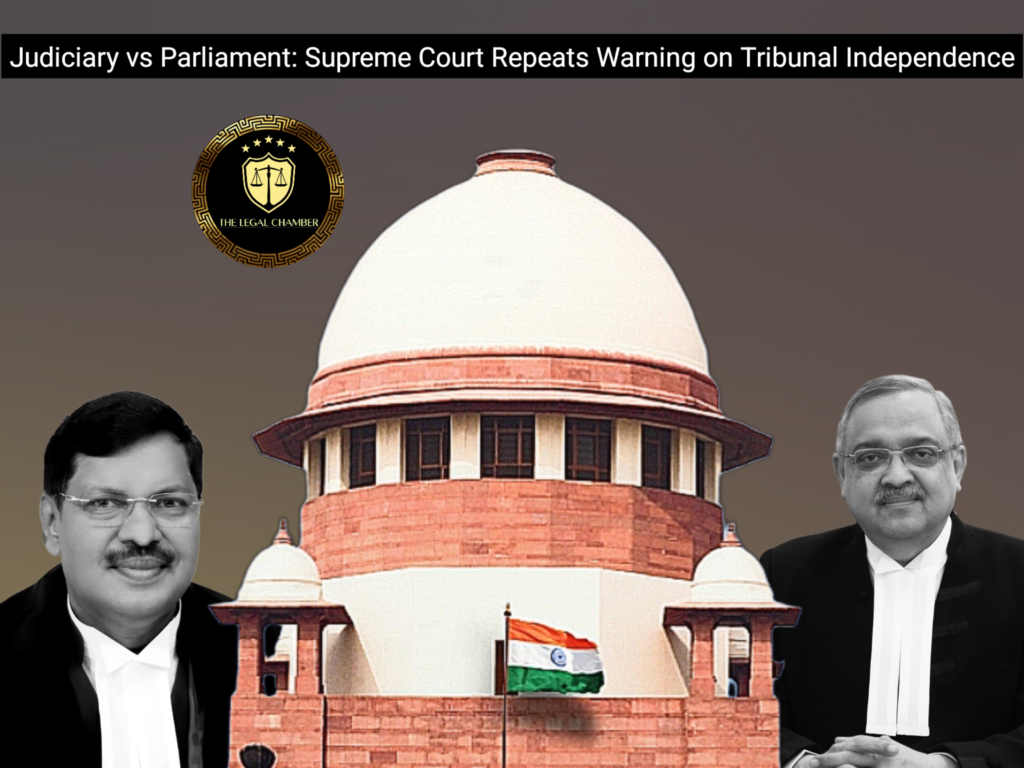
Judges/Justices: Justice  B.R. Gavai & Justice K. VINOD CHANDRAN
Download The Judgement Here