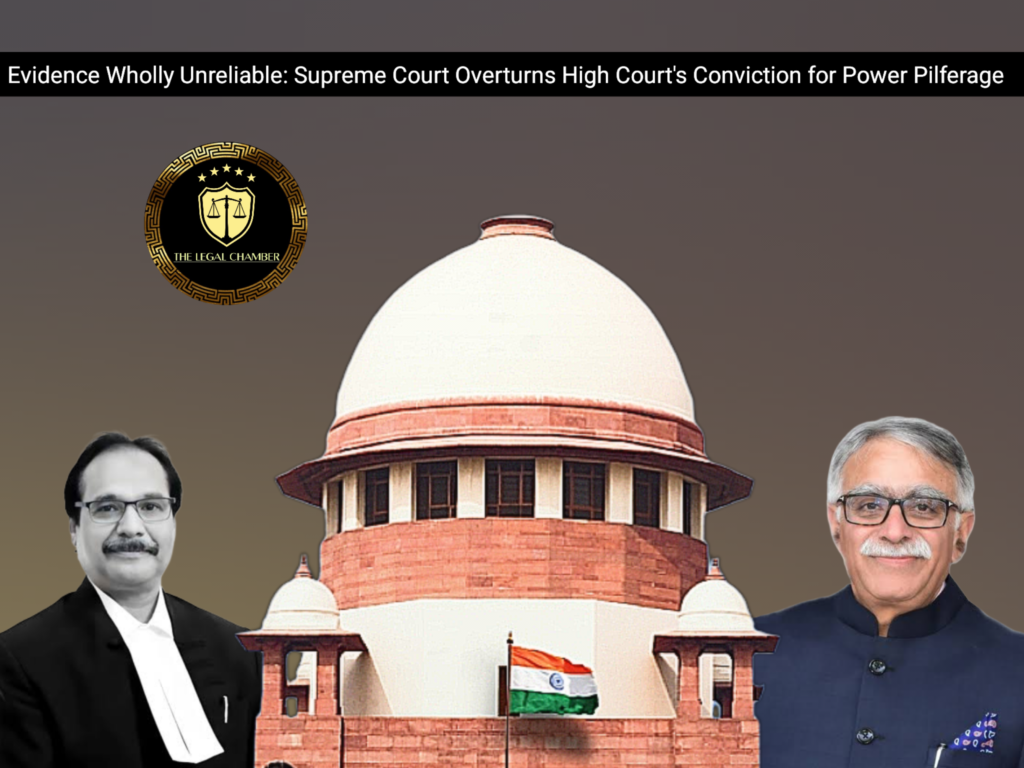
The Supreme Court acquitted the appellant, holding that the prosecution failed to prove the use of “artificial means” for electricity theft under Section 39 of the Indian Electricity Act, 1910, which is necessary to invoke the statutory presumption against the consumer. The evidence was deemed insufficient, speculative, and not beyond reasonable doubt to establish offences under Sections 39 or 44.
Facts Of The Case:
Officials from the Maharashtra State Electricity Board (MSEB) detected a 36.6% discrepancy between supplied units and meter readings at M/s. Rushi Steels and Alloys Pvt. Ltd. in March 1993. An inspection revealed three holes in the company’s meter box. The prosecution alleged that unauthorized wires were inserted through these holes to slow the meter and steal electricity, causing an estimated loss of Rs. 30 lakhs. After the holes were sealed, the discrepancy reportedly reduced to 10%. An FIR was lodged, and the company’s directors, including the appellant Mahaveer, were charged under Sections 39 (theft of energy) and 44 (interference with meters) of the Indian Electricity Act, 1910. The Trial Court acquitted the accused, finding the prosecution failed to prove the case beyond reasonable doubt. The High Court reversed this acquittal, convicting the appellant. On final appeal, the Supreme Court examined the evidence, found it based on estimation and inference rather than direct proof of “artificial means,” and restored the acquittal.
Procedural History:
The case originated from a criminal complaint before the Judicial Magistrate in Jalna, which resulted in the acquittal of the accused directors. This acquittal was challenged before the High Court of Judicature at Bombay (Aurangabad Bench) in a criminal appeal and revision application. The High Court reversed the Trial Court’s judgment, convicting the appellant under Sections 39 and 44 of the Indian Electricity Act, 1910, and imposing a sentence of rigorous imprisonment and a fine. Subsequently, the appellant filed an appeal before the Supreme Court of India under Article 136 of the Constitution. The Supreme Court, after hearing the parties, set aside the High Court’s conviction and restored the Trial Court’s order of acquittal, thereby concluding the litigation in favor of the appellant.
READ ALSO:Supreme Court Eases Burden of Proof for Railway Accident Victims in Landmark Ruling
Court Observation:
The Supreme Court observed that for the presumption under Section 39 of the Indian Electricity Act, 1910, to operate against a consumer, the prosecution must first conclusively prove the use of “artificial means or means not authorised by the licensee” for stealing electricity. The Court found the evidence, based entirely on the inference drawn from three holes in the meter box and a subsequent reduction in discrepancy, to be speculative, approximate, and insufficient to meet this essential legal threshold. It held that the testimonies of the prosecution witnesses were unreliable as they were founded on guesswork and possibility rather than direct proof, and the prosecution failed to rule out other reasonable explanations. Consequently, neither the charge of theft under Section 39 nor of meter tampering under Section 44 was established beyond a reasonable doubt.
Final Decision & Judgement:
The Supreme Court allowed the appeals and set aside the conviction and sentence imposed by the High Court. It acquitted the appellant, Mahaveer, of all charges under Sections 39 and 44 of the Indian Electricity Act, 1910. The Court held that the prosecution failed to prove the essential ingredients of the offences beyond a reasonable doubt, as the evidence was insufficient to establish the use of “artificial means” for theft or any intentional tampering with the meter. The bail bonds of the appellant were discharged.
Case Details:
Case Title: Mahaveer v. State of Maharashtra & Anr.
Criminal/Civil Appeal No.: Criminal Appeal Nos. 2154-2155 of 2011.
Date of Judgement: October 8, 2025.
Judges/Justice Name: Justice Sanjay Karol and Justice Prashant Kumar Mishra
Download The Judgement Here