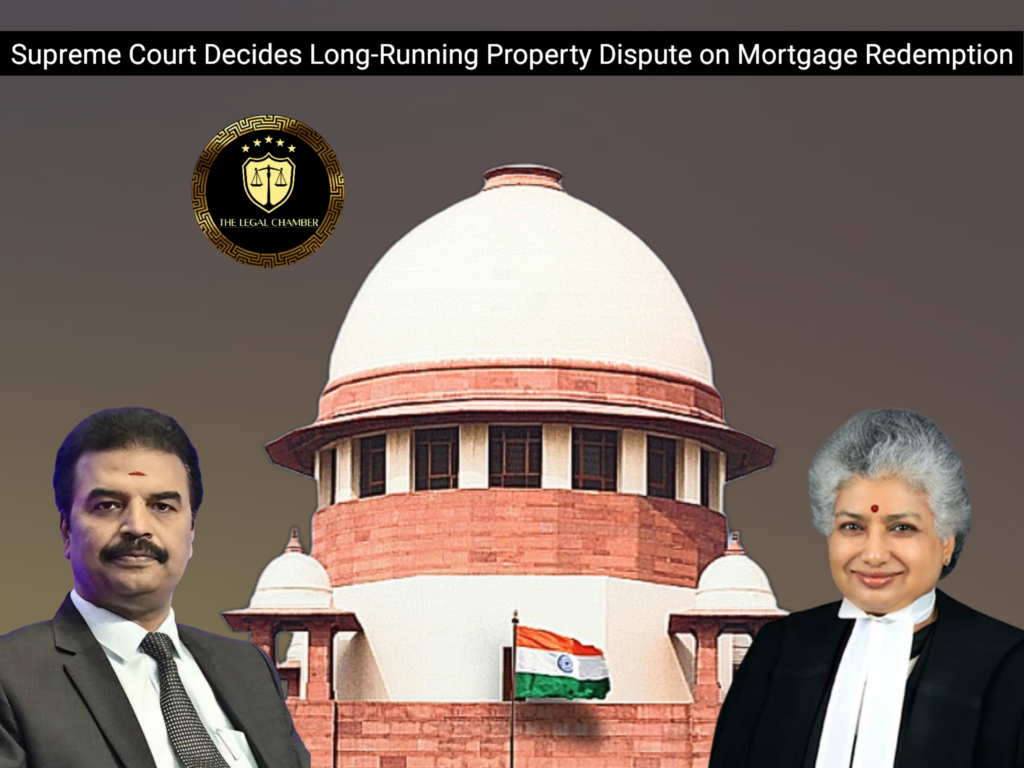
This Supreme Court judgement clarifies the limitation period for redeeming a usufructuary mortgage. The Supreme Court held that the right to redeem does not arise from the mortgage’s creation date. Instead, the limitation period commences only when the mortgagor tenders the mortgage money, meaning the mortgagor’s redemption right is not extinguished by mere lapse of time.
Facts Of The Case:
This case originated from a dispute over the redemption of a usufructuary mortgage concerning agricultural land in Punjab. The respondents’ ancestors had mortgaged the property to the appellants’ predecessors. In 1975, the Collector allowed the respondents’ application for redemption under the Redemption of Mortgage Act, 1913. Challenging this, the appellants (original plaintiffs) filed a civil suit, arguing the redemption right was time-barred. The Trial Court agreed in 1976, setting aside the Collector’s order. This decree was upheld by the First Appellate Court in 1980.However, the Punjab and Haryana High Court, in a Regular Second Appeal (2001), reversed this, ruling the right to redeem was not barred by limitation. The Supreme Court remanded the matter on procedural grounds. Upon rehearing, the High Court again allowed the respondents’ appeal in 2010, restoring the Collector’s redemption order. It relied on precedent stating that for a usufructuary mortgage with no fixed term, the limitation period runs from when the mortgagor tenders the mortgage money, not from the mortgage date. The appellants then appealed to the Supreme Court for a final determination.
Procedural History:
The procedural history of this case spans over several decades across multiple judicial forums. It commenced with the Collector’s order allowing redemption in 1975, which was challenged in Civil Suit No. 291/1975. The Trial Court decreed in favor of the plaintiffs in 1976, a decision upheld by the Additional District Judge in First Appeal in 1980. The defendants then succeeded in Regular Second Appeal before the Punjab and Haryana High Court in 2001. The Supreme Court, in 2009, remanded the matter back to the High Court on the procedural ground of failure to formulate substantial questions of law. Upon re-adjudication after framing the questions, the High Court again allowed the defendants’ appeal in 2010. This led to the final appeal before the Supreme Court, which culminated in the present judgement dismissing the plaintiffs’ appeal and affirming the High Court’s 2010 decision.
READ ALSO:Alternative Remedy Rule Strengthened: Supreme Court Says Writ Petition Not Maintainable If Appeal to High Court Was Available
Court Observation:
In its observations, the Supreme Court explicitly affirmed and applied the legal principle established in the three-judge bench decision of Singh Ram v. Sheo Ram. The Court held that for a usufructuary mortgage where no time is fixed for redemption, the limitation period for seeking redemption does not commence from the date of the mortgage deed. Crucially, the right to redeem arises, and the limitation clock starts running, only from the date the mortgagor tenders or deposits the mortgage money as stipulated under Section 52 of the Transfer of Property Act, 1882. Consequently, merely because the period specified in the mortgage deed had expired, it could not extinguish the mortgagor’s substantive right of redemption. The Court found this ratio directly applicable to the present case, leading it to conclude that the plaintiffs’ suit for declaration of title was not maintainable as the defendants’ redemption right remained alive.
Final Decision & Judgement:
The Supreme Court dismissed the civil appeal filed by the original plaintiffs (mortgagees). It affirmed the judgement of the Punjab and Haryana High Court dated 25.01.2010, thereby upholding the defendants’ (mortgagors’) right to redeem the usufructuary mortgage. The Court restored the Collector’s original order from 1975, which had allowed the redemption. Consequently, the civil suit filed by the plaintiffs challenging the redemption was dismissed, the interim order of stay was vacated, and the parties were directed to bear their respective costs.
Case Details:
Case Title: DALIP SINGH (D) THROUGH LRS. & ORS. VERSUS SAWAN SINGH (D) THROUGH LRS. & ORS.
Citation: 2025 INSC 1498
Appeal Number: CIVIL APPEAL NO(s). 3358/2010
Date of Judgement:November 12, 2025
Judges/Justices: Justice B.V. NAGARATHNA and Justice R. MAHADEVAN
Download The Judgement Here