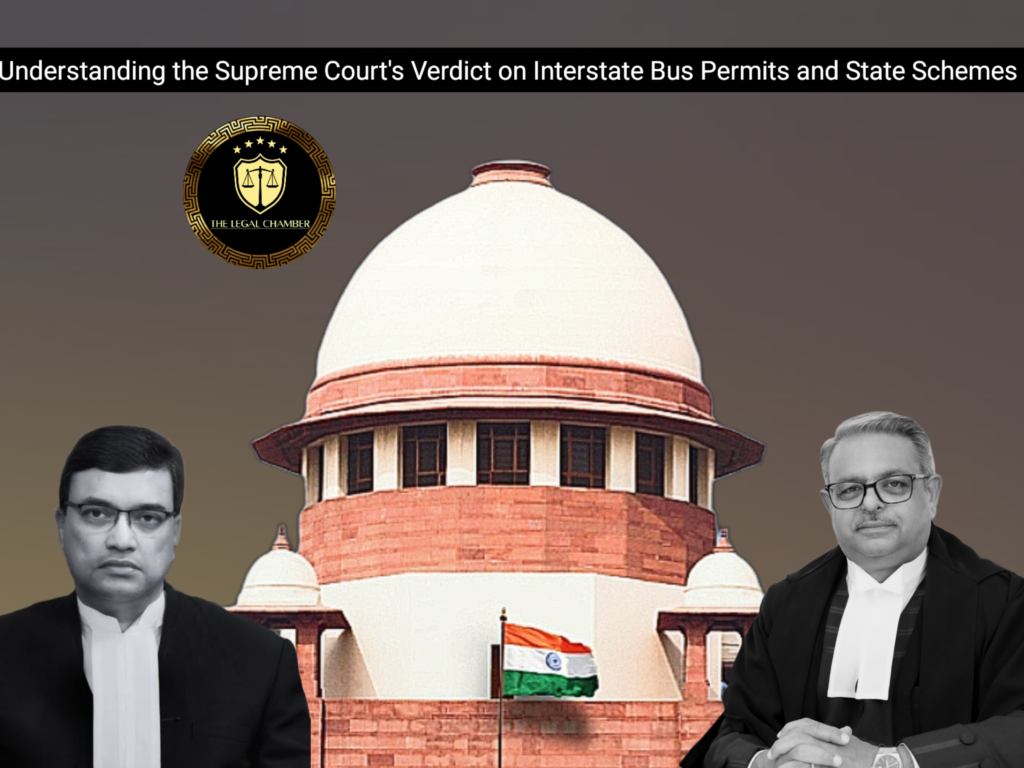
The Supreme Court ruled that an inter-state reciprocal transport agreement under Section 88 of the Motor Vehicles Act, 1988, does not override an approved nationalization scheme under Chapter VI. A notified route for a State Transport Undertaking prevails, prohibiting private operators from plying on any overlapping portion, even if part of an inter-state route.
Facts Of The Case:
The case centered on disputes arising from an Inter-State Reciprocal Transport (IS-RT) Agreement of 2006 between Madhya Pradesh (MP) and Uttar Pradesh (UP). The agreement reserved certain inter-state routes for the Madhya Pradesh State Road Transport Corporation (MPSRTC). After MPSRTC reportedly stopped operations, private operators obtained temporary permits from MP’s transport authority to ply on these de-notified routes. However, UP’s transport authority refused to countersign these permits, as required for inter-state operation. This refusal prompted a series of legal challenges by the private operators and a public interest litigant before the Madhya Pradesh High Court, which generally ruled in their favor, directing UP to countersign the permits.The Uttar Pradesh State Road Transport Corporation (UPSRTC) appealed to the Supreme Court, arguing that the private operators could not ply on portions of these inter-state routes that overlapped with intra-state routes in UP that were “notified” under a nationalization scheme. The core legal conflict was whether the subsequent IS-RT Agreement could allow private operators to run services on stretches of highway that were part of a pre-existing, legally protected scheme exclusively operated by the state transport undertaking.
Procedural History:
The procedural history of this case originated with writ petitions filed by private permit holders and a public interest litigant before the High Court of Madhya Pradesh, primarily at its Gwalior Bench. The High Court, in its impugned orders, ruled in favor of the private operators, directing the State of Uttar Pradesh to countersign the permits issued by Madhya Pradesh. Challenging these directions, the Uttar Pradesh State Road Transport Corporation (UPSRTC) and the State of UP filed special leave petitions before the Supreme Court. The apex court clubbed these appeals with a connected civil appeal and a writ petition under Article 32 of the Constitution, all raising identical legal issues concerning the interplay between inter-state agreements and approved nationalization schemes. The Supreme Court, after hearing arguments, ultimately set aside the High Court’s orders and dismissed the writ petition, remanding certain policy aspects for deliberation between the two state governments.
READ ALSO:Arbitration Award Final: Supreme Court Dismisses MMTC’s Post-Decree Objections
Court Observation:
In its observations, the Supreme Court emphasized the hierarchical statutory structure, noting that Chapter VI of the Motor Vehicles Act, 1988, which governs approved nationalization schemes, expressly overrides Chapter V, under which Inter-State Reciprocal Transport (IS-RT) Agreements are made. The Court reaffirmed settled law that an IS-RT Agreement is an administrative pact between states, not a law, and therefore cannot supersede a statutorily notified route. It observed that once a route is notified for a State Transport Undertaking, private operators—even on inter-state routes—are completely excluded from plying on any overlapping portion, unless the scheme itself expressly provides an exemption. The Bench lamented the lack of foresight by the states in drafting an agreement that conflicted with existing schemes, causing public inconvenience, and urged the transport authorities of Uttar Pradesh and Madhya Pradesh to engage in dialogue to resolve the impasse while protecting the interests of the travelling public.
Final Decision & Judgement:
The Supreme Court allowed the appeals filed by the Uttar Pradesh State Road Transport Corporation (UPSRTC). It set aside the impugned judgments and orders of the Madhya Pradesh High Court and dismissed Writ Petition No. 748 of 2024. The Court held that the private operators could not be granted permits to ply on the inter-state routes, as portions of these routes overlapped with intra-state routes in Uttar Pradesh that were duly notified under an approved nationalization scheme. Such notified schemes under Chapter VI of the Motor Vehicles Act, 1988, prevail over any Inter-State Reciprocal Transport Agreement executed under Section 88. However, the Court directed the Principal Secretaries of the transport departments of Uttar Pradesh and Madhya Pradesh to meet within three months to explore modifications to the agreement and find a consensus-based solution, keeping public interest in focus.
Case Details:
Case Title: U.P. State Road Transport Corporation Through Its Chief General Manager v. Kashmiri Lal Batra & Ors.
Citation:  2025 INSC 1281.
Civil Appeal No.: Civil Appeal Nos. 10522, 10523, and 10524 of 2025.
Date of Judgement: November 04, 2025.
Judges/Justice Name:  Justice Dipankar Datta and Justice Augustine George Masih
Download The Judgement Here