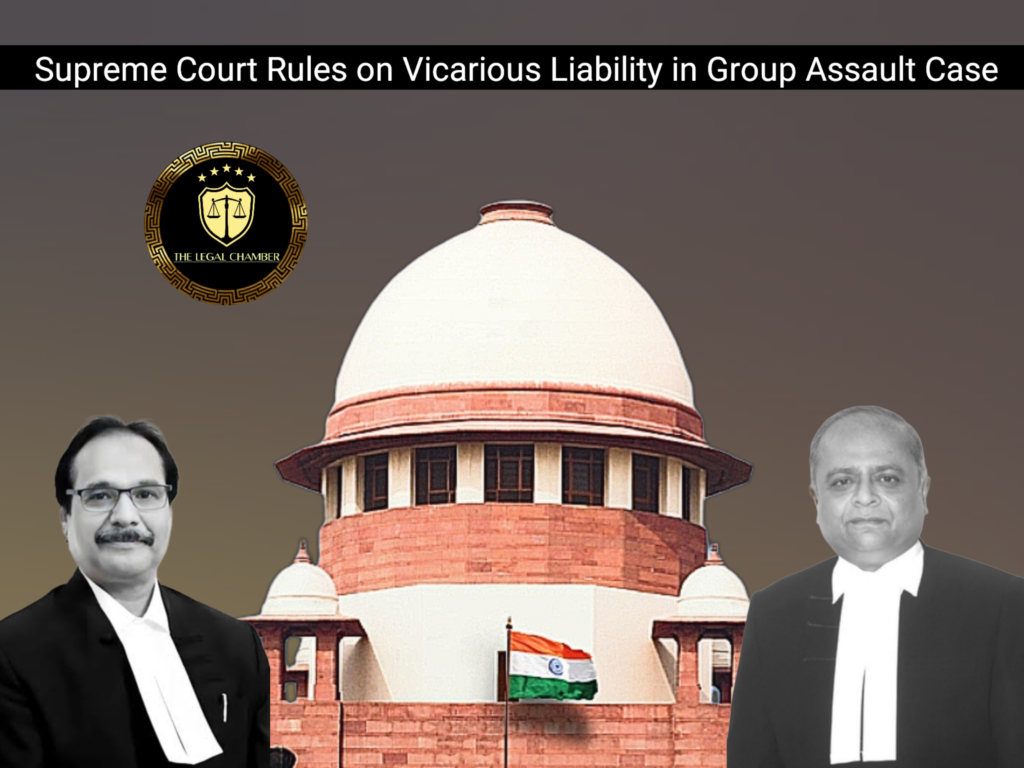
In this Supreme Court judgement, the Supreme Court affirmed the conviction of appellants under Sections 302 and 307 read with Section 149 IPC. The Court clarified that vicarious liability under Section 149 applies when a member of an unlawful assembly shares its common object, irrespective of direct commission of the fatal act. It upheld that active facilitation and participation in a coordinated attack establishes guilt.
Facts Of The Case:
On April 27, 1999, Ankush Gholap and others were returning from Bhor in a jeep when they were intercepted by six accused persons on two motorcycles. The accused, armed with weapons like knives and a sattur, stopped the jeep near Navi Ali. Accused no. 3 removed the jeep’s keys and assaulted the driver, while the others dragged Ankush and two other occupants, Rajendra Gholap (PW-7) and Shivaji Sanas (PW-9), from the vehicle. Accused no. 1 and 2 then fatally attacked Ankush with sharp weapons, causing his death on the spot. PW-7 and PW-9 sustained serious injuries in the assault. The incident stemmed from a prior altercation during a wedding procession on April 26. The Sessions Court initially convicted only accused no. 1, 2, and 6, acquitting others including appellants no. 1 and 2 (accused no. 3 and 4). The High Court reversed these acquittals, convicting all five accused under Sections 147, 148, 302, and 307 read with Section 149 IPC. The Supreme Court appeal challenged this reversal, centering on the applicability of vicarious liability under Section 149 for common object.
Procedural History:
The procedural history of this case began with the Sessions Court, Pune, which on May 18, 2001, convicted accused no. 1, 2, and 6 for murder and attempt to murder, while acquitting accused no. 3, 4, and 5. The convicted accused and the State filed separate appeals before the Bombay High Court. In its judgment dated February 2, 2011, the High Court dismissed the appeals of the convicted accused but allowed the State’s appeal in part, thereby reversing the acquittals of accused no. 3 and 4 and also convicting accused no. 6 for murder under Section 302 read with Section 149 IPC. Aggrieved by this reversal, accused no. 3, 4, and 6 filed the present criminal appeals before the Supreme Court, which, in its judgment dated October 29, 2025, dismissed the appeals and affirmed the convictions and sentences imposed by the High Court.
READ ALSO:Insurance Must Pay Victims First: Supreme Court Upholds ‘Pay and Recover’ in Route Deviation Case
Court Observation:
The Court observed that the evidence of the three injured eyewitnesses was natural, coherent, and mutually corroborative, establishing the appellants’ active participation. It held that the common object of the unlawful assembly extended to murder, given the coordinated attack with lethal weapons. The Court emphasized that under Section 149 IPC, every member of an unlawful assembly is vicariously liable for offences committed in prosecution of the common object, regardless of who inflicted the fatal blow. It found no perversity in the High Court’s reasoned reversal of the acquittal, as the Trial Court had fundamentally misappreciated the evidence.
Final Decision & Judgement:
The Supreme Court dismissed the appeals and affirmed the convictions and sentences imposed by the High Court. It held that the prosecution proved beyond reasonable doubt that all appellants were members of an unlawful assembly with the common object of committing murder. The Court found that the appellants’ active participation and facilitation of the armed assault established their vicarious liability under Section 149 of the IPC for the offences under Sections 302 and 307. The impugned judgment of the High Court was upheld as legally sound and based on a proper reappraisal of the evidence.
Case Details:
Case Title: Haribhau @ Bhausaheb Dinkar Kharuse & Anr. Vs. The State of Maharashtra (with connected appeal)
Citation: 2025 INSC 1266
Criminal Appeal No(s): 1755 of 2011 & 150-151 of 2013
Date of Judgement: October 29, 2025
Judges/Justice Name: Justice Prashant Kumar Mishra & Justice Vipul M. Pancholi
Download The Judgement Here