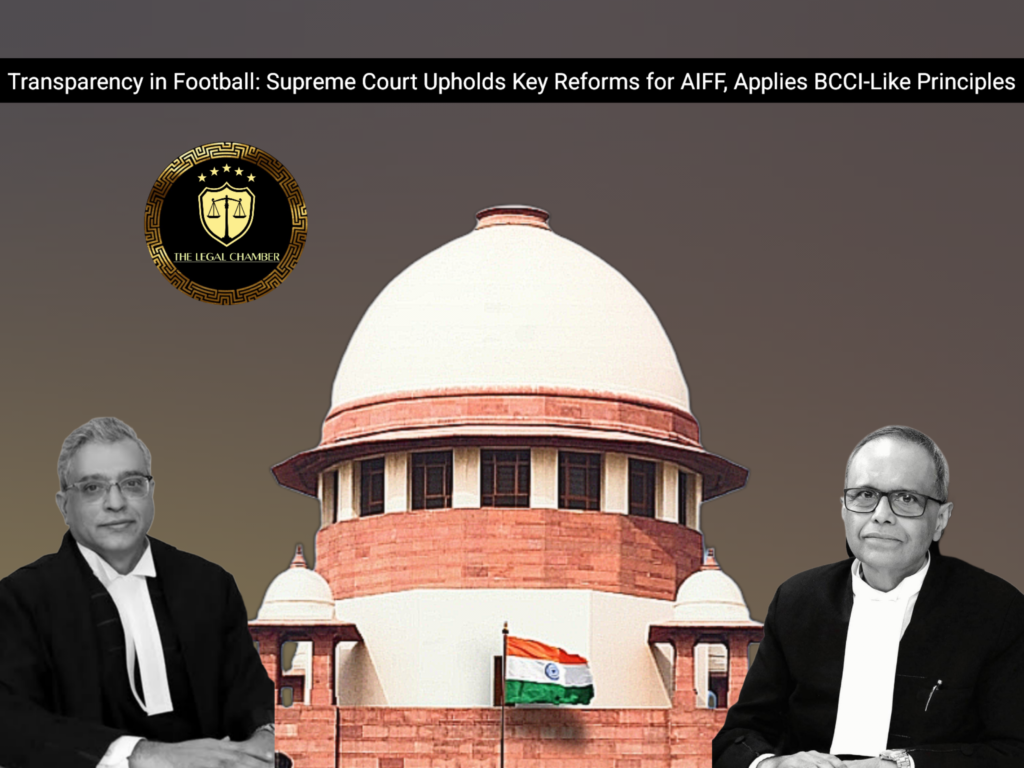
This Supreme Court judgment finalizes the AIFF Constitution, mandating compliance with the National Sports Code. Key legal directives include ensuring player representation in governance, imposing age and tenure limits for office-bearers, defining conflict of interest, and extending constitutional governance principles to state associations for transparency and accountability.
Facts Of The Case:
Procedural History:
The procedural history of this case began with a writ petition filed by Rahul Mehra before the Delhi High Court, challenging the election processes of sports federations including the AIFF. The High Court, in its order dated 31.10.2017, set aside the AIFF’s 2016 elections for violating the National Sports Code and appointed an Administrator to oversee fresh elections and constitutional amendments. The AIFF appealed to the Supreme Court, which stayed the High Court’s order on 10.11.2017 and constituted a Committee of Administrators (CoA) to draft a new constitution. The CoA’s mandate was later reconstituted, and the draft constitution was subsequently referred to former Justice L. Nageswara Rao for finalization after considering stakeholder objections. The Supreme Court heard extensive arguments on the draft before delivering the present judgment, which approves the constitution with specific modifications.
READ ALSO:Cheque Bounce Notice Must Demand Exact Cheque Amount, Rules Supreme Court
Court Observation:
The Supreme Court made several key observations, emphasizing that the principles of good governance and reforms established in the BCCI judgment are squarely applicable to the AIFF as a National Sports Federation. The Court underscored that sporting bodies are “institutions of national life” and their administration must be founded on transparency, accountability, and democratic values. It observed that the pyramidical structure of football necessitates that the AIFF’s constitution, incorporating age and tenure limits, cooling-off periods, and robust conflict-of-interest rules, must mandatorily apply to its state associations to ensure uniformity and prevent the circumvention of reforms. The Court also highlighted that the inclusion of eminent players and other stakeholders in the governance structure is vital for fostering fraternity and is in harmony with both the National Sports Code and international best practices endorsed by FIFA.
Final Decision & Judgement:
The Supreme Court approved the draft Constitution of the All India Football Federation (AIFF) with specific modifications. It directed the AIFF to adopt this finalized Constitution within four weeks. The Court held that the current elected Executive Committee is a permanent body and can complete its term, functioning in accordance with the new Constitution. Key modifications included reducing the eligibility criteria for ‘Eminent Players’, increasing the number of Vice-Presidents to three with one being a woman, refining disqualification events to align with the BCCI precedent, and mandating that the AIFF’s Constitution, with its governance reforms, applies to all state associations. The judgment aims to usher in a new era of transparency, accountability, and professional management for Indian football.
Case Details:
Case Title: All India Football Federation (AIFF) vs. Rahul Mehra & Ors.
Citation: 2025 INSC 1131
Appeal Number:  (Arising out of SLP (C) No(s). 30748-30749 of 2017)
Date of Judgement: September 19, 2025
Judges/Justice Name: Justice PAMIDIGHANTAM SRI NARASIMHA and Justice JOYMALYA BAGCHI
Download The Judgement Here