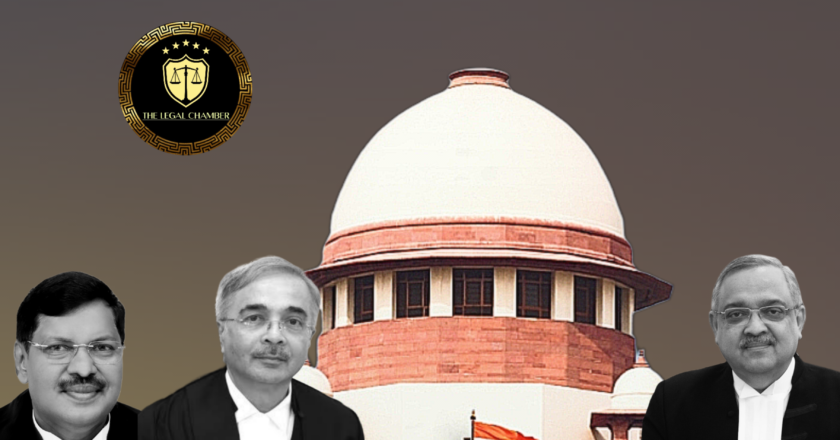
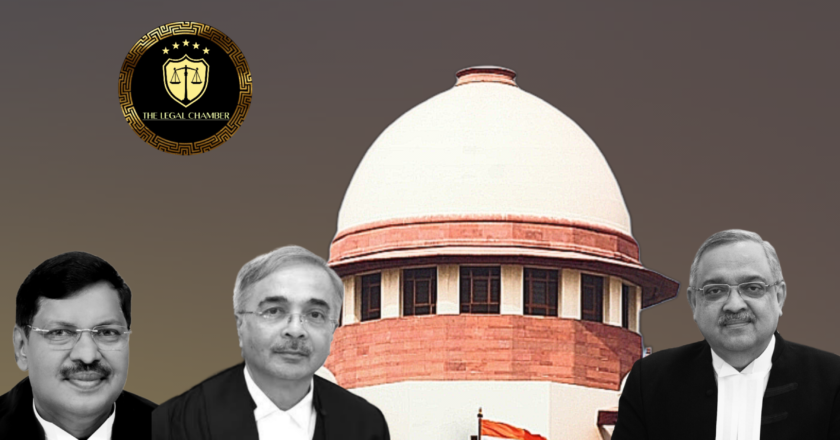
Tag: Justice K. Vinod Chandran

Dead Body in House Isn’t Enough: Supreme Court Overturns Murder Conviction in Loan Dispute Case
Supreme Court

Dead Body in House Isn’t Enough: Supreme Court Overturns Murder Conviction in Loan Dispute Case

In a case based solely on circumstantial evidence, the Supreme Court acquitted the accused, ruling that the prosecution failed to establish an unbroken chain of circumstances pointing exclusively to their guilt. The Court found the evidence—including motive, recovery of weapons, and extra-judicial confessions made in a police station—to be unreliable, insufficient, and lacking credible corroboration to sustain a conviction. Facts Of The Case: The case originated from the brutal murder of a police driver on the night of 10th-11th March 2006. The prosecution alleged that the murder was instigated by a fellow policeman, A1, due to his inability to repay a loan of ₹1 lakh to the deceased. The deceased was lured to the house of A1 and A2 (A1's wife) on the false pretext of repaying the debt. ...
State Cannot Penalize Employee for Its Own Error, Rules Supreme Court
Supreme Court

State Cannot Penalize Employee for Its Own Error, Rules Supreme Court

The Supreme Court exercised its extraordinary jurisdiction under Article 142 to grant relief, ruling that an appellant, though initially ineligible, cannot be penalized for the state authorities' error in selecting and appointing him. The court reinstated the appellant with continuity of service but denied back wages, clarifying the decision was based on the case's peculiar facts and would not set a precedent. Facts Of The Case: The Jharkhand Staff Selection Commission advertised for the post of Trained Graduate Teacher (TGT), reserving 25% of vacancies for teachers from Government Elementary Schools with five years of experience. The appellant, a teacher at a fully government-aided minority school, applied under this quota. His application was processed by the Commission, which found hi...
Tenant Can’t Deny Landlord’s Title, Rules Supreme Court in Key Eviction Case
Supreme Court

Tenant Can’t Deny Landlord’s Title, Rules Supreme Court in Key Eviction Case

The Supreme Court held that in an eviction suit, strict proof of ownership is not required. A tenant cannot deny the landlord's title under whom they entered possession. The Will bequeathing the property, especially when probated, confers sufficient legal sanctity to maintain the eviction proceedings. The bona fide need of the landlord was also upheld. Facts Of The Case: The dispute involves a shop room tenancy initiated in 1953 by Ramji Das, the appellant's father-in-law, with the father of the respondents. Upon Ramji Das's death in 1999, a Will bequeathed the shop to the appellant, Jyoti Sharma. She subsequently filed a suit for eviction on grounds of bona fide need, seeking to expand her husband's adjacent sweets business, and for recovery of rent arrears from January 2000. Th...
Supreme Court Boosts Compensation: Sets Minimum Income for Accident Victims
Supreme Court

Supreme Court Boosts Compensation: Sets Minimum Income for Accident Victims

In a significant ruling on motor accident claims, the Supreme Court reinforced the principles from Pranay Sethi and Somwati. The Court established that the income of a deceased, even if not fully substantiated, cannot be assessed lower than the notional income of an unskilled labourer, with due consideration for annual increments. It upheld the application of standard multipliers, future prospects, and clarified that loss of consortium is payable to spouses, children, and dependent parents. Facts Of The Case: In a tragic accident on July 25, 2010, four friends from Bijapur on a pilgrimage to Shirdi lost their lives when their car was involved in a head-on collision with a rashly and negligently driven goods lorry on NH-13. The case concerns one of the deceased, a qualified pharmacist, wh...
Supreme Court Judgment: Key Takeaway from Vanita vs. Shriram Insurance Co. Ltd.
Supreme Court

Supreme Court Judgment: Key Takeaway from Vanita vs. Shriram Insurance Co. Ltd.

The Supreme Court dismissed the civil appeal, thereby upholding the decision of the lower courts. The ruling signifies that the appellants' legal challenge against the insurance company's position was not tenable in law. The court found no merit to interfere, allowing the impugned judgment and the terms of the insurance policy to stand. Facts Of The Case: The case originated from a claim filed by Vanita and others, likely the legal heirs of a deceased, seeking compensation under a motor accident claim. The accident presumably involved a vehicle insured with M/s Shriram Insurance Company Ltd. The Motor Accidents Claims Tribunal (MACT) initially ruled in the case, and its decision was subsequently challenged in a High Court. It appears that the claimants' appeal was unsuccessful in the Hig...
Domicile vs. Study: Supreme Court Explains Who Qualifies as a “Local” for Medical Seats
Supreme Court

Domicile vs. Study: Supreme Court Explains Who Qualifies as a “Local” for Medical Seats

The Supreme Court upheld the constitutional validity of Telangana's rules defining 'local candidates' for medical admissions. It ruled that the classification, based on consecutive years of study/residence within the state, is not arbitrary and falls within the legislative competence under Article 371D, Entry 25 of List III, and the relevant Presidential Order. Facts Of The Case: The case originated from challenges to the Telangana Medical & Dental Colleges Admission Rules, 2017, and their 2024 amendment, which defined 'local candidates' eligible for 85% state quota seats. The definition required candidates to have studied in educational institutions within the state for four consecutive years ending with the qualifying examination, or to have resided there for the same period if not...
Mens Rea is Must: Supreme Court Rules Accused Must Intend to Drive Victim to Suicide for Abetment Charge
Supreme Court

Mens Rea is Must: Supreme Court Rules Accused Must Intend to Drive Victim to Suicide for Abetment Charge

The Supreme Court reiterated that to establish abetment of suicide under Section 306 IPC, there must be clear evidence of mens rea and a proximate act of instigation by the accused, which directly led the deceased to commit suicide. Mere allegations of harassment, without positive action intended to push the victim toward suicide, are insufficient to sustain the charge. The absence of a live link between the alleged acts and the suicide warranted quashing of the FIR. Facts Of The Case: A seven-term independent Member of Parliament committed suicide on 22 February 2021, leaving behind a suicide note. In the note, he named several officials from the administration and police of Dadra and Nagar Haveli, accusing them of conspiring to defame, degrade, and demean him to end his political caree...
Supreme Court Seeks Larger Bench’s View :Can a Serving Judicial Officer Apply as a “Fresh” Judge?
Supreme Court

Supreme Court Seeks Larger Bench’s View :Can a Serving Judicial Officer Apply as a “Fresh” Judge?

The Supreme Court referred to a 5-Judge Constitution Bench the interpretation of Article 233(2) of the Constitution. It identified two substantial questions of law concerning the eligibility of judicial officers with prior bar experience for direct recruitment as District Judges, and the relevant time for determining such eligibility. Facts Of The Case: The present batch of petitions primarily sought a review of the Supreme Court's 2020 judgment in Dheeraj Mor v. Hon’ble High Court of Delhi. In that decision, a three-judge bench had upheld rules that barred members of the state judicial service from applying for the posts of District Judges reserved for direct recruitment from the bar under Article 233(2) of the Constitution. The review petitioners, along with other connected writ petiti...
Landmark Judgment: Supreme Court Explains How to Calculate Compensation for a Child’s Death
Supreme Court

Landmark Judgment: Supreme Court Explains How to Calculate Compensation for a Child’s Death

The Supreme Court clarified that in claims under Section 166 of the MV Act, a notional income for a deceased child need not be limited to the figures in Schedule II (for Section 163-A claims). It reinstated the Tribunal's calculation, confirming no deduction for personal expenses is required in such cases. Facts Of The Case: The case originated from a motor accident involving a 10-year-old boy who was fatally struck by a bus owned by the Tamil Nadu State Transport Corporation while he was cycling to school. The parents of the deceased child filed a claim petition before the Motor Accidents Claims Tribunal. The Tribunal, acknowledging the undisputed negligence of the bus driver, awarded a total compensation of ₹8,55,000. This calculation was based on attributing a notional monthly...
Marriage Dead: Supreme Court Dissolves Union, Quashes 498A Case in Landmark Irretrievable Breakdown Ruling
Supreme Court

Marriage Dead: Supreme Court Dissolves Union, Quashes 498A Case in Landmark Irretrievable Breakdown Ruling

The Supreme Court, invoking its extraordinary power under Article 142 of the Constitution, dissolved the marriage on the ground of irretrievable breakdown. It quashed the pending criminal proceedings under Section 498-A IPC, finding the allegations to be vague and arising from marital discord, while upholding the terms of a settlement agreement for a clean break. Facts Of The Case: The marriage between Anurag Goel (appellant-husband) and the second respondent (wife) took place on July 25, 2015, following prior divorces for both. After approximately one year and nine months of conjugal life, the relationship soured. The husband alleged constant harassment, leading him to abandon the matrimonial home—a Mumbai apartment he owned—in April 2017 to move to Faridabad with his autistic child fro...