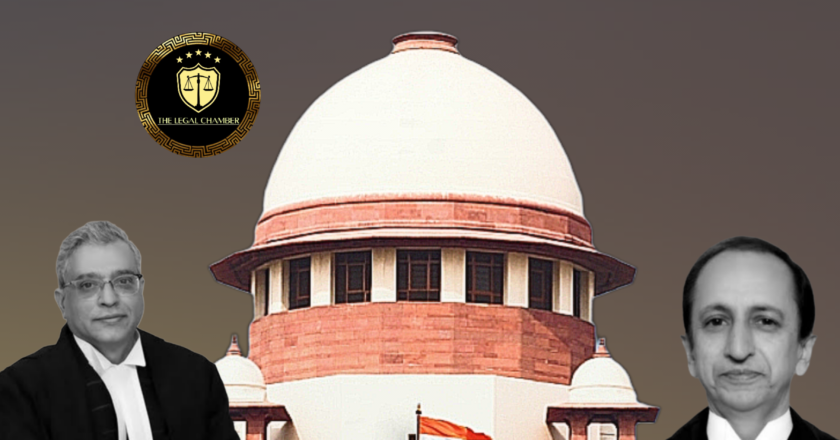
Tag: Justice Atul S. Chandurkar

No Hiding Criminal Past: Supreme Court Says Undisclosed Conviction Makes Election Null & Void
Supreme Court

No Hiding Criminal Past: Supreme Court Says Undisclosed Conviction Makes Election Null & Void

The Supreme Court held that a candidate's non-disclosure of a subsisting criminal conviction in the mandatory election affidavit, as required under Rule 24-A of the relevant rules, constitutes a fundamental breach. This failure vitiates the nomination process itself, rendering the election void under Section 22(1)(d) of the M.P. Municipalities Act, as it violates the voters' constitutional right to informed choice under Article 19(1)(a). Facts Of The Case: The petitioner, Poonam, was elected as a Councillor from Ward No. 5 of Nagar Parishad, Bhikangaon in October 2022. However, her election was challenged by the first respondent, Dulesingh, on the ground that she had failed to disclose a previous conviction in her nomination affidavit. Specifically, on August 7, 2018, Poonam ...
Supreme Court: No Absorption for Waitlisted Candidate After Recruitment Process Ends
Supreme Court

Supreme Court: No Absorption for Waitlisted Candidate After Recruitment Process Ends

The Supreme Court held that a candidate in the reserved panel (waitlist) has no vested right to appointment once the selected candidates join their posts. A legal concession made before a tribunal cannot bind the authorities if it contravenes statutory recruitment rules or extends the life of a waitlist indefinitely. Facts Of The Case: The case originated from a 1997 recruitment drive by All India Radio, Eastern Zone, for three Technician posts reserved for Scheduled Castes. The respondent, Subit Kumar Das, was placed at Serial No. 1 in the Reserved Panel (waitlist). All three selected candidates joined their posts, so the waitlist was not operated. In 1999, during litigation before the Central Administrative Tribunal (CAT), the appellants (Union of India) gave a statement that the r...
Fabricated Documents Can’t Validate a Sale, Rules Supreme Court in Insolvency Case
Supreme Court

Fabricated Documents Can’t Validate a Sale, Rules Supreme Court in Insolvency Case

The Supreme Court held that for a sale by an Official Receiver to be protected under Section 37 of the Provincial Insolvency Act, 1920 upon annulment, the underlying transaction must be valid and attain finality. A transfer based on a fundamentally flawed and fabricated agreement is not a "duly made" disposition and does not survive the annulment of insolvency, requiring the property to revert to the debtor. Facts Of The Case: The case originated from a partnership firm, M/s Gavisiddheshwara & Co. Following the death of partner Singamasetty Subbarayudu, his son (the appellant) was inducted. Due to family indebtedness, the appellant was alleged to have offered his inherited one-anna share for sale via a letter. Respondent Allam Karibasappa claimed to have accepted this offer, assertin...
Supreme Court Says No :Can You Change Your Mind After Cashing the Cheque?
Supreme Court

Supreme Court Says No :Can You Change Your Mind After Cashing the Cheque?

The Supreme Court dismissed the appeal, upholding the rejection of a time-barred review petition. It affirmed the legal principle that a party cannot "approbate and reprobate"—they cannot accept a benefit under an order and later challenge it. A party who voluntarily accepts compensation with full knowledge is bound by their conduct and cannot subsequently resile from it. Facts Of The Case: In a motor accident claim case concerning the death of Priyank Chand, the Motor Accident Claims Tribunal awarded a total compensation of approximately Rs. 11.82 lakh to his legal heirs: his mother (Urmila Chand, the appellant), his wife (Sonu Chand), and his two minor children. Upon a joint application filed by all claimants, including Urmila, the Tribunal passed a disbursement order on 21.04.2015. As...
Supreme Court Ruling: Key Lesson for Armed Forces, Location Misrepresentation is a Punishable Offence
Supreme Court

Supreme Court Ruling: Key Lesson for Armed Forces, Location Misrepresentation is a Punishable Offence

The Supreme Court declined to interfere with the penalty imposed by the disciplinary authority, upholding the High Court's decision. The Court affirmed that misconduct, proven on the preponderance of probabilities and bringing disrepute to a disciplined force, warrants a commensurate penalty. It found no grounds for intervention under Article 136 of the Constitution. Facts Of The Case: The appellant, Constable Amar Singh, was serving with the Central Industrial Security Force (CISF) at the Mallaram Camp. On August 27, 1995, he was granted a two-hour out-pass to visit a hospital. Instead of doing so, he went to a residential colony located approximately 12 kilometres from the camp to enquire about quarters allotted to another constable. His presence and actions there agitated the local ci...