Tag: Civil Law

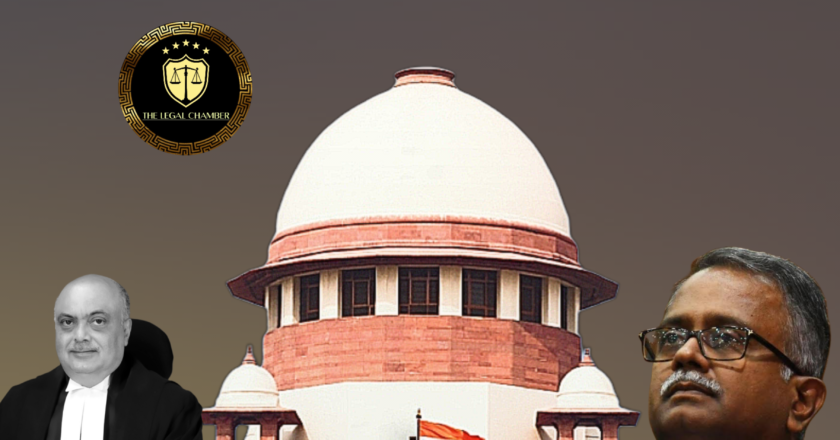
Supreme Court: Death of Appellant Before Hearing Renders Appellate Judgment Void
Supreme Court

Supreme Court: Death of Appellant Before Hearing Renders Appellate Judgment Void

The Supreme Court held that a decree passed in favor of deceased appellants, whose legal heirs were not substituted, is a nullity. Consequently, the original trial court decree revives and is executable, as a null appellate decree cannot supersede a valid prior decree. Facts Of The Case: The legal heirs of Arjunrao Thakre filed a civil suit challenging the re-allotment of his agricultural land to defendants 3 to 5. The trial court decreed the suit in 2006, declaring the plaintiffs as owners and the subsequent allotment illegal. Defendants 4 and 5 appealed. During the pendency of this first appeal, both appellants died—defendant 4 in 2006 and defendant 5 in 2010—but their legal heirs were never brought on record. Unaware of the deaths, the first appellate court heard and partl...
Supreme Court Ends Confusion, Sets Uniform Rule for Accident Payouts
Supreme Court

Supreme Court Ends Confusion, Sets Uniform Rule for Accident Payouts

The Supreme Court held that the application of a "split multiplier" in motor accident compensation cases is impermissible. Relying on the structured formula from Sarla Verma and Pranay Sethi, the Court ruled that compensation must be calculated using a single multiplier based solely on the victim's age, as superannuation does not constitute an exceptional circumstance justifying a deviation from this settled method. Facts Of The Case: On 3rd August 2012, T.I. Krishnan, aged 51, died in a road accident on the Pala-Thodupuzha Road when his car was hit by a rashly driven bus. His surviving family—his wife and children—filed a claim petition before the Motor Accidents Claims Tribunal (MACT), Pala, seeking compensation. The Tribunal, in April 2014, awarded approximately ₹44 lakhs, determining...
Supreme Court Dismisses Arbitration Petition Due to Limitation Issues
Supreme Court

Supreme Court Dismisses Arbitration Petition Due to Limitation Issues

The Supreme Court dismissed the petition for appointment of an arbitrator under Section 11(5) of the Arbitration and Conciliation Act, 1996. The Court held that the underlying claim for recovery of money was hopelessly barred by limitation, rendering the appointment of an arbitrator untenable in law. Facts Of The Case: The case involves a dispute arising from a partnership deed containing an arbitration clause. The petitioner, residing in the UK, entered into a partnership with the respondent on 20.09.2014, succeeding an earlier partnership involving the petitioner’s sister. The petitioner alleged that he paid substantial sums amounting to Rs. 2.31 crores, relying on a clause entitling him to 75% of profits from a property purchased on 04.05.2016, but received nothing. The partnership wa...
Supreme Court Eases Burden of Proof for Railway Accident Victims in Landmark Ruling
Supreme Court

Supreme Court Eases Burden of Proof for Railway Accident Victims in Landmark Ruling

In this judgment, the Supreme Court clarified the burden of proof in railway accident compensation claims under Section 124-A of the Railways Act, 1989. The Court held that the initial burden on claimants can be discharged by affidavit and verified ticket records, shifting the onus to the Railways. Mere absence of a ticket or seizure memo does not defeat a legitimate claim, as the statutory regime is a welfare-oriented, no-fault liability system based on preponderance of probabilities. Facts Of The Case: The case arose from the death of Sanjesh Kumar Yagnik on 19 May 2017. He was allegedly travelling from Indore to Ujjain by the Ranthambore Express (Train No. 12465) when, due to overcrowding, he was pushed from the moving train near Ujjain, sustaining fatal head injuries. The police regi...
Supreme Court Explains “Sufficient Cause”: Key Tests for Granting Stay on a Money Decree
Supreme Court

Supreme Court Explains “Sufficient Cause”: Key Tests for Granting Stay on a Money Decree

The Supreme Court upheld the High Court's grant of unconditional stay on a money decree's execution under Order XLI Rule 5, CPC, ruling that deposit of the decretal amount is not mandatory. An unconditional stay can be granted in exceptional cases where the decree is egregiously perverse, patently illegal, or facially untenable, upon establishing "sufficient cause." Facts Of The Case: The petitioners, Lifestyle Equities C.V. & Anr., proprietors of the "Beverly Hills Polo Club" (BHPC) trademark, filed a suit for infringement and damages against Amazon Technologies Inc. and others before the Delhi High Court. The suit claimed damages of approximately Rs. 2 crore. Amazon was proceeded against ex parte in April 2022. The learned Single Judge, after an ex parte trial, decreed the suit...
Simplifying the Supreme Court’s Order 37 Judgment: Why “Leave to Defend” is Mandatory
Supreme Court

Simplifying the Supreme Court’s Order 37 Judgment: Why “Leave to Defend” is Mandatory

The Supreme Court held that in a summary suit under Order XXXVII CPC, a defendant cannot file a defence without first obtaining "leave to defend" from the court. Permitting a reply to a summons for judgment bypasses this mandatory procedure, which effaces the fundamental distinction between a summary suit and an ordinary suit. The Court set aside the impugned order for this procedural deviation. Facts Of The Case: The case originated from a commercial summary suit filed by the appellant, Executive Trading Company, to recover a sum of over Rs. 2.38 crore from the respondent, Grow Well Mercantile. The suit was instituted under the special fast-track procedure of Order XXXVII of the Civil Procedure Code (CPC). After the defendant entered appearance, the plaintiff served a "summons for judgm...
Supreme Court Ruling: Family of US-Based Driver Wins Enhanced Compensation
Supreme Court

Supreme Court Ruling: Family of US-Based Driver Wins Enhanced Compensation

The Supreme Court, applying the principles established in National Insurance Co. Ltd. v. Pranay Sethi, held that a self-employed person, even one working abroad, is entitled to an addition of 40% of their established income towards future prospects when computing compensation in motor accident claims. The Court enhanced the compensation by recalculating the loss of dependency and conventional heads as per the standardized formula mandated by the Constitution Bench. Facts Of The Case: The case arose from a motor accident that occurred on 31st August 2007 at approximately 3:00 a.m. at Nirmal Kutia Chowk, Karnal. The deceased, Rajinder Singh Mihnas, a 31-year-old U.S. national, was travelling in a car from Delhi to Hoshiarpur when it was struck by a rashly and negligently driven Swaraj Mazd...