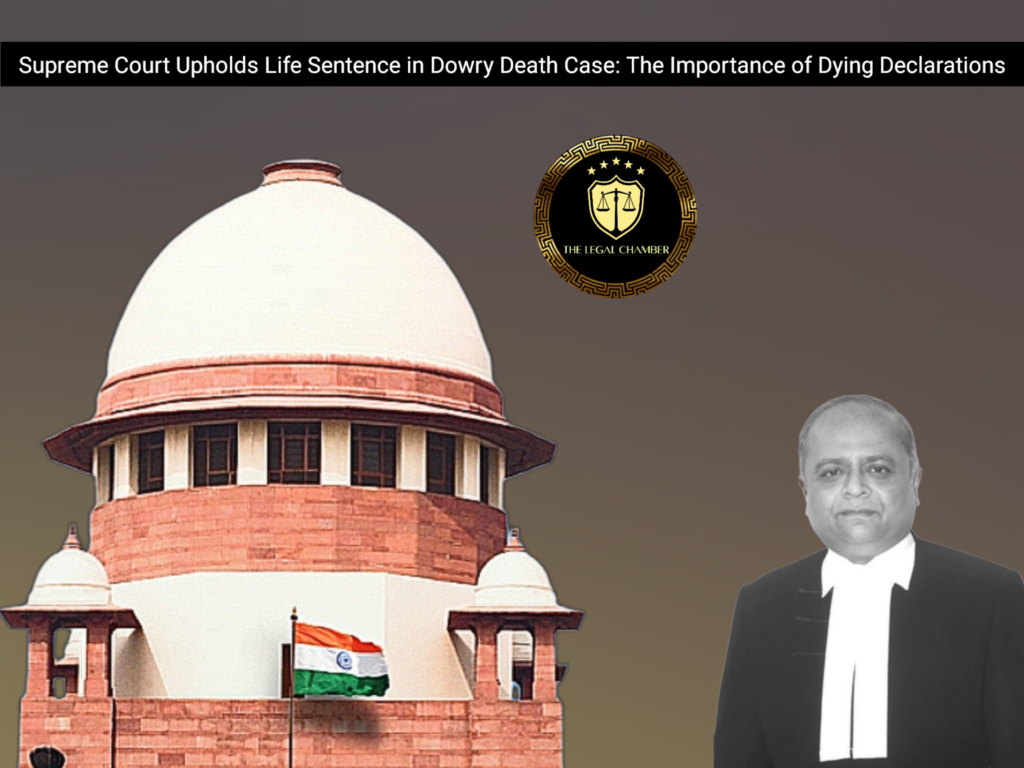
Supreme Court Upholds Life Sentence in Dowry Death Case: The Importance of Dying Declarations

This Supreme Court judgment clarifies the legal principle regarding multiple dying declarations. The Supreme Court held that each declaration must be assessed independently for evidentiary value. It ruled that the first, corroborated dying declaration recorded by an independent witness (a doctor) was reliable, and minor discrepancies in subsequent versions did not invalidate it, justifying the High Court’s reversal of the acquittal.

Facts Of The Case:

The prosecution’s case was that the appellant, Jemaben, conspired with a co-accused to kill Leelaben and her son, Ganesh. On the intervening night of November 29-30, 2004, while the victims were sleeping in their hut, Jemaben poured kerosene on Leelaben and set her on fire. Leelaben suffered severe burns and succumbed to her injuries on December 4, 2004. Her young son also sustained 10-12% burn injuries. The case rested primarily on dying declarations made by the deceased. Leelaben gave three statements, the first being to the attending doctor at the hospital, where she explicitly named her aunt-in-law, Jemaben, as the perpetrator who set her ablaze after a dispute. The Trial Court acquitted both accused, citing discrepancies between the three dying declarations. The Gujarat High Court reversed this acquittal for Jemaben, convicting her under Section 302 of the IPC and sentencing her to life imprisonment. The Supreme Court, in appeal, upheld the High Court’s decision, emphasizing the reliability of the first, medically certified dying declaration, which was corroborated by physical evidence like an empty kerosene container and the smell of kerosene at the scene.

Procedural History:

The procedural history of the case commenced with the Sessions Court (Fast Track Court, Deesa) acquitting the appellant-accused in 2005, primarily due to perceived discrepancies in the deceased’s multiple dying declarations. The State of Gujarat challenged this acquittal by filing Criminal Appeal No. 539 of 2006 before the High Court of Gujarat at Ahmedabad. In 2016, the High Court allowed the state’s appeal, set aside the acquittal, and convicted the appellant under Section 302 of the Indian Penal Code, sentencing her to life imprisonment. The appellant then filed Criminal Appeal No. 1934 of 2017 before the Supreme Court of India, which, in its judgment dated October 29, 2025, dismissed the appeal and upheld the High Court’s conviction and sentence.

READ ALSO:“Mere Suspicion Not Proof”:Supreme Court Landmark Ruling on Circumstantial Evidence

Court Observation:

The Supreme Court made key observations centered on the evidentiary value of dying declarations. It held that multiple dying declarations must be evaluated independently, and the presence of minor discrepancies in subsequent statements does not invalidate a first, credible declaration. The Court found the deceased’s initial statement to the doctor (PW-3) — made while conscious, specifically naming the appellant as the perpetrator, and disclosing a motive — to be wholly reliable. This declaration was strongly corroborated by independent physical evidence, including the recovery of an empty kerosene container, the smell of kerosene at the scene and on the victim, and the medical certificate detailing 100% burns. The Court concluded that on the basis of this cogent evidence, only one conclusion of guilt was possible, and thus the High Court was justified in reversing the erroneous acquittal by the trial court.

Final Decision & Judgement:

The Supreme Court, in its final judgment, dismissed the criminal appeal filed by the appellant, Jemaben. It upheld the conviction and life imprisonment sentence under Section 302 of the Indian Penal Code, as ordered by the Gujarat High Court. The Court affirmed that the High Court correctly interfered with the trial court’s acquittal, as the first dying declaration before an independent medical witness was credible, corroborated by physical evidence, and made a conviction the only possible conclusion. No interference with the High Court’s impugned order was deemed warranted.

Case Details:

Case Title: Jemaben vs. The State of Gujarat
Citation: 2025 INSC 1268
Criminal Appeal No.: Criminal Appeal No. 1934 of 2017
Date of Judgement: October 29, 2025
Judges/Justice Name: Justice Vipul M. Pancholi
 Download The Judgement Here

Leave a Reply

Your email address will not be published. Required fields are marked *