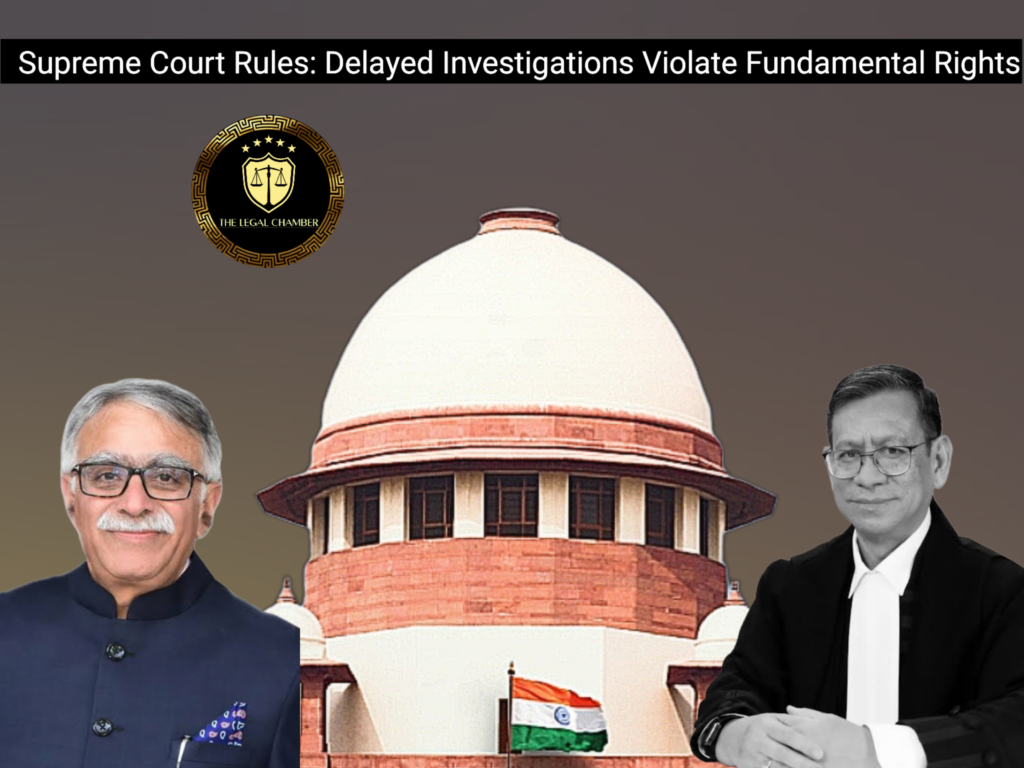
In this appeal, the Supreme Court allowed the petition and quashed the criminal proceedings against the appellant. The Court held that the prosecution sanction under Section 197 CrPC was a non-speaking order devoid of application of mind and was therefore invalid. Furthermore, the inordinate delay of over 11 years in completing the investigation violated the appellant’s fundamental right to a speedy trial under Article 21 of the Constitution.
Facts Of The Case:
The case originates from the alleged irregular issuance of arms licenses in 2004-2005 when the appellant, an IAS officer, served as the District Magistrate-cum-Licensing Authority in Saharsa, Bihar. An FIR was registered in 2005 alleging that licenses were granted to unfit, non-resident, and even fictitious persons without proper police verification, implicating the appellant in a criminal conspiracy. After investigation, a 2006 supplementary chargesheet concluded no offence was made out against him, terming the allegations false. However, further investigation was permitted in 2009.Despite a 2015 departmental show-cause notice, the appellant was discharged from disciplinary proceedings in 2016. Subsequently, after a prolonged delay, a chargesheet was filed against him in August 2020. The State granted sanction for prosecution under Section 197 CrPC in April 2022, and cognizance was taken by the Magistrate in June 2022. The appellant’s petition under Section 482 CrPC to quash these proceedings was dismissed by the Patna High Court in May 2025. The appellant then approached the Supreme Court, challenging the validity of the sanction order and arguing that the inordinate delay of over 15 years in filing the chargesheet violated his right to a speedy trial.
Procedural History:
The procedural history of this case is marked by significant delays and multiple investigative phases. The saga began with the registration of an FIR in April 2005. After initial investigation, a supplementary chargesheet in April 2006 exonerated the appellant, finding the allegations false. In 2009, the Chief Judicial Magistrate, Saharsa, permitted further investigation under Section 173(8) of the CrPC, rejecting a request for re-investigation. This further investigation culminated in a new chargesheet filed against the appellant in August 2020—a delay of 11 years from the permission granted.Concurrently, departmental proceedings initiated in 2015 concluded with the appellant’s discharge in February 2016. Following the 2020 chargesheet, the State granted prosecution sanction under Section 197 CrPC in April 2022, and the Chief Judicial Magistrate took cognizance in June 2022. The appellant’s petition under Section 482 CrPC to quash these proceedings was dismissed by the Patna High Court in May 2025. The appellant then appealed to the Supreme Court by way of Special Leave, leading to the present judgment which allowed the appeal and quashed all proceedings.
READ ALSO:SARFAESI Act vs EPF Act: Supreme Court Says Provident Fund Charge Prevails Over Bank
Court Observation:
Final Decision & Judgement:
The Supreme Court allowed the criminal appeal and set aside the impugned judgment of the Patna High Court. Consequently, all criminal proceedings against the appellant, including the order taking cognizance dated 1st June 2022 and the underlying sanction order dated 27th April 2022, were quashed. The Court’s decision was primarily founded on two grounds: the prosecution sanction under Section 197 CrPC was invalid for being a non-speaking order devoid of application of mind, and the inordinate delay of over 11 years in completing the investigation violated the appellant’s fundamental right to a speedy trial under Article 21 of the Constitution.
Case Details:
Case Title: Robert Lalchungnuga Chongthu @ R L Chongthu vs. State of Bihar
Citation: 2025 INSC 1339
Appeal No.:  (Arising out of SLP(Crl.) No. 10130 of 2025)
Date of Judgement: November 20, 2025
Judges/Justices: Justice Sanjay Karol and Justice Nongmeikapam Kotiswar Singh