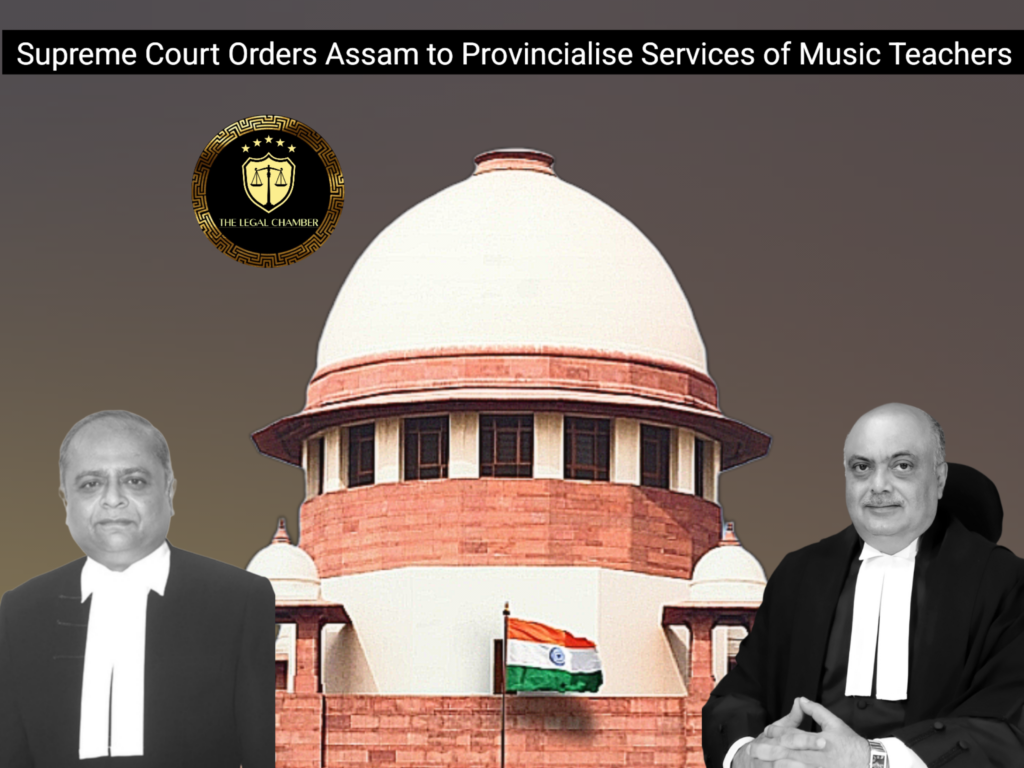
The Supreme Court held that the appellants’ right to provincialisation had crystallised under the 2011 Act. Despite favourable findings, the High Court erred in not granting mandamus relief. The Court modified the impugned judgment, ruling that a Writ Court has inherent power under Article 226 to mould relief and grant consequential mandamus to remedy injustice, which it duly issued.
Facts Of The Case:
The case originated from a batch of appeals before the Supreme Court, filed by a large group of Music Teachers employed in various provincialised schools in Assam. Their grievance stemmed from the State of Assam’s failure to formally provincialise their services under the Assam Venture Educational Institutions (Provincialisation of Services) Act, 2011. The appellants’ eligibility had been verified by the District Scrutiny Committee, and a list of 214 teachers, including the appellants, was recommended for provincialisation by the Director of Secondary Education in June 2016. However, the State did not issue the final notification. The Gauhati High Court, in its impugned 2024 judgment, upheld the appellants’ claims on all substantive legal and factual issues, finding they had a vested right to provincialisation. Yet, it declined to issue a writ of mandamus to compel the State, instead directing the teachers to seek fresh remedies before the government. Aggrieved by this denial of relief after a favourable verdict, the appellants approached the Supreme Court, arguing the High Court should have granted the consequential mandamus.
Procedural History:
The procedural history of this case began with the filing of Writ Petitions before the Gauhati High Court by the aggrieved Music Teachers, challenging the State of Assam’s inaction on provincialising their services despite a 2016 recommendation. A Division Bench of the High Court, in its common Judgment dated 04.10.2024, ruled in favour of the appellants on all substantive legal and factual issues but declined to issue a writ of mandamus, relegating them to seek fresh remedies before the State Government. Dissatisfied, the appellants filed Special Leave Petitions before the Supreme Court of India, which were converted into Civil Appeals. The Supreme Court, after hearing the parties, allowed the appeals vide an order dated 18.11.2025, with the detailed Judgment following subsequently, thereby modifying the High Court’s order and granting the final relief.
READ ALSO:Forest Fire Deaths Not Culpable Homicide, Supreme Court Discharges Forester
Court Observation:
In its judgment, the Supreme Court made several critical observations. It noted that the Gauhati High Court, in its impugned order, had returned clear and categorical findings in favour of the appellants, establishing that they possessed a vested right to provincialisation under the 2011 Act, a right which was not extinguished by subsequent legislation. The Court observed that the High Court erred in not granting a writ of mandamus despite these favourable findings, erroneously believing such a prayer was not made, when in fact it was specifically pleaded. Importantly, the Supreme Court emphasised the inherent and wide powers of a Writ Court under Article 226 of the Constitution to mould relief and do complete justice, even if a specific prayer is not explicitly pleaded, to prevent injustice and provide an effective remedy. It found no valid reason for the State to initiate a fresh verification process.
Final Decision & Judgement:
The Supreme Court allowed the appeals and set aside the operative portion (Paragraph 194) of the Gauhati High Court’s judgment. The Court modified the impugned order and issued a writ of mandamus directing the State of Assam and its concerned authorities to provincialise the services of the appellant Music Teachers, in terms of the prayer made in the original writ petition. It mandated that the necessary consequential actions be completed by the State within a maximum period of three months from the date of the judgment. The Court further ruled that the provincialisation of the appellants’ services would take effect retrospectively from 01.01.2013. No order as to costs was passed.
Case Details:
Case Title: Nur Islam & Ors. vs. The State of Assam & Ors.
CITATION: Civil Appeal No. 13802 of 2025
Date of Judgement:NOVEMBER 18, 2025
Judges/Justice Name: Justice Ahsanuddin Amanullah and Justice Vipul M. Pancholi
Download The Judgement Here