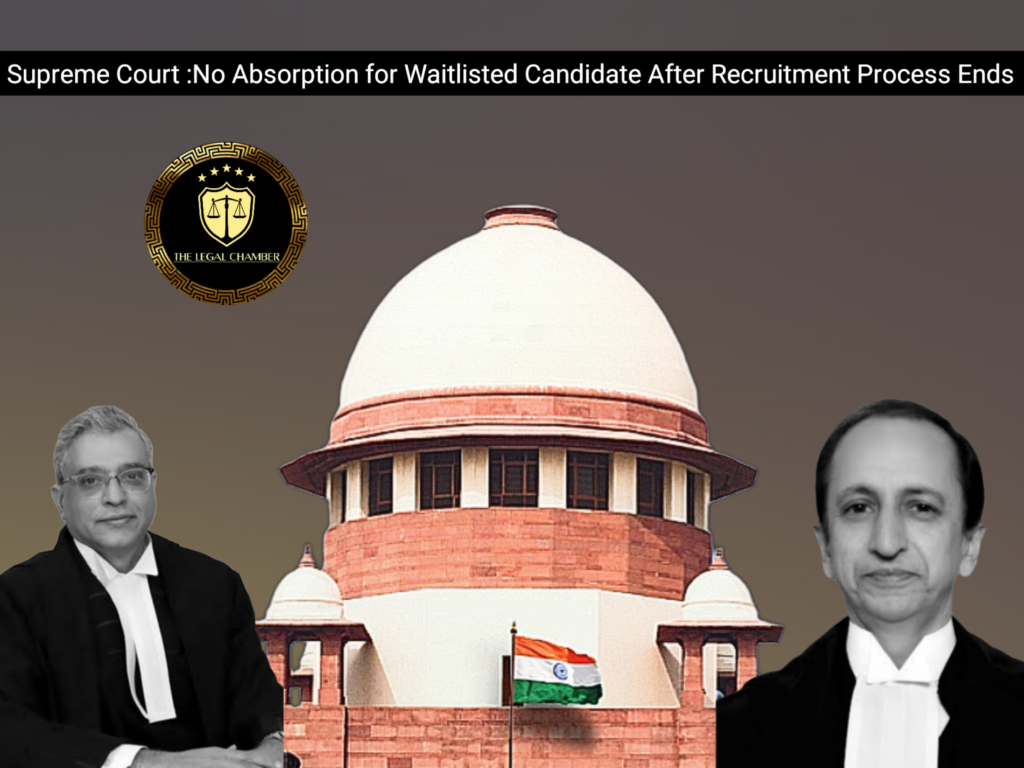
The Supreme Court held that a candidate in the reserved panel (waitlist) has no vested right to appointment once the selected candidates join their posts. A legal concession made before a tribunal cannot bind the authorities if it contravenes statutory recruitment rules or extends the life of a waitlist indefinitely.
Facts Of The Case:
The case originated from a 1997 recruitment drive by All India Radio, Eastern Zone, for three Technician posts reserved for Scheduled Castes. The respondent, Subit Kumar Das, was placed at Serial No. 1 in the Reserved Panel (waitlist). All three selected candidates joined their posts, so the waitlist was not operated. In 1999, during litigation before the Central Administrative Tribunal (CAT), the appellants (Union of India) gave a statement that the respondent’s case would be considered for the next available SC vacancy. Despite this assurance and subsequent legal battles over decades, the appellants did not absorb him, citing exhausted vacancies and later, the respondent being age-barred as per recruitment rules. The Calcutta High Court, in 2024, ultimately directed the appellants to absorb the respondent, a decision challenged before the Supreme Court. The core legal dispute revolved around whether the 1999 concession could create a right to appointment contrary to recruitment rules and long after the original selection process ended.
Procedural History:
The procedural history of this case is extensive, spanning nearly three decades. It commenced with the respondent’s Original Application before the Central Administrative Tribunal (CAT) in 1997. After an interim concession by the appellants in 1999, the CAT finally disposed of the matter in 2004 with a direction to consider the respondent for future vacancies. This led to a writ petition before the Calcutta High Court, which modified the order in 2009. Subsequent rounds of litigation followed, with the respondent filing fresh applications before the CAT in 2013 and 2016, challenging speaking orders that denied him absorption. The High Court, in its impugned 2024 judgment, allowed the respondent’s writ petition and directed his absorption, which was ultimately appealed to and overturned by the Supreme Court in 2025.
READ ALSO:Will, Mutation & Adverse Possession: Supreme Court Allows Title Suit to Proceed to Trial
Court Observation:
The Supreme Court made critical observations on the limitations of a waitlisted candidate’s rights and the nature of legal concessions. The Court held that placement on a waitlist does not create a vested right to appointment, and any such right extinguishes once all selected candidates join their posts. It further observed that a waitlist cannot operate indefinitely or be used to fill vacancies arising from a fresh recruitment process. Crucially, the Court ruled that a concession on a point of law made before a tribunal, if contrary to statutory recruitment rules, is not binding on the authorities. Implementing such a concession would unfairly prejudice future eligible candidates and extend the life of a waitlist impermissibly.
Final Decision & Judgement:
The Supreme Court allowed the appeal and set aside the judgment of the Calcutta High Court dated 25.06.2024. It held that the direction to absorb the respondent was legally unsustainable. The Court ruled that the respondent, as a waitlisted candidate from the 1997 recruitment, had no subsisting right to appointment after the selected candidates joined their posts. The 1999 concession made by the appellants could not override the statutory recruitment rules or create a right to absorption in a subsequent recruitment process. Consequently, the respondent’s writ petition was dismissed, and no relief was granted.
Case Details:
Case Title: The Union of India & Ors. vs. Subit Kumar Das
Appeal Number:  Civil Appeal arising out of SLP(Civil) Diary No. 57192 of 2024
Date of Judgment: October 15, 2025
Judges/Justice Name: Justice Atul S. Chandurkar and Justice Pamidighantam Sri Narasimha
Download The Judgement Here