The Supreme Court dismissed the appeal, holding that the statutory remedy under Sections 37-A/38 of the Tamil Nadu Revenue Recovery Act, 1864, providing a 30-day period to challenge an auction, is mandatory. Failure to exhaust this specific remedy within limitation bars subsequent writ jurisdiction under Article 226, irrespective of other pending proceedings or interim orders.
Facts Of The Case:
The case concerns recovery proceedings against the legal heirs of late Ramaswamy Udayar for arrack shop dues from 1972-73. Following an ex-parte decree in 1987, the Revenue authorities issued an auction notice in 2005 for his properties. The appellant, his widow, challenged this notice via a writ petition. Although the High Court granted an interim stay on the confirmation of sale, the auction itself proceeded in July 2005, and the property was sold to a third party. The sale was later confirmed in July 2008. The appellant did not file an application to set aside the sale under the specific statutory remedies (Sections 37-A or 38 of the Revenue Recovery Act) within the mandatory 30-day period. Her writ petition, subsequent writ appeal, and review application were all dismissed by the High Court primarily for this failure to exhaust the statutory remedy. She then appealed to the Supreme Court, arguing the auction was illegal as it occurred during pending litigation and that her substantial deposits pursuant to court orders satisfied the dues.
Procedural History:
The procedural history of this case originated with the filing of Writ Petition No. 25194 of 2005 before the Madras High Court, challenging the auction notice dated June 28, 2005. The High Court, while granting an interim stay on the confirmation of the sale, did not stay the auction itself, which was conducted on July 29, 2005. Following the dismissal of this writ petition, the appellant filed Writ Appeal No. 797 of 2008, which was dismissed by a Division Bench on August 7, 2009. The appellant then filed Review Application No. 129 of 2009, which was also dismissed by the High Court on January 6, 2011. Aggrieved by these concurrent dismissals, which were primarily based on her failure to exhaust the specific statutory remedy under the Revenue Recovery Act within the 30-day limitation period, the appellant filed the present Civil Appeal No. 2322 of 2013 before the Supreme Court, which ultimately dismissed it in November 2025.
READ ALSO:Supreme Court Upholds Expert Panels’ Role in Cauvery Water Dispute, Dismisses Tamil Nadu’s Applications
Court Observation:
In its observations, the Supreme Court emphasized the mandatory and self-contained nature of the statutory remedy provided under Sections 37-A and 38 of the Tamil Nadu Revenue Recovery Act, 1864. The Court held that the prescribed 30-day limitation period for challenging an auction sale is absolute and failure to invoke this specific remedy within time creates a statutory bar. It further clarified that interim orders from a writ court, which only stayed the confirmation of sale, did not absolve the appellant of the obligation to pursue the statutory remedy, nor did they suspend the limitation period. The Court noted that once a sale is confirmed, as it was in 2008, vested rights accrue in favour of the auction-purchaser which cannot be undone belatedly through writ jurisdiction under Article 226, especially in the absence of proven fraud or material irregularity. The deposits made by the appellant during writ proceedings were held to be no substitute for the formal application required by the statute.
Final Decision & Judgement:
The Supreme Court, in its final judgment, dismissed the civil appeal and upheld the decisions of the Madras High Court. It ruled that the appellant’s failure to avail the specific statutory remedy under Sections 37-A or 38 of the Revenue Recovery Act within the mandatory 30-day period from the date of the auction (July 29, 2005) was fatal to her case. The Court held that the auction and its subsequent confirmation were conducted lawfully, and the interim orders in the writ petition did not excuse compliance with the statutory limitation. Consequently, the writ jurisdiction under Article 226 could not be invoked to challenge the sale after this significant delay, thereby protecting the vested rights of the auction-purchaser. The appeal was found to be devoid of merit and was accordingly dismissed.
Case Details:
Case Title: KOLANJIAMMAL (D) THR LRS. vs. THE REVENUE DIVISIONAL OFFICER PERAMBALUR DISTRICT & ORS.
Citation: 2025 INSC 1319
Civil Appeal No.: Civil Appeal No. 2322 of 2013
Date of Judgement: November 14, 2025
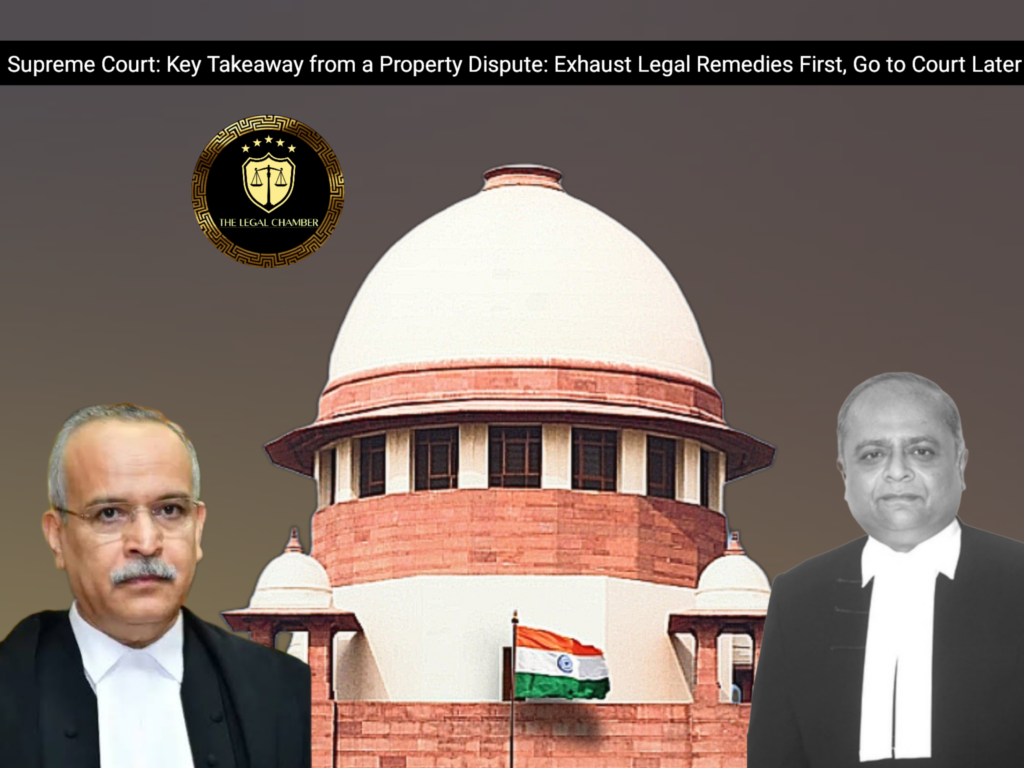
Judges/Justice Name: Justice Vipul M. Pancholi and Justice Satish Chandra Sharma
Download The Judgement Here