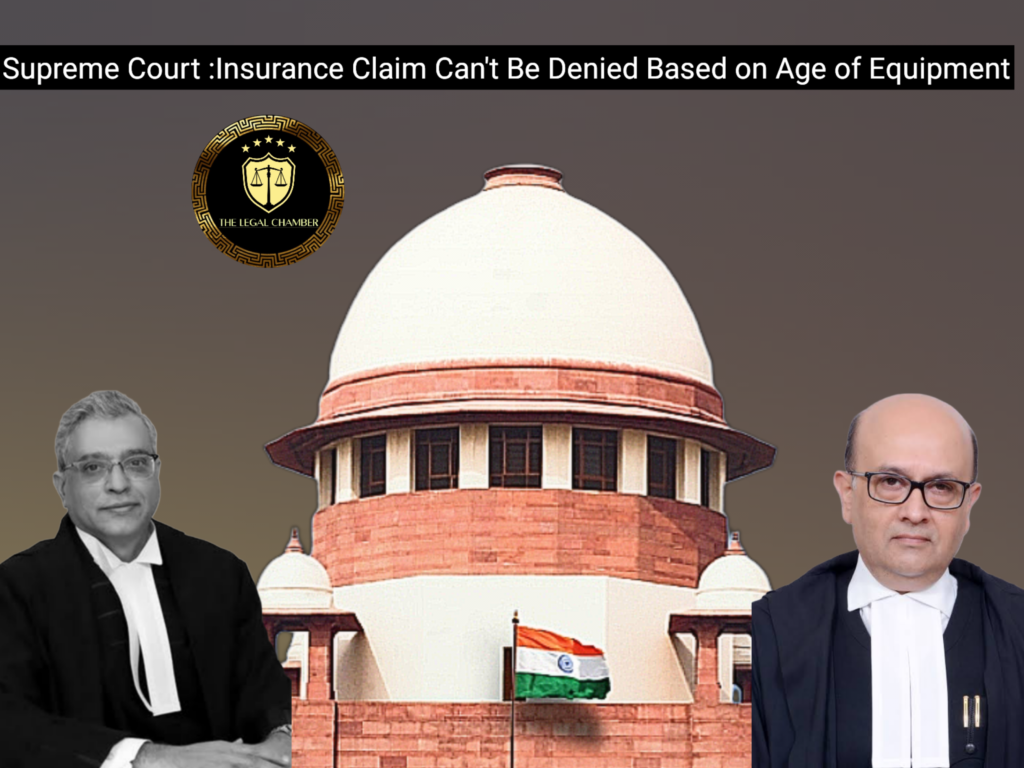
The Supreme Court held that an insurer cannot repudiate a claim merely by invoking an exclusion clause for wear and tear. The burden lies on the insurer to prove material non-disclosure, fraud, or that the loss was definitively caused by an excluded peril. A valid statutory fitness certificate creates a strong presumption of the equipment’s insurable condition, shifting the evidentiary onus onto the insurer.
Facts Of The Case:
The appellant, a sugar mill, held an insurance policy from National Insurance Co. Ltd. covering its boiler. During the policy period in May 2005, an incident occurred causing two boiler tubes to detach. The insurer repudiated the claim, citing Exclusion Clause 5, which excludes losses from wear, corrosion, and gradual deterioration. It relied on a surveyor’s report noting tube corrosion and that some tubes, installed in 1986, had outlived their useful life. The sugar mill contested this, arguing the detachment resulted from a sudden explosion, a covered peril, and that the boiler possessed a valid statutory certificate of fitness issued under the Indian Boilers Act. The State Commission ruled in favour of the mill, awarding compensation. However, the National Commission reversed this, accepting the insurer’s exclusion defence. The Supreme Court, in appeal, set aside the National Commission’s order. It emphasized the boiler’s valid registration and fitness certificate, placing a heavy burden on the insurer to prove fraud or material non-disclosure to justify repudiation. The Court found the survey reports inconclusive, as they did not rule out an explosion as the cause, and held that mere evidence of ageing parts could not trigger the exclusion clause in these circumstances. The matter was remanded to the National Commission solely to determine the quantum of compensation.
Procedural History:
The case originated from Consumer Complaint No. 7 of 2007 filed by the appellant before the Maharashtra State Consumer Disputes Redressal Commission. The State Commission, in 2012, partly allowed the complaint and awarded compensation. Both parties appealed this order to the National Consumer Disputes Redressal Commission (NCDRC). In 2020, the NCDRC allowed the insurance company’s appeal, setting aside the State Commission’s award and dismissing the complaint. Aggrieved by the NCDRC’s reversal, the sugar mill filed the present appeals before the Supreme Court of India, which granted leave and ultimately allowed the appeals in 2025, setting aside the NCDRC’s judgment and restoring the matter to the NCDRC for a fresh determination on the quantum of compensation.
READ ALSO:Supreme Court Rules: Counter-Claim Against Co-Defendant Not Allowed
Court Observation:
The Supreme Court made critical observations on the principles governing insurance contracts and claim repudiation. It emphasized that a contract of insurance is one of utmost good faith, with the burden of proving non-disclosure or fraud firmly on the insurer. The Court held that a valid statutory certificate of fitness for the boiler, issued under the Indian Boilers Act, created a strong prima facie presumption of its insurable condition. It found the insurer’s reliance on Exclusion Clause 5 to be misplaced, as the survey reports were not conclusive and did not definitively rule out a sudden explosion—a covered peril—as the cause of the damage. Merely pointing to the age of parts or gradual corrosion, without proof of material non-disclosure by the insured or that the damage was solely due to an excluded cause, was insufficient to repudiate the claim. The Court underscored that exclusion clauses must be construed strictly and cannot be used to defeat the very purpose of the insurance contract.
Final Decision & Judgement:
The Supreme Court allowed the appeals, setting aside the impugned judgment of the NCDRC. It held that the insurance company was not justified in repudiating the claim by invoking Exclusion Clause 5, as it failed to prove any material non-disclosure, fraud, or suppression of facts by the insured. The valid boiler fitness certificate under the Boilers Act shifted a heavy burden onto the insurer, which it did not discharge. The Court restored the two appeals (Nos. 580 of 2012 and 166 of 2013) to the file of the NCDRC, but limited its remit solely to determining the quantum of compensation payable to the appellant. All other issues, including liability, were decided in favour of the insured sugar mill. Parties were directed to bear their own costs.
Case Details:
Case Title: Kopargaon Sahakari Sakhar Karkhana Ltd.  vs. National Insurance Co. Ltd. & Anr.
Citation: INSC 1315 (2025)
Civil Appeal No.: (Arising out of SLP (C) Nos. 1377-1378 of 2022)
Date of Judgement: November 13, 2025
Judges/Justice Name: Justice Manoj Misra and Justice Pamidighantam Sri Narasimha
Download The Judgement Here