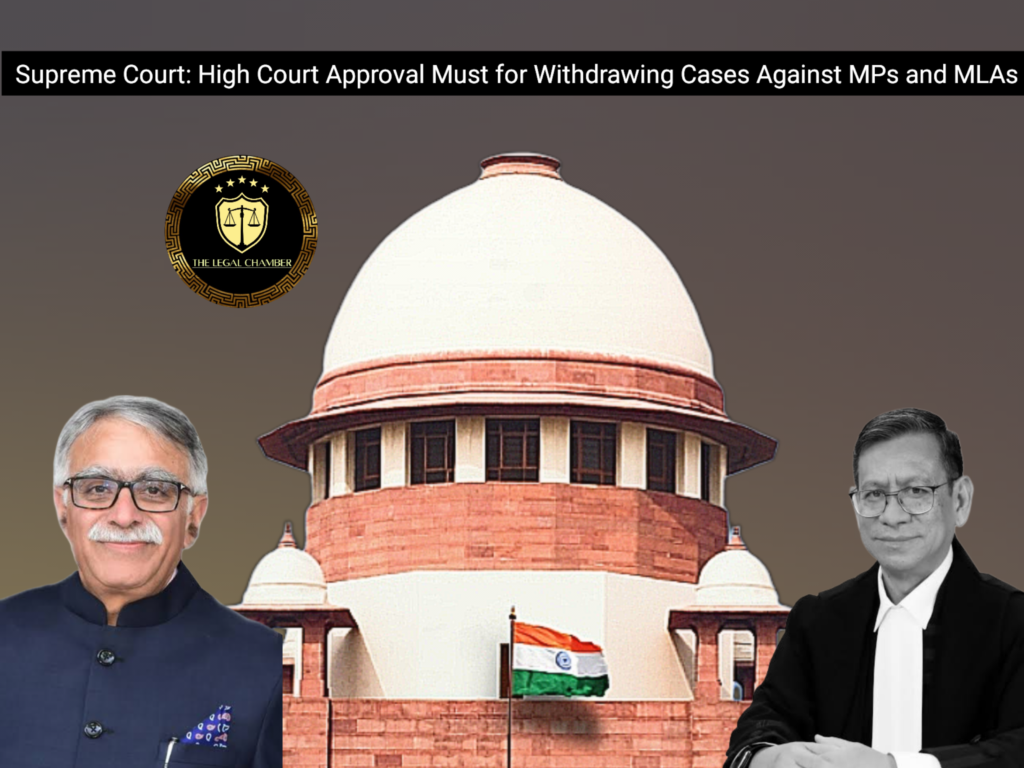
The Supreme Court held that for withdrawing prosecution against sitting or former MPs/MLAs, the State must seek the High Court’s permission under the mandate of Ashwini Kumar Upadhyay. The Public Prosecutor must disclose all reasons for seeking withdrawal, enabling the High Court to apply its judicial mind and pass a reasoned order.
Facts Of The Case:
The appellant, Bal Kumar Patel @ Raj Kumar, was the subject of multiple First Information Reports (FIRs) registered in June 2007 at Police Station Kotwali Nagar, Raebareli. These included Case Crime No. 656/07 and others under Sections 25, 27, 30 of the Arms Act, as well as Sections 420, 467, 468, and 471 of the Indian Penal Code concerning an arms license. Following investigation, a chargesheet was filed, and the Chief Judicial Magistrate, Raebareli, took cognizance of it on 10th August 2007. Years later, on 6th August 2014, the Government of Uttar Pradesh issued a Government Order (G.O.) deciding to withdraw the prosecution in several of these cases (specifically Crime Nos. 654, 655, and 656 of 2007) against the appellant, citing public interest and the interest of justice. Pursuant to this G.O., the learned Public Prosecutor filed an application under Section 321 of the CrPC before the Trial Court on 27th August 2014, seeking withdrawal of the cases. However, the Trial Court, vide order dated 8th October 2021, observed that the State had not sought the permission of the High Court to withdraw the prosecution as mandated by the Supreme Court’s decision in Ashwini Kumar Upadhyay v. Union of India. The Trial Court granted the State thirty days to obtain the requisite permission, failing which the prosecution would proceed as per law. The State did not seek such permission from the High Court. Consequently, the appellant filed applications under Section 482 CrPC/528 BNSS before the High Court of Judicature at Allahabad, seeking quashing of the criminal proceedings. The High Court dismissed these applications, leading to the filing of the present appeals before the Supreme Court.
Procedural History:
The criminal proceedings originated from multiple First Information Reports registered against the appellant in June 2007 at Police Station Kotwali Nagar, Raebareli. After investigation, a chargesheet was filed, and the Chief Judicial Magistrate, Raebareli, took cognizance on 10th August 2007. On 27th August 2014, the Public Prosecutor filed an application under Section 321 of the Code of Criminal Procedure, 1973, seeking withdrawal of the prosecution based on a Government Order dated 6th August 2014, wherein the State of Uttar Pradesh had decided to withdraw the cases against the appellant in public interest. The Trial Court, by order dated 8th October 2021, observed that the State had not obtained permission from the High Court as mandated by the Supreme Court’s decision in Ashwini Kumar Upadhyay v. Union of India and granted thirty days to seek such permission. When the State failed to obtain the requisite permission, the appellant filed multiple applications under Section 482 CrPC before the High Court of Judicature at Allahabad seeking quashing of the criminal proceedings. The High Court dismissed these applications through various impugned judgments between April and May 2025, declining to exercise its jurisdiction. Aggrieved by these dismissals, the appellant approached the Supreme Court by filing Special Leave Petitions under Article 136 of the Constitution of India. The Supreme Court granted leave and heard the appeals along with several connected matters arising from similar orders, ultimately delivering its judgment on 3rd December 2025 dismissing all the appeals.<|end▁of▁thinking|>Here is the procedural history of the case presented in a paragraph format:The case originated from multiple First Information Reports registered against the appellant in June 2007. Following investigation, a chargesheet was filed, and the Chief Judicial Magistrate, Raebareli, took cognizance on 10th August 2007. On 27th August 2014, the Public Prosecutor filed an application under Section 321 of the Code of Criminal Procedure, 1973, seeking withdrawal of the prosecution based on a Government Order dated 6th August 2014, wherein the State of Uttar Pradesh had decided to withdraw the cases in public interest. The Trial Court, by order dated 8th October 2021, observed that the State had not obtained permission from the High Court as mandated by the Supreme Court’s decision in Ashwini Kumar Upadhyay v. Union of India and granted thirty days to seek such permission. When the State failed to obtain the requisite permission, the appellant filed multiple applications under Section 482 CrPC before the High Court of Judicature at Allahabad seeking quashing of the criminal proceedings. The High Court dismissed these applications through various impugned judgments between April and May 2025. Aggrieved by these dismissals, the appellant approached the Supreme Court by filing Special Leave Petitions under Article 136 of the Constitution of India. The Supreme Court granted leave and heard the appeals along with several connected matters, ultimately delivering its judgment on 3rd December 2025 dismissing all the appeals.
READ ALSO:Rights of Persons with Disabilities Upheld: Supreme Court’s Landmark Judgment on Exam Accessibility
Court Observation:
The Supreme Court made several significant observations regarding the withdrawal of prosecution in cases involving Members of Parliament and Members of Legislative Assembly. The Court observed that the law on withdrawal from prosecution is well-settled, drawing upon the principles formulated in State of Kerala v. K. Ajith, which established that Section 321 CrPC entrusts the decision to withdraw to the Public Prosecutor, but the consent of the court is mandatory. The Court observed that the Public Prosecutor must formulate an independent opinion before seeking consent, and while the initiative may come from the Government, the court must elicit reasons for withdrawal to ensure the Public Prosecutor’s satisfaction is genuine. The Court further observed that before granting consent, the court must be satisfied that the Public Prosecutor’s function has not been improperly exercised, the application is made in good faith in the interest of public policy and justice, it does not suffer from improprieties or illegalities causing manifest injustice, and the grant of consent subserves the administration of justice. The Court also observed that the true function of the court is to ensure the executive function has not been improperly exercised or used to interfere with the normal course of justice for illegitimate reasons. Carrying forward these principles, the Court observed that in Ashwini Kumar Upadhyay v. Union of India, a three-judge bench explicitly directed that no prosecution against a sitting or formerMP or MLA shall be withdrawn without the leave of the High Court. The Court significantly observed that the duty of applying judicial mind applies equally to the High Court when considering such permission applications. The Court observed that the Public Prosecutor must disclose all reasons that weighed with them in seeking withdrawal, as reasons are the soul of judicial and administrative functions. The Court clarified that in view of Ashwini Kumar Upadhyay, the application disclosing reasons for withdrawal, along with case records, must be placed before the High Court, which must exercise its judicial mind and pass a reasoned order granting or denying permission. The Court ultimately observed that since this mandatory permission was missing in the present case, the High Court’s judgment dismissing the quashing petitions could not be faulted.
Final Decision & Judgement:
The Supreme Court delivered its judgment on 3rd December 2025, dismissing all the appeals filed by Bal Kumar Patel @ Raj Kumar and the connected matters. The Court held that since the mandatory permission from the High Court under the mandate of Ashwini Kumar Upadhyay v. Union of India was missing, the impugned judgment of the High Court dismissing the petitions for quashing could not be faulted. The Court affirmed the High Court’s decision to decline exercising jurisdiction under Section 482 CrPC and refused to quash the criminal proceedings against the appellant. However, the Supreme Court was careful to clarify that it had not expressed any view on the merits of the case. The Court explicitly left open all contentions available to the appellant to be raised at the appropriate stage, whether at the time of discharge or during trial. The Court also directed that any pending applications, if any, shall stand disposed of. The judgment was authored by Justice Sanjay Karol, with Justice Nongmeikapam Kotiswar Singh concurring.
Case Details:
Case Title: Bal Kumar Patel @ Raj Kumar v. State of U.P.
Citation: 2025 INSC 1378
Criminal Appeal No.: Criminal Appeal No. 5196 of 2025
Date of Judgment: December 03, 2025
Judges/Justice Name: Justice Sanjay Karol and  Justice Nongmeikapam Kotiswar Singh
Download The Judgement Here