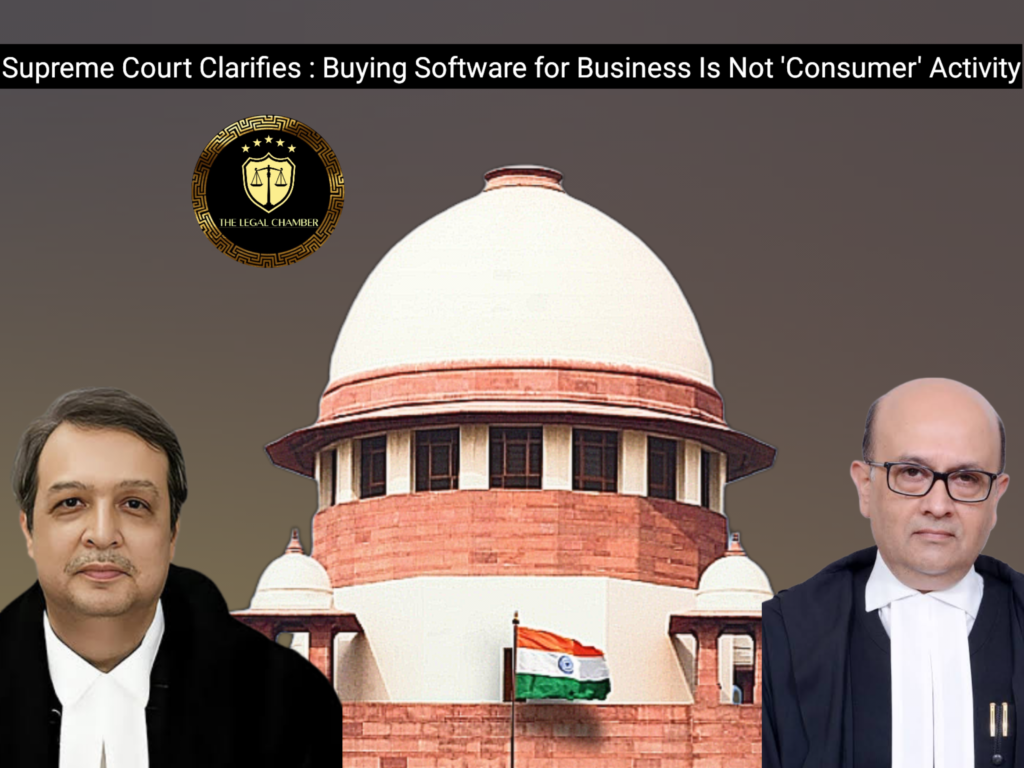
The Supreme Court held that a company purchasing software to automate and streamline its core, profit-generating business operations does so for a “commercial purpose” under Section 2(1)(d) of the Consumer Protection Act, 1986. Consequently, it does not qualify as a “consumer” and cannot maintain a complaint before a consumer forum for alleged deficiency in such services.
Facts Of The Case:
M/s Poly Medicure Ltd., the appellant, is a company engaged in the import and export of medical devices. To implement an export/import documentation system at its plant, it purchased a product license for the “Brillio Opti Suite” software from M/s Brillio Technologies Pvt. Ltd., the respondent. After making the requisite payment, the appellant alleged the software was defective and non-functional. Claiming deficiency in service, Poly Medicure filed a consumer complaint before the State Commission seeking a refund of the license cost and additional development charges, along with interest.The respondent contested the complaint’s maintainability, arguing that the appellant was not a “consumer” as defined under the Consumer Protection Act, 1986, since the software was purchased for a commercial purpose. The State Commission agreed, dismissing the complaint on the ground that the purchase was for business use. This decision was upheld by the National Consumer Disputes Redressal Commission. The appellant then appealed to the Supreme Court, contending the software was for self-use as an end-user with no intent to resell or generate profit directly, and thus it qualified as a consumer.
Procedural History:
The case originated with a consumer complaint (No. 515 of 2019) filed by M/s Poly Medicure Ltd. before the State Consumer Disputes Redressal Commission, Delhi. The State Commission, in its order dated 19.08.2019, dismissed the complaint as non-maintainable, holding that the appellant was not a “consumer” under the Consumer Protection Act, 1986, as the software was purchased for a commercial purpose. Aggrieved, the appellant filed First Appeal No. 1977 of 2019 before the National Consumer Disputes Redressal Commission, which, vide order dated 15.06.2020, dismissed the appeal and affirmed the State Commission’s order. The appellant then approached the Supreme Court by way of a Special Leave Petition (SLP (C) No. 14306 of 2020), which was granted, leading to the filing of the present Civil Appeal No. 6349 of 2024. The Supreme Court, after hearing the parties, dismissed the appeal, thereby upholding the concurrent findings of both the State and National Commissions.
READ ALSO:Supreme Court on NDPS Bail: Delay and Custody Can’t Override Statutory Bar for Commercial Quantity
Court Observation:
In its judgment, the Supreme Court made several key observations to determine the appellant’s status as a ‘consumer’. The Court reaffirmed that the definition of ‘person’ under the Act is inclusive, meaning a company can be a consumer. However, the crucial test is the purpose of the transaction. It observed that the term “commercial purpose” ordinarily includes business-to-business transactions and purchases with a direct nexus to profit-generating activity. The Court distinguished between a self-employed individual purchasing goods for livelihood (which is excluded from ‘commercial purpose’) and a commercial entity like the appellant, which purchased the software to automate its core business processes of import/export documentation. This automation was intrinsically linked to reducing costs and maximizing profits. Therefore, the dominant purpose of the purchase was commercial, placing it outside the protective scope of the Consumer Protection Act, 1986.
Final Decision & Judgement:
Case Details:
Case Title: M/S Poly Medicure Ltd. vs. M/S Brillio Technologies Pvt. Ltd.
Appeal Number: Civil Appeal No. 6349 of 2024
Date of Judgment: November 13, 2025
Judges/Justice Name:  Justice Manoj Misra and Justice J. B. Pardiwala