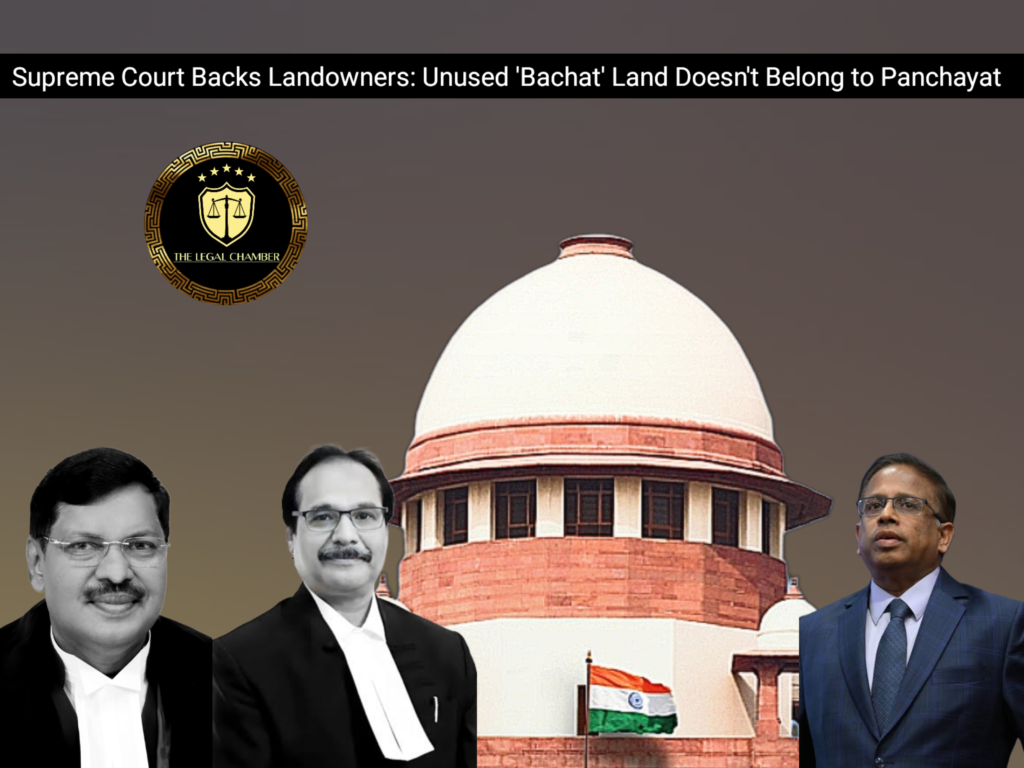
The Supreme Court upheld that lands contributed by proprietors during consolidation proceedings, but not specifically reserved or utilized for common purposes (known as bachat land), do not vest in the Gram Panchayat or the State. Relying on the doctrine of stare decisis and Constitution Bench precedents, the Court affirmed that such land continues to belong to the original proprietors, dismissing the State’s appeal.
Facts Of The Case:
The case originated from a challenge by landowners (respondents) to an amendment made by the State of Haryana in 1992 to the Punjab Village Common Lands (Regulation) Act, 1961. This amendment, via Haryana Act No. 9 of 1992, expanded the definition of “shamilat deh” (village common land) to include lands reserved for common purposes under the consolidation scheme, with management vesting in the Gram Panchayat. The landowners, who had contributed a portion of their holdings on a pro-rata basis to form a common pool during consolidation proceedings under the East Punjab Holdings Act, 1948, argued that the amendment arbitrarily sought to vest lands with the Panchayat that were never actually used for any common purpose, often remaining in their cultivation. These unused lands were termed ‘bachat’ land. A Full Bench of the Punjab & Haryana High Court partly allowed the landowners’ petitions, leading the State to appeal to the Supreme Court. While the Supreme Court initially allowed the State’s appeal in 2022, it subsequently recalled that judgment upon a review petition. The present judgment is the outcome of the fresh hearing, centering on whether the ‘bachat’ land vested in the State/Panchayat or remained with the original proprietors.
Procedural History:
The legal challenge began with writ petitions filed by landowners before the Punjab & Haryana High Court, contesting the 1992 amendment to the Punjab Village Common Lands Act. A Full Bench of the High Court, in its 1995 judgment, struck down the amendment. The State appealed to the Supreme Court (Civil Appeal No. 5480 of 1995), which in 1998 remanded the matter back to the High Court for reconsideration in light of Article 31-A of the Constitution. Upon remand, a Full Bench of the High Court partly allowed the writ petitions in the impugned judgment. The State again appealed to the Supreme Court (Civil Appeal No. 6990 of 2014), which initially allowed the State’s appeal in April 2022. However, a Review Petition was filed, which the Supreme Court allowed in May 2024, recalling its 2022 judgment and restoring the appeal for a fresh hearing, culminating in the present judgment which dismissed the State’s appeal.
READ ALSO:Supreme Court Quashes FIR in Property Dispute, Calls it “Abuse of Process of Law”
Court Observation:
The Supreme Court observed that the legal position was squarely governed by the Constitution Bench precedent in Bhagat Ram v. State of Punjab. It reaffirmed the crucial distinction that for land to vest in the Gram Panchayat, it must be specifically reserved or assigned for a common purpose in the consolidation scheme. The Court held that lands merely contributed to the common pool but left unutilized and unearmarked—known as bachat land—do not vest in the State or Panchayat and must remain with the original proprietors. It further endorsed the application of the doctrine of stare decisis, noting that the High Court’s view aligning with this principle had been consistently upheld in a long line of judgments over decades, creating a settled position that should not be disturbed.
Final Decision & Judgement:
The Supreme Court dismissed the appeal filed by the State of Haryana, thereby upholding the impugned judgment of the Full Bench of the Punjab & Haryana High Court. The Court affirmed that lands contributed by proprietors during consolidation proceedings, which were not specifically reserved or earmarked for any common purpose in the scheme and remained unutilized (referred to as bachat land), do not vest in the Gram Panchayat or the State. Consequently, the ownership and rights over such bachat land continue to remain with the original proprietor-landowners. No order as to costs was passed.
Case Details:
Case Title: The State of Haryana vs. Jai Singh and Others
Citation: 2025 INSC 1122
Appeal Number: Civil Appeal No. 6990 of 2014
Date of Judgement: September 16, 2025
Judges/Justice Name: Justice B.R. Gavai,&  Justice Prashant Kumar Mishra & Justice K.V. Viswanathan
Download The Judgement Here