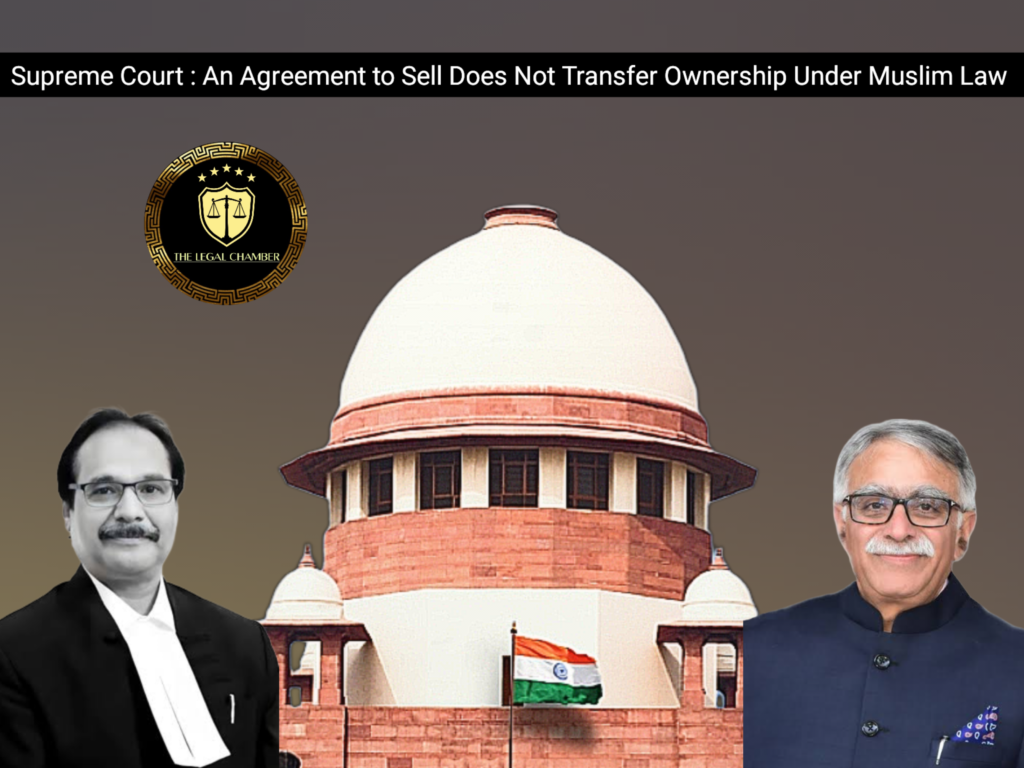
The Supreme Court affirmed that an agreement to sell does not transfer title under Section 54 of the Transfer of Property Act. Property remains part of the deceased’s matruka (estate) until a registered sale deed is executed. Inheritance under Muslim law applies to the entire estate, with the widow entitled to a one-fourth share as a sharer, absent descendants.
Facts Of The Case:
The case concerns a dispute over the inheritance of Chand Khan’s property between his widow, Zoharbee (appellant), and his brother, Imam Khan (respondent). Chand Khan died issueless, leaving behind two plots of land. Zoharbee claimed the entire property as matruka (estate) and, under Muslim law, sought a three-fourths share as the surviving spouse. Imam Khan contended that one plot had been transferred via an agreement to sell during Chand Khan’s lifetime, and the other had been sold to a third party after his death, leaving nothing to inherit. The trial court partially decreed in favour of Imam Khan, excluding the properties subject to the agreements. The First Appellate Court reversed this, holding that a mere agreement to sell does not transfer title, so the properties remained part of the estate. The High Court dismissed the second appeal. Before the Supreme Court, the core issue was whether an agreement to sell removes property from the deceased’s estate for inheritance purposes.
Procedural History:
The suit was initially filed by Imam Khan (since deceased, represented by LRs) before the Civil Judge, which decreed partially in his favour. Zoharbee’s first appeal under Section 96 CPC before the District Judge was allowed, reversing the trial court. Imam Khan’s LRs then filed a second appeal before the Bombay High Court (Aurangabad Bench), which was dismissed, affirming the first appellate court’s judgment. The matter was further challenged before the Supreme Court via civil appeals, which were also dismissed, thereby upholding the judgments of the first appellate court and the High Court.
READ ALSO:Supreme Court: No Absorption for Waitlisted Candidate After Recruitment Process Ends
Court Observation:
The Supreme Court observed that an agreement to sell creates no right, title, or interest in immovable property, which remains with the owner until execution of a registered sale deed under Section 54 of the Transfer of Property Act. Consequently, the property in question formed part of the deceased’s matruka (estate) for inheritance. Applying Muslim law, the Court held that the widow, as a sharer in the absence of descendants, is entitled to one-fourth of the estate, with the brother as a residuary entitled to the remainder. The Court further clarified that a seller can only convey the title they possess, affirming the maxim nemo dat quod non habet.
Final Decision & Judgement:
The Supreme Court dismissed the appeals, upholding the decisions of the First Appellate Court and the High Court. It held that the properties in question constituted matruka property of the deceased Chand Khan, as the agreement to sell did not effect a transfer of title. The estate was to be distributed according to Muslim law, entitling the widow Zoharbee to a one-fourth share and the brother Imam Khan (through his LRs) to the remaining three-fourths as the residuary heir. No costs were awarded.
Case Details:
Case Title: Zoharbee & Anr. vs. Imam Khan (D) Thr. LRS. & Ors.
Citation: 2025 INSC 1245
Appeal No: Civil Appeal Nos. 4516-4517 of 2023
Date of Judgement: October 16, 2025
Judges: Justice Sanjay Karol and Justice Prashant Kumar Mishra