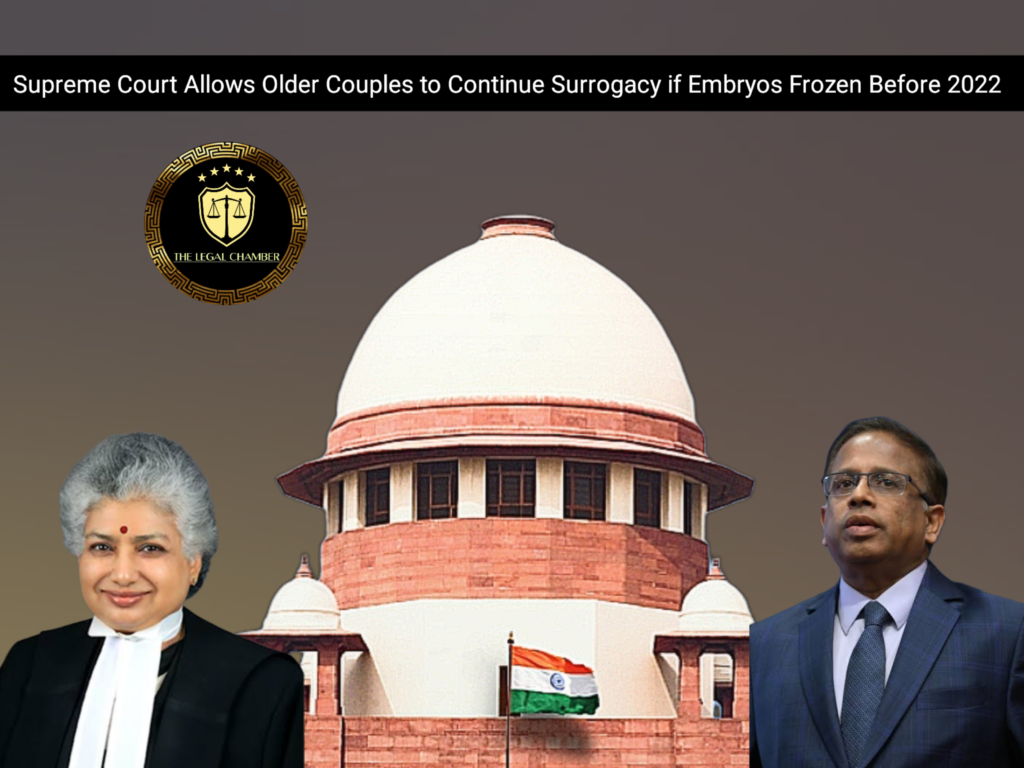
The Supreme Court held that the age restrictions under Section 4(iii)(c)(I) of the Surrogacy (Regulation) Act, 2021, do not apply retrospectively. Intending couples who had commenced the surrogacy process—specifically by creating and freezing embryos—before the Act’s enforcement retain their vested right to continue the procedure, irrespective of subsequently exceeding the statutory age limits.
Facts Of The Case:
The case consolidates three petitions concerning age restrictions for intending couples under the Surrogacy (Regulation) Act, 2021. In the first, a couple married in 2019 began IVF treatment in 2020 but were advised to use surrogacy due to the wife’s medical history. Their embryos were frozen in January 2021, but the process was stalled by the pandemic before the Act, with its age cap of 50 for women and 55 for men, came into force in January 2022, rendering them ineligible. The second couple, married in 2011, had unsuccessful embryo transfers between 2012 and 2019. The enforcement of the Act in 2022 barred them as the husband was then 58. The third couple, who lost their only child in 2018, underwent medical procedures for surrogacy with donor eggs. An embryo was transferred to a surrogate in January 2022, resulting in a miscarriage. The subsequent enforcement of the Act disqualified them as both were above the prescribed age limits. All couples argued they had legitimately commenced surrogacy procedures under the prior unregulated regime and that applying the new age restrictions retrospectively unfairly extinguished their vested right to parenthood.
Procedural History:
The procedural history of this case originated with the filing of separate writ petitions before the Supreme Court of India under its civil original jurisdiction. Writ Petition (Civil) No. 331 of 2024 and Writ Petition (Civil) No. 809 of 2024 were filed directly, while the issues for the third intending couple were raised through Interlocutory Application No. 181569 of 2022 in the pending Writ Petition (Civil) No. 756 of 2022. The Court, recognizing the common legal question regarding the retrospective application of age restrictions under the Surrogacy (Regulation) Act, 2021, clubbed these matters for a consolidated hearing. After considering extensive submissions from the petitioners’ counsel and the learned Additional Solicitor General for the Union of India, a bench comprising Justices B.V. Nagarathna and K.V. Viswanathan reserved judgment and subsequently delivered the reported ruling on October 9, 2025.
READ ALSO:Supreme Court Ruling: Judicial Officers with 7 Years’ Combined Experience Eligible for District Judge Post
Court Observation:
In its observations, the Supreme Court emphasized that the right to reproductive autonomy, including the choice to pursue surrogacy, is a fundamental aspect of the right to privacy and personal liberty under Article 21 of the Constitution. The Court noted that prior to the Act’s enforcement, there was no legal age restriction for intending couples, and by commencing the surrogacy process—specifically by creating and cryopreserving embryos—the petitioners had exercised a vested right. The bench held that a statute is presumed to be prospective unless a contrary intention is explicitly stated or necessitated by implication. It found no such legislative intent to apply the age restrictions under Section 4(iii)(c)(I) retrospectively to frustrate procedures lawfully begun under the prior legal regime. Consequently, the Court ruled that for couples who had completed the extraction, fertilization, and freezing of embryos before the Act came into force, the age bar would not apply, protecting their vested constitutional right from being extinguished by the new law.
Final Decision & Judgement:
The Supreme Court allowed the writ petitions and the interlocutory application. It held that the age restrictions prescribed under Section 4(iii)(c)(I) of the Surrogacy (Regulation) Act, 2021, do not apply retrospectively to intending couples who had commenced the surrogacy procedure prior to the Act’s enforcement on January 25, 2022. The Court defined “commencement” for this purpose as the stage where the couple has completed the extraction and fertilization of gametes and cryopreserved the embryos with the intention of transfer to a surrogate mother. Consequently, the petitioners and similarly situated couples are exempt from the age-limit certification requirement for continuing their surrogacy process, provided they fulfill all other conditions under the Act and Rules. The Court clarified that it was not adjudicating on the overall constitutional validity of the age restrictions, limiting its ruling to their retrospective applicability.
Case Details:
Case Title:Vijaya Kumari S & Anr. vs. Union of India
Citation:2025 INSC 1209
Appeal No.:Civil Original Jurisdiction Writ Petition (Civil) No. 331 of 2024
Date of Judgment:October 9, 2025
Judges/Justices: Justice B.V. Nagarathna & Justice K.V. Viswanathan
Download The Judgement Here