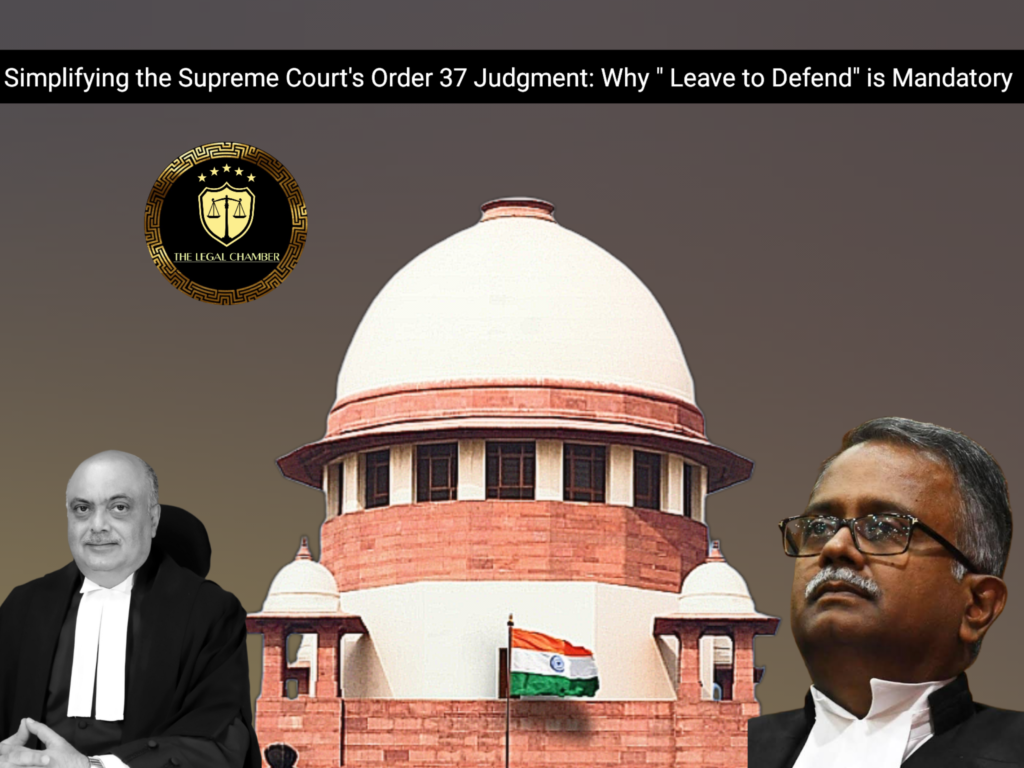
The Supreme Court held that in a summary suit under Order XXXVII CPC, a defendant cannot file a defence without first obtaining “leave to defend” from the court. Permitting a reply to a summons for judgment bypasses this mandatory procedure, which effaces the fundamental distinction between a summary suit and an ordinary suit. The Court set aside the impugned order for this procedural deviation.
Facts Of The Case:
The case originated from a commercial summary suit filed by the appellant, Executive Trading Company, to recover a sum of over Rs. 2.38 crore from the respondent, Grow Well Mercantile. The suit was instituted under the special fast-track procedure of Order XXXVII of the Civil Procedure Code (CPC). After the defendant entered appearance, the plaintiff served a “summons for judgment.” Instead of applying for “leave to defend” the suit as mandated by Order XXXVII, the defendant filed an application to dismiss the suit for non-compliance with pre-litigation mediation. This application was allowed, and the suit was stayed for mediation. After mediation failed, the plaintiff amended its pleadings. The defendant then filed an application to condone the delay in seeking leave to defend. The Bombay High Court, however, passed an order directly allowing the defendant to file a “reply” to the summons for judgment. The plaintiff appealed to the Supreme Court, contending that this procedural step of allowing a reply, bypassing the mandatory requirement of a “leave to defend” application, was legally unsustainable.
Procedural History:
The procedural history began with the filing of Commercial Summary Suit No. 19 of 2020 before the High Court of Judicature at Bombay by the appellant/plaintiff under Order XXXVII of the CPC. After the defendant entered appearance and the plaintiff served a summons for judgment, the defendant did not seek leave to defend but instead successfully applied for mediation under the Commercial Courts Act, leading to an abeyance of the suit. Following unsuccessful mediation, the plaintiff amended its pleadings. The defendant then filed an application for condonation of delay in applying for leave to defend. At this juncture, the High Court, vide its impugned order dated December 5, 2023, bypassed the pending application and directly allowed the defendant to file a “reply” to the summons for judgment. It was this specific procedural order of the High Court that was challenged before the Supreme Court, which set it aside for deviating from the mandatory procedure under Order XXXVII.
READ ALSO:Supreme Court Quashes FIR in Property Dispute, Says Mere Breach of Contract Isn’t Cheating
Court Observation:
The Supreme Court made a pivotal observation that the procedure under Order XXXVII of the CPC is a special, self-contained code that maintains a crucial distinction from ordinary suits. It explicitly held that permitting a defendant to file a reply or defence to a summons for judgment, without first obtaining “leave to defend,” is a fundamental procedural deviation that effaces this very distinction. The Court emphasized that the mandatory sequence requires a defendant to file an application for leave, disclosing a substantial defence, which the court must then evaluate. Bypassing this requirement by allowing a direct reply goes to the “root of the matter” and is legally unsustainable, as it undermines the summary nature of the remedy envisioned by the legislature.
Final Decision & Judgement:
The Supreme Court allowed the appeal and set aside the impugned order of the High Court dated December 5, 2023. The Court held that the High Court’s direction, which permitted the defendant to file a reply to the summons for judgment without first obtaining leave to defend, was a procedural illegality that undermined the essential character of a summary suit under Order XXXVII of the CPC. The apex court clarified that this decision was solely on the point of procedure and would not prejudice the substantive rights or defences of either party. The case was remitted to the High Court, leaving the parties free to pursue their remedies, including the defendant’s pending application for condonation of delay in seeking leave to defend, in strict accordance with the procedural steps envisaged under Rule 3 of Order XXXVII. No order as to costs was made.
Case Details:
Case Title: Executive Trading Company Private Limited  versus Grow Well Mercantile Private Limited
Citation: 2025 INSC 1157
Appeal Number:  [Arising out of Special Leave Petition (C) No. 1134 of 2024]
Date of Judgement: September 25, 2025
Judges/Justice Name: Justice Ahsanuddin Amanullah and Justice S.V.N. Bhatti