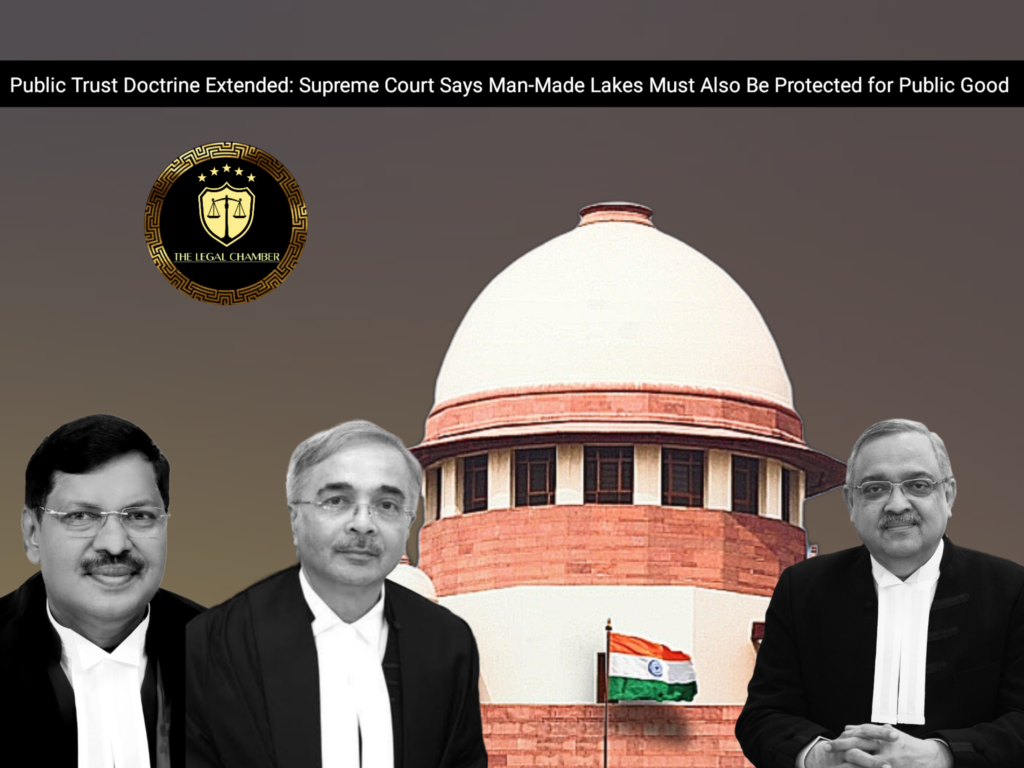
The Supreme Court ruled that a man-made lake constructed for irrigation is not a statutory “wetland” under the 2017 Rules, exempting it from a complete ban on permanent construction. However, the Court applied the Public Trust Doctrine, extending its protection to such artificial water bodies and prohibiting permanent structures to ensure ecological balance and public use.
Facts Of The Case:
The appellant, Swacch Association, an environmental organization, filed a Public Interest Litigation before the Bombay High Court challenging various construction and recreational projects in and around the Futala Lake in Nagpur. The association argued that the lake was a protected ‘wetland,’ and that the construction of a Viewer’s Gallery on its bank, the installation of a Musical Fountain and an artificial Banyan Tree inside the water body, and the building of a multi-storey Parking Plaza nearby were illegal. They contended that these permanent structures violated environmental laws, including the Wetlands Rules and the principle of Public Trust, and would cause ecological damage under the guise of beautification. The High Court dismissed the petition, leading to this appeal. The respondent authorities justified the projects, stating all necessary permissions and No Objection Certificates were obtained from competent bodies, including the Heritage Committee. They asserted the Futala Lake is a man-made water body constructed for irrigation and not a statutory ‘wetland,’ and that the structures were either temporary or built on the lake’s periphery without causing ecological harm.
Procedural History:
The procedural history of this case began with a Public Interest Litigation (PIL No.4 of 2023) filed by Swacch Association before the Division Bench of the Bombay High Court. The High Court, after hearing the parties, refused to grant interim relief in an order dated 05.07.2023 and subsequently disposed of the main petition by its final judgement and order dated 30.11.2023, declining the appellant’s prayers. Aggrieved by this decision, the appellant, Swacch Association, filed a Special Leave Petition (No.1420 of 2024) before the Supreme Court of India. The Supreme Court granted leave to appeal, which was registered as Civil Appeal No._____ of 2025, and after hearing the matter at length, dismissed the appeal, thereby upholding the judgement and directions of the High Court.
READ ALSO:Supreme Court Quashes Chhattisgarh’s Tender Rule, Upholds “Level Playing Field” for Businesses
Court Observation:
The Supreme Court made several key observations, primarily holding that the Futala Lake, being a man-made water body constructed for irrigation, does not fall within the statutory definition of a “wetland” under the Wetlands (Conservation & Management) Rules, 2017. Consequently, the absolute prohibitions under Rule 4 of the 2017 Rules were not strictly applicable. However, the Court crucially expanded the application of the Public Trust Doctrine, ruling that it extends to protect even artificially created water bodies from permanent constructions and ecological harm. The Court observed that structures like the artificial Banyan Tree, being removable and without a permanent foundation, were not permanent in nature. It endorsed the High Court’s balanced approach, reiterating directions to prohibit permanent constructions within the lake and to ensure its protection, thereby harmonizing public recreation with the imperative of environmental conservation under the constitutional framework of Articles 21, 48-A, and 51-A(g).
Final Decision & Judgement:
The Supreme Court dismissed the appeal, thereby upholding the judgement and directions of the Bombay High Court. The Court affirmed that the Futala Lake, as a man-made waterbody for irrigation, is not a statutory “wetland” and thus not subject to the full rigour of the Wetlands Rules. However, it firmly endorsed the High Court’s application of the Public Trust Doctrine to such artificial bodies, reinforcing the prohibition on permanent constructions within the lake. The Court found that the challenged structures either lacked permanence or had necessary approvals, and it reiterated the directive for authorities to maintain the lake’s ecological health, ensuring that its use for public recreation does not compromise its protection for future generations.
Case Details:
Case Title: SWACCH ASSOCIATION, NAGPUR VS. THE STATE OF MAHARASHTRA & ORS.
Citation: 2025 INSC 1199
Appeal Number:  (Arising out of Special Leave Petition (C) No.1420 of 2024)
Date of Judgement: October 07, 2025
Judges/Justices Name:  Justice B.R. GAVAI & Justice K. VINOD CHANDRAN & Justice N.V. ANJARIA
Download The Judgement Here