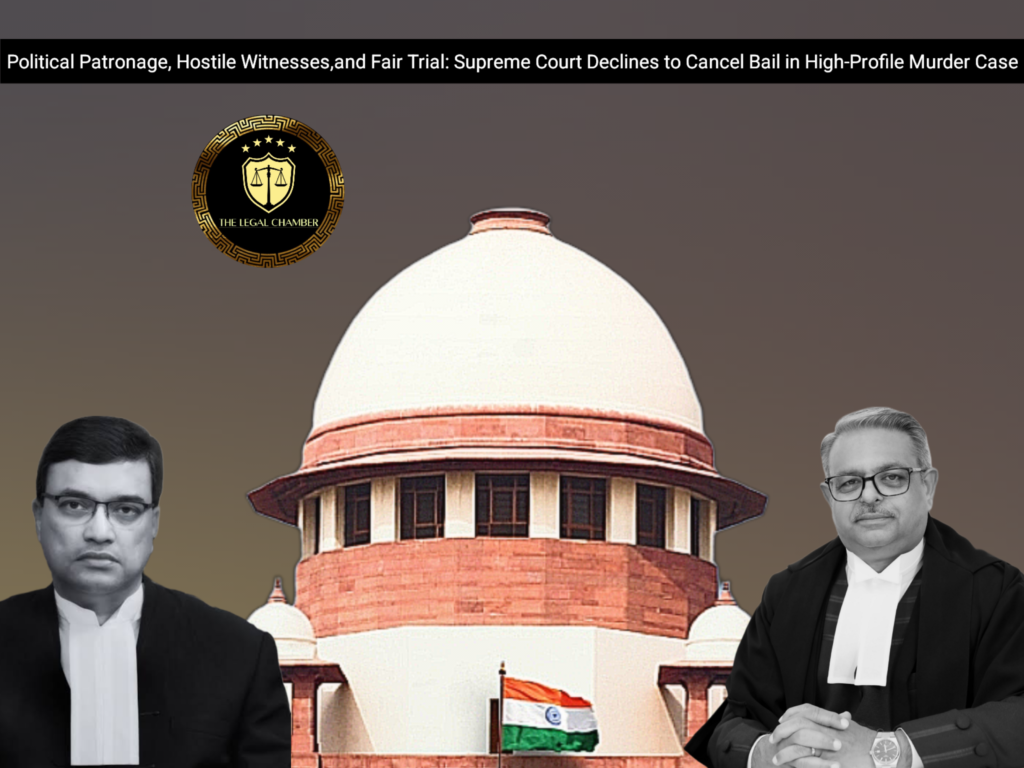
The Supreme Court held that a coordinate bench cannot modify or relax bail conditions imposed by an earlier bench absent gross error or changed circumstances, emphasizing judicial discipline, finality of orders, and sanctity of verdicts. Cancellation of bail requires proof of breach, not mere apprehension. Trial courts must avoid unwarranted criticism of court-appointed special public prosecutors.
Facts Of The Case:
The case arises from a murder conspiracy allegation registered on 8th October 2019, wherein Sk. Md. Anisur Rahaman and co-accused were charged under Sections 302/120B IPC and Arms Act for the killing of a political rival. Anisur was arrested on 16th November 2019 and trial commenced before the 3rd Additional Sessions Judge, Tamluk. On 26th February 2021, the West Bengal government issued an order directing withdrawal of prosecution under Section 321 Cr.PC, leading to the trial court’s mechanical acquittal on 2nd March 2021. The same day, a Calcutta High Court Single Judge set aside the withdrawal order. An intra-court appeal by Anisur resulted in remand, but the Division Bench clarified that he would remain in custody. Subsequently, the de facto complainant sought to withdraw the writ petition citing threat perception; Afzal Ali Sha, brother of the deceased, was transposed as petitioner. Anisur’s successive bail applications before the trial court and High Court were consistently rejected, culminating in dismissal of his special leave petition by the Supreme Court on 15th December 2022. On 17th March 2023, the Supreme Court transferred the trial to the Chief Judge, City Sessions Court, Calcutta, imposed stringent conditions including denial of bail except by the High Court, and directed expeditious conclusion. Despite this, Anisur filed repeated bail applications; on 3rd January 2025, a coordinate bench granted bail on condition of confinement to Kolkata. Anisur sought modification of this condition, while Afzal sought cancellation of bail. The trial was ongoing with witnesses turning hostile, and the Sessions Court had criticised the Special Public Prosecutor in an interim order.
Procedural History:
The matter originated from Panskura P.S. Case No.496 of 2019 registered on 8th October 2019, culminating in chargesheet and commitment for trial before the 3rd Additional Sessions Judge, Tamluk. On 26th February 2021, the Legal Remembrancer, Government of West Bengal, issued an order directing withdrawal of prosecution under Section 321 Cr.PC, pursuant to which the trial court mechanically acquitted the accused on 2nd March 2021. On the same date, a writ petition filed by the de facto complainant was allowed by a Calcutta High Court Single Judge, setting aside the withdrawal order. Anisur preferred an intra-court appeal; the Division Bench on 13th April 2021 set aside the Single Judge’s order on natural justice grounds and remanded the matter, clarifying that Anisur would remain in custody. On 28th April 2021, when the de facto complainant sought to withdraw the writ petition, the Single Judge permitted Afjal Ali Sha, brother of the deceased, to be transposed as petitioner. Anisur’s appeal against this order was dismissed by the Division Bench on 2nd July 2021. Afjal then approached the Supreme Court under Section 406 Cr.PC seeking transfer of trial, and this Court on 5th October 2021 ordered stay of trial proceedings. On 2nd May 2022, the Supreme Court clarified that the stay would not preclude consideration of bail applications. Anisur’s bail application was dismissed by the trial court on 12th May 2022, by the High Court Division Bench on 10th June 2022, and his special leave petition was dismissed by the Supreme Court on 15th December 2022. Meanwhile, on 2nd August 2022, the Single Judge allowed the writ petition and set aside the 26th February 2021 withdrawal order.On 17th March 2023, the Supreme Court disposed of the transfer petition, directing transfer of trial to the Chief Judge, City Sessions Court, Calcutta, imposing stringent conditions including that Anisur shall not be enlarged on bail except by the High Court. Despite this, Anisur filed successive bail applications before the High Court, which were dismissed on 29th January 2024 and 8th November 2024. On 3rd January 2025, a coordinate bench of the Supreme Court granted bail to Anisur subject to stringent conditions including confinement to Kolkata. Anisur thereafter filed I.A. No.197604/2025 seeking modification of the bail condition, and Afjal filed I.A. No.244053/2025 seeking cancellation of bail, along with I.A. No.227763/2025 for condonation of delay. These applications were heard together and disposed of by the present judgment dated 26th November 2025.
READ ALSO:No Dismissal for Honourably Acquitted Employee: Supreme Court Upholds Fair Play, Awards Family Pension
Court Observation:
The Supreme Court made several significant observations throughout the judgment. The Court observed that the developments in the trial, including the de facto complainant resiling from his stand, nearly ten police witnesses turning hostile, and the State government issuing direction for withdrawal of prosecution, left a very bitter taste and cast grave doubt on the bona fides of the State in effectively prosecuting the accused. The Court noted that the State appeared to have crossed the line of being an honest and fair prosecutor and bordered on becoming a real facilitator for the accused to evade conviction. Referring to the High Court’s observations, the Supreme Court remarked that the manner in which prosecution was sought to be jettisoned gave rise to grave doubt regarding State’s bona fides, and that an aura of fear and apprehension seemed to pervade the minds of witnesses and relations of the victim. The Court observed that the trial court’s mechanical acceptance of the withdrawal application on the very date when the writ petition was being heard, even after being informed of such fixation, evoked suspicion about motive rather than confidence in good faith. On judicial discipline, the Court emphatically observed that it is fundamental to the rule of law to maintain sanctity and finality of judicial verdicts, and that judicial orders which determine issues bind parties with conclusive finality.The Court expressed pain over the growing trend of verdicts pronounced by judges being overturned by succeeding benches, observing that permitting reopening of verdicts hoping that change in composition will yield different outcome undermines this Court’s authority and the value of its pronouncements. The Court observed that judicial discipline, propriety and comity demand that subsequent benches defer to earlier benches unless there is something grossly erroneous on the face of record necessitating review or curative petition. Regarding the Sessions Court’s remarks against the Special Public Prosecutor, the Court observed that characterizing the prosecutor’s approach as torpid and indifferent was wholly uncalled for, thoroughly unwarranted and absolutely unnecessary, particularly when the application was partly allowed, and that the Sessions Court ought to have been alive to the situation that predecessor in office was tardy and lethargic for which current initiative was necessary for fair trial. The Court observed that reference to legal maxims, while insightful if context requires, overusing them might distract from the main issue.
Final Decision & Judgement:
The Supreme Court dismissed both applications. The application for cancellation of bail filed by Afjal Ali Sha was rejected on the ground that no breach of bail conditions was conclusively established, and having regard to the advanced stage of trial, no useful purpose would be served by cancelling the bail granted to Anisur. The application for condonation of delay filed by Anisur was allowed. However, the application for modification of the bail condition requiring Anisur to remain confined to Kolkata was dismissed. The Court held that the stringent condition was justifiably imposed by the coordinate bench while granting bail, balancing competing interests of need for incarceration and right to liberty, and there being no significant change in circumstances warranting reconsideration. The Court further held that judicial discipline, propriety and comity demanded deference to the earlier bench’s view, and modification would amount to overstepping that order and undermine the principle of finality of judicial decisions. Regarding the Sessions Court’s order dated 21st November 2025, the Supreme Court interfered to the extent of setting aside the reference made to the Legal Remembrancer criticizing the Special Public Prosecutor, holding such comments wholly uncalled for and unwarranted. The Special Public Prosecutor was encouraged to continue conducting the trial with fairness, integrity and diligence. The Sessions Court was directed to deal with all applications on merits and conclude the trial in accordance with law without being overly concerned about previous timelines.
Case Details:
Case Title: SK. MD. ANISUR RAHAMAN v. THE STATE OF WEST BENGAL & ANR. (with AFJAL ALI SHA @ ABJAL SHAUKAT SHA v. THE STATE OF WEST BENGAL & ANR.)
Citation: 2025 INSC 1360
Criminal Appeal No.: Criminal Appeal No. 43/2025
Date of Judgment: November 26, 2025
Judges/Coram:  Justice Dipankar Datta and Justice Augustine George Masih
Download The Judgement Here