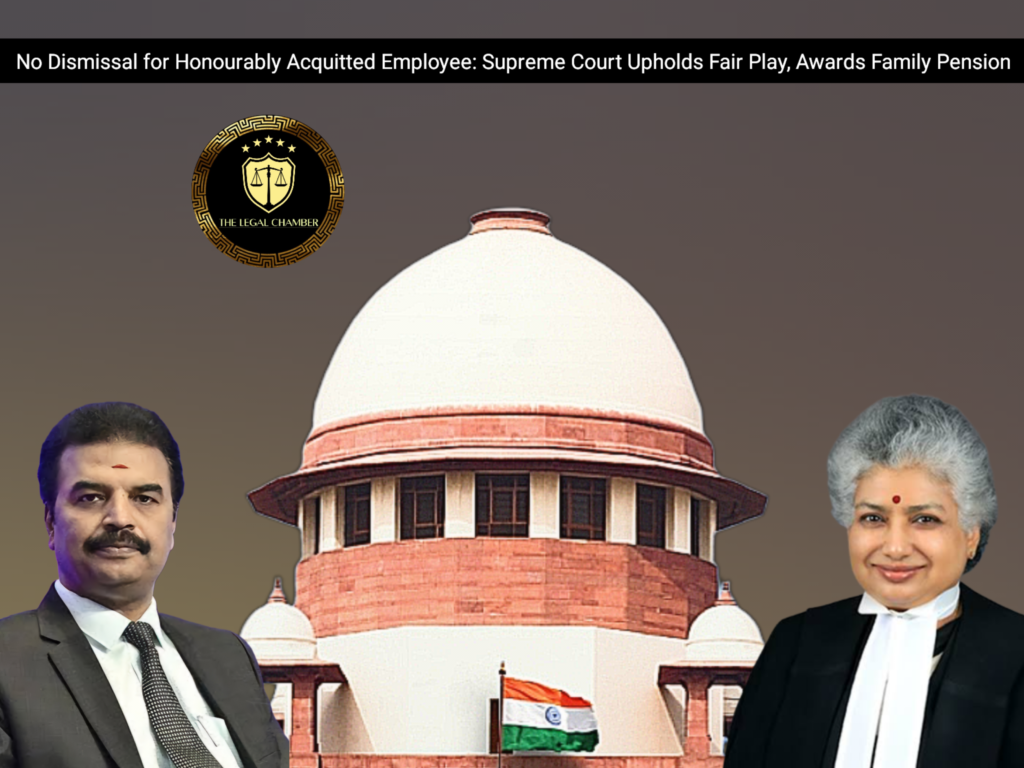
No Dismissal for Honourably Acquitted Employee: Supreme Court Upholds Fair Play, Awards Family Pension

The Supreme Court held that dismissal from service for suppression of involvement in a criminal case was disproportionate, despite misconduct being proved. The punishment was modified to compulsory retirement, entitling the deceased appellant’s legal representatives to arrears of pension and family pension. Acquittal with a specific finding of alibi further warranted penalty modulation.

Facts Of The Case:

The appellant was appointed as a Constable in the Railway Protection Force in 1994. In 2007, an FIR was registered against him, his father, and brothers under Sections 363 and 366 IPC for alleged abduction of a girl. The charge-sheet was initially filed only against his brother, but in 2010, the appellant was summoned under Section 319 CrPC, and charges were framed against him. Immediately thereafter, disciplinary proceedings were initiated for concealing his involvement in the criminal case and for failing to report his arrest and detention to the department. An inquiry report noted that the appellant was on duty in Delhi on the date of the incident, yet he was dismissed from service in June 2011. His revision petition was dismissed. During the pendency of his writ petition before the High Court, the appellant was acquitted in the criminal trial. The trial court specifically recorded that he was not present at the place of occurrence and was performing official duties in Delhi. Despite this, the High Court dismissed his petition, observing that the acquittal was based on technical grounds. The appellant appealed to the Supreme Court, where he passed away in October 2023 at age 54. His legal representatives pursued the appeal seeking quashment of dismissal or conversion of punishment to compulsory retirement for pensionary benefits.

Procedural History:

The disciplinary proceedings commenced with a charge-sheet dated 12 January 2011 issued under Rule 153 of the Railway Protection Force Rules, 1987. Following an inquiry, the Senior Circle Security Commissioner passed an order dated 24 June 2011 dismissing the appellant from service. Aggrieved, the appellant preferred a revision petition before the Inspector General, Chief Protection Commissioner, which was dismissed on 18 January 2012. The appellant thereafter filed Civil Writ Petition No.6411 of 2012 before the Delhi High Court assailing the dismissal order. During the pendency of the writ petition, the appellant was acquitted in the criminal trial on 16 November 2013. The Division Bench of the High Court, by judgment dated 29 July 2015, dismissed the writ petition, holding that the acquittal was based on technical considerations and that the disciplinary authority’s decision warranted no interference. Being aggrieved, the appellant approached the Supreme Court by way of Civil Appeal No.13402 of 2015. During the pendency of the appeal before the Supreme Court, the original appellant died on 3 October 2023, and his legal representatives were brought on record. On 26 November 2025, the Supreme Court delivered judgment partly allowing the appeal, modifying the punishment from dismissal to compulsory retirement.

READ ALSO:Conservation or Cruelty? Supreme Court Steps In to Save Delhi’s Deer From Faulty Relocation Plan

Court Observation:

The Supreme Court observed that although misconduct in the nature of suppression of involvement in a criminal case and failure to report arrest and detention was proved in the disciplinary inquiry, the punishment of dismissal from service was wholly disproportionate. The Court noted that the appellant had completed approximately seventeen years of service and was entitled to career progression and retirement benefits, which warranted imposition of a lesser penalty. The Court further observed that the appellant had secured an honourable acquittal in the criminal proceedings, with the trial court specifically recording that he was on duty in Delhi on the date of the incident and was not present at the place of occurrence. This finding, according to the Court, further reinforced the case for modulation of punishment. The Court emphasized that while the misconduct did call for disciplinary action, the extreme penalty of dismissal was not justified in the facts and circumstances. The Court also took judicial notice of the appellant’s death during the pendency of the appeal, observing that the ends of justice would be met by converting the dismissal into compulsory retirement, thereby enabling his legal representatives to receive arrears of pension and family pension in accordance with law.

Final Decision & Judgement:

The Supreme Court partly allowed the appeal and modified the punishment of dismissal from service to compulsory retirement, effective from the original date of dismissal, 24 June 2011. The Court directed that the appellant, and now his legal representatives, shall be entitled to receive arrears of pension from the date of dismissal and family pension from the date of his demise, to be computed and paid in accordance with law. The respondents were ordered to release the pensionary benefits to the legal representatives within six weeks from the receipt of the copy of the judgment. The Court clarified that the modification was warranted on account of the disproportionality of the punishment, the appellant’s seventeen years of service, his honourable acquittal with a specific finding of alibi, and his death during the pendency of the appeal. The appeal was allowed in part in the aforesaid terms.

Case Details:

Case Title: Sahab Singh (D) Through LRs. v. Director General, RPF, Rail Bhawan & Others
Citation: 2025 INSC 1497
Case Type: Civil Appeal No. 13402 of 2015
Date of Judgment: 26 November 2025
Bench: Justice B.V. Nagarathna and Justice R. Mahadevan

Leave a Reply

Your email address will not be published. Required fields are marked *