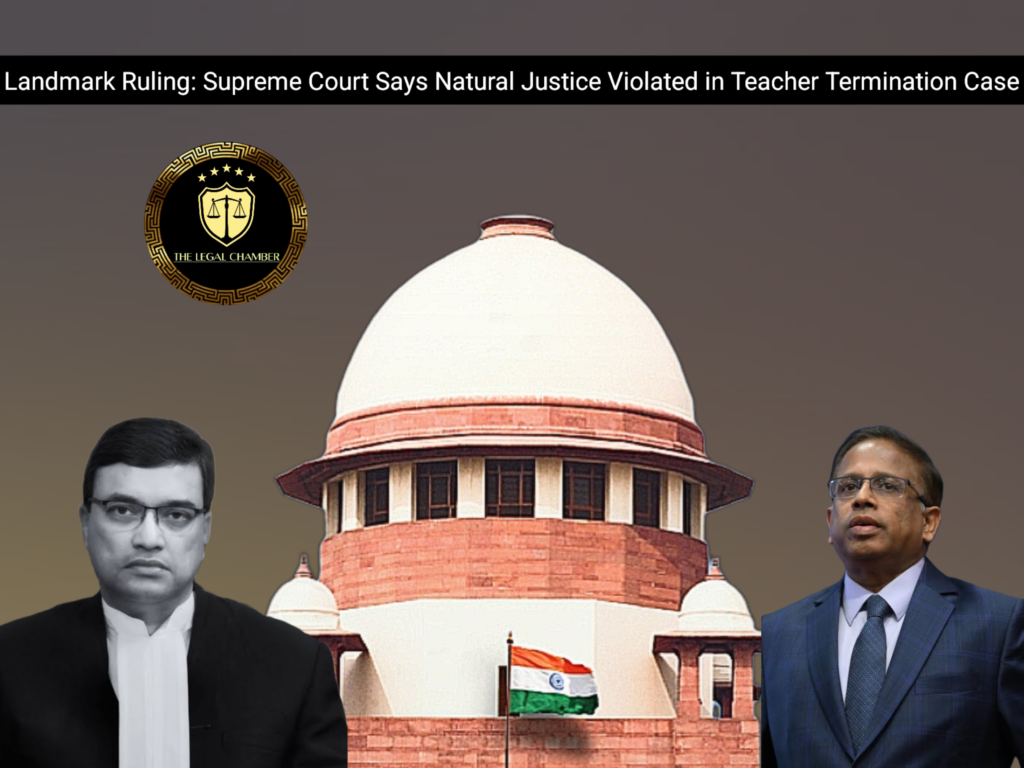
The Supreme Court held that Rule 21 of the Jharkhand Primary School Teacher Appointment Rules, 2012, applies only to the preparation of a merit list and not to determining eligibility. The termination orders were quashed for violating principles of natural justice, as the appellants were not given notice regarding the exclusion of vocational subject marks.
Facts Of The Case:
The State of Jharkhand advertised posts for Intermediate Trained Teachers in 2015. The appellants—Ravi Oraon, Premial Hembrom, and Surendra Munda—successfully applied, were selected, and commenced their duties in December 2015. In September 2016, they were issued show cause notices alleging they did not meet the minimum eligibility criterion of 45% marks in their intermediate examination and questioning the validity of their graduation certificates. The appellants, belonging to the Scheduled Tribe category, replied that they were entitled to a 5% relaxation, requiring only 40% marks, which they had secured, and clarified that graduation certificates were not mandatory for the post. Nonetheless, their services were terminated in October 2016 on the grounds that they had secured less than 40% marks, a calculation achieved by excluding the marks from their vocational subjects. They challenged the terminations before the High Court. A Single Judge allowed their writ petitions, but a Division Bench reversed these decisions. The appellants then appealed to the Supreme Court. During the pendency of litigation, the validity of their graduation certificates was subsequently recognized by the state government, and two appellants were freshly appointed in 2025, while the third appellant had passed away.
Procedural History:
The procedural history of this case originated with the termination of the appellants’ services in October 2016. They challenged these orders by filing separate writ petitions before the Jharkhand High Court. A Single Judge allowed these petitions in 2018 and 2022, setting aside the terminations. The respondents, the State of Jharkhand, then preferred intra-court appeals before a Division Bench of the same High Court. The Division Bench allowed these appeals in 2021 and 2022, thereby upholding the termination orders and overturning the Single Judge’s decisions. Aggrieved by the Division Bench’s judgments, the appellants invoked the appellate jurisdiction of the Supreme Court of India, which culminated in the present civil appeals being allowed in October 2025.
READ ALSO:Society Cannot Evade Decree by Raising Unauthorized Constructions, Rules Supreme Court
Court Observation:
Final Decision & Judgement:
The Supreme Court allowed the appeals, setting aside the impugned judgments of the High Court Division Bench as well as the original termination orders. The Court held that the appellants were eligible for appointment as they had secured the required minimum marks, and their termination was illegal and in violation of principles of natural justice. Consequently, the two surviving appellants, Ravi and Premlal, were ordered to be reinstated with continuity of service from their original appointment date in December 2015, and were granted full arrears of pay and seniority benefits. For the deceased appellant, Surendra, the Court directed payment of full arrears to his legal heirs from the date of termination till his death, and granted them the benefit of compassionate appointment schemes as if he had died in harness.
Case Details:
Case Title: Ravi Oraon vs. The State of Jharkhand & Ors.
Case Number: Civil Appeal Nos. 11748, 11749, and 11750 of 2025
Date of Judgment: October 09, 2025
Judges/Justices: Justice Dipankar Datta and Justice K.V. Viswanathan
Download The Judgement Here