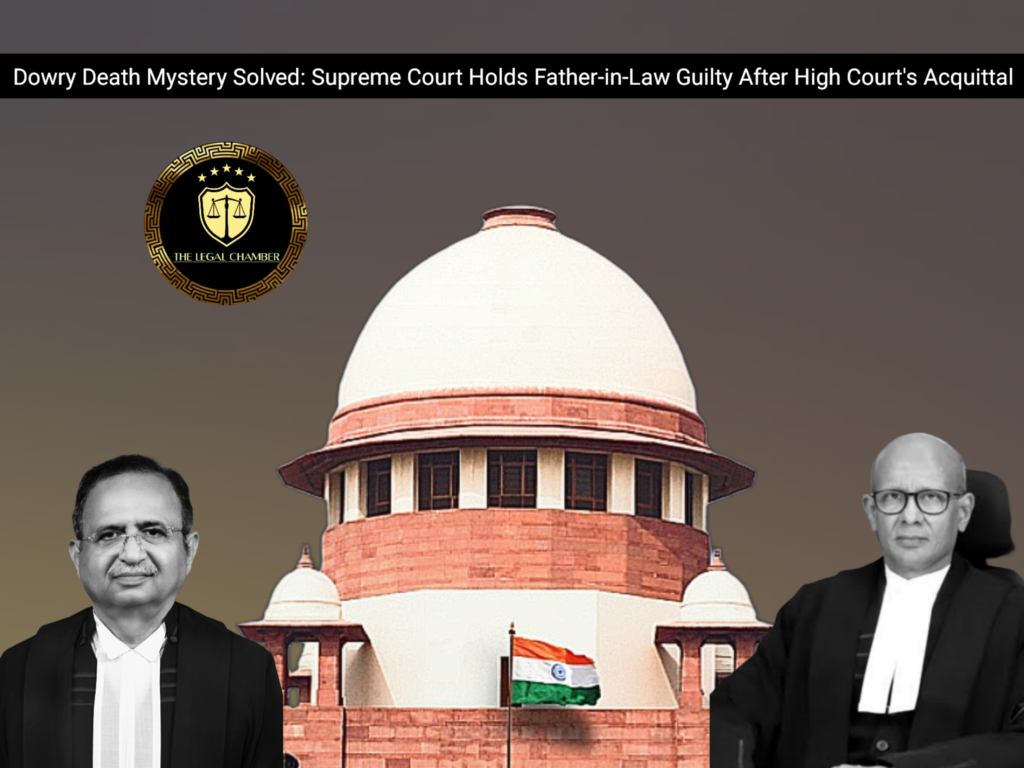
The Supreme Court restored the conviction of the accused under Sections 302 and 201 of the IPC, holding that in cases of unnatural death within a household, the burden to explain the circumstances lies with the accused under Section 106 of the Evidence Act. The Court found the chain of circumstantial evidence complete, establishing guilt beyond reasonable doubt.
Facts Of The Case:
The case revolves around the death of Smt. Pushpa, who was married to Mahesh Singh. Her family alleged she faced persistent dowry harassment and cruelty from her husband and father-in-law, Janved Singh. On December 31, 1997, Janved Singh reported to police that Pushpa died from accidental electrocution while ironing clothes. However, the post-mortem revealed the cause was asphyxia due to strangulation, with burn marks being post-mortem. The police, finding discrepancies, converted the inquiry into a murder case. The Sessions Court convicted Mahesh under dowry death provisions and Janved for murder, fabricating evidence, and giving false information. The High Court later acquitted both, doubting witness credibility and the proof of marriage duration. The State appealed only against Janved’s acquittal to the Supreme Court. The apex court, analyzing the circumstantial evidence, found the death was homicidal, occurred in Janved’s house, and that his false electrocution story was an attempt to mislead. It restored his conviction, emphasizing his failure to explain the death under Section 106 of the Evidence Act.
Procedural History:
The procedural history of this case began with the registration of a Merg report under Section 174 CrPC following the father-in-law’s report of an accidental electrocution death. After investigation revealed it was a homicide, the police filed a chargesheet for murder and dowry-related offences. The Sessions Court convicted the husband under Sections 304-B and 498-A IPC and the father-in-law under Sections 302, 498-A, and 201 IPC. The High Court, on appeal, reversed this decision and acquitted both accused. The State’s appeal to the Supreme Court against the father-in-law’s acquittal was initially dismissed concerning the husband but was later heard. The Supreme Court, in its final judgment, set aside the High Court’s acquittal and restored the Trial Court’s conviction and sentence of the father-in-law.
READ ALSO:Supreme Court Dismisses Arbitration Petition Due to Limitation Issues
Court Observation:
In its observations, the Supreme Court emphasized the applicability of Section 106 of the Evidence Act, placing a burden on the accused to explain the circumstances of an unnatural death occurring within the confines of his household. The Court found a complete chain of circumstantial evidence, including the homicidal nature of death proven by medical science, the deceased’s presence in the accused’s home, the lodging of a false FIR suggesting electrocution to mislead investigation, and established evidence of dowry-related cruelty. It held that the accused’s false explanation regarding the death constituted an additional link in the chain pointing to his guilt, and that the High Court had erred by not considering this material evidence and the Trial Court’s reasoning.
Final Decision & Judgement:
The Supreme Court partly allowed the State’s appeal. It set aside the impugned judgment of acquittal passed by the High Court and restored the conviction and sentence of the respondent, Janved Singh (the father-in-law), as originally ordered by the Trial Court. The Court held that the prosecution had proved his guilt for the offences under Sections 302 (murder) and 201 (causing disappearance of evidence) of the Indian Penal Code beyond reasonable doubt. Consequently, Janved Singh was directed to be taken into custody forthwith to serve the remainder of his sentence.
Case Details:
Case Title: State of Madhya Pradesh vs. Janved Singh
Citation: 2025 INSC 1229
Criminal Appeal No.: Criminal Appeal No. 460 of 2014
Date of Judgement: October 14, 2025
Judges/Justice Name: Justice Sanjay Kumar and Justice Alok Aradhe