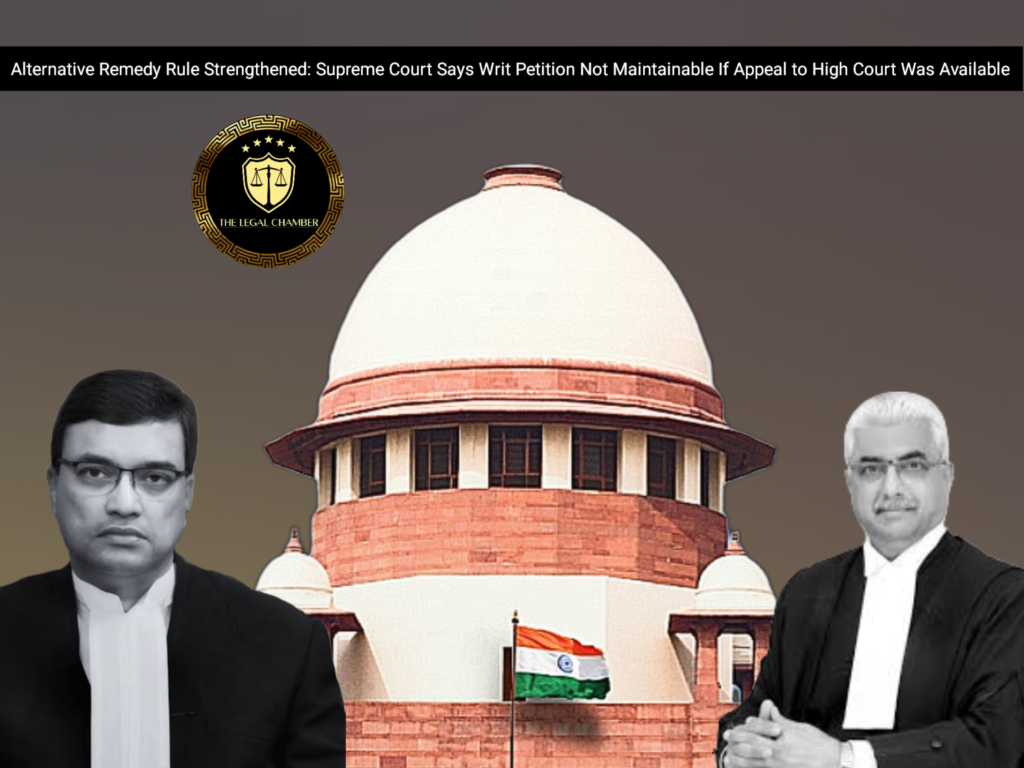
This Supreme Court judgment reiterates the principle that the existence of an alternative statutory remedy, especially one before the High Court itself, is a valid ground for refusing to exercise writ jurisdiction under Article 226 of the Constitution. It emphasizes that discretionary writ relief is generally unavailable where a litigant has, through their own fault, failed to exhaust an equally efficacious alternative forum provided by statute.
Facts Of The Case:
The appellant, Rikhab Chand Jain, faced proceedings concerning 252.177 kg of allegedly smuggled silver seized on September 27, 1992. The Additional Collector of Customs, respondent no. 3, ordered the confiscation of the silver and imposed a penalty of Rs. 50,000 on the appellant via an order dated May 7, 1996. The appellant appealed this order to the Customs, Excise and Gold (Control) Appellate Tribunal (CEGAT) under the Customs Act, 1962. The CEGAT, in its order dated June 23, 2000, upheld the confiscation but reduced the penalty to Rs. 30,000. The appellant did not file a further statutory appeal to the High Court against this CEGAT order within the prescribed 180-day limitation period. Instead, he filed a writ petition under Article 226 of the Constitution before the Rajasthan High Court on March 18, 2003, challenging both the original confiscation order and the CEGAT’s appellate order. The High Court dismissed the writ petition, citing the appellant’s failure to exhaust the alternative statutory remedy of appeal and also on merits. The appellant then appealed to the Supreme Court, challenging the High Court’s refusal to exercise its writ jurisdiction.
Procedural History:
The procedural history of this case began with the seizure of alleged smuggled silver and the subsequent order of confiscation and penalty by the Additional Collector of Customs on May 7, 1996. The appellant appealed this order to the Customs, Excise and Gold (Control) Appellate Tribunal (CEGAT), which upheld the confiscation but reduced the penalty on June 23, 2000. The appellant did not file a further appeal to the High Court under Section 130 of the Customs Act within the statutory limitation period. Instead, he invoked the writ jurisdiction of the Rajasthan High Court under Article 226 of the Constitution on March 18, 2003. The High Court dismissed the writ petition on March 14, 2011, primarily for non-exhaustion of the alternative statutory remedy and also on merits. The appellant then appealed to the Supreme Court by special leave, which was granted on September 17, 2012.
READ ALSO:Judicial Propriety Upheld: Supreme Court Says Validity of Sanction Must Be Challenged Only Before It
Court Observation:
The Supreme Court observed that the High Court was justified in refusing to entertain the writ petition under Article 226 of the Constitution. The Court emphasized that where a statutory alternative remedy, especially an appeal to the High Court itself, is available and equally efficacious, the writ jurisdiction should not normally be invoked, as it would bypass the statutory machinery. The appellant had forfeited this statutory appeal remedy through his own fault by filing it beyond the limitation period, and his belated invocation of writ jurisdiction could not be justified. The Court further noted that the writ petition lacked necessary pleadings to substantiate the claim that the confiscation order was challenged before the CEGAT but not considered, thus also failing on merits.
Final Decision & Judgement:
Case Details:
Case Title: Rikhab Chand Jain vs. Union of India & Ors.
Citation: 2025 INSC 1337
Appeal No.: Civil Appeal No. 6719 of 2012
Date of Judgement: November 12, 2025
Judges/Justices: Justice DiPankar Datta, & Justice Aravind Kumar