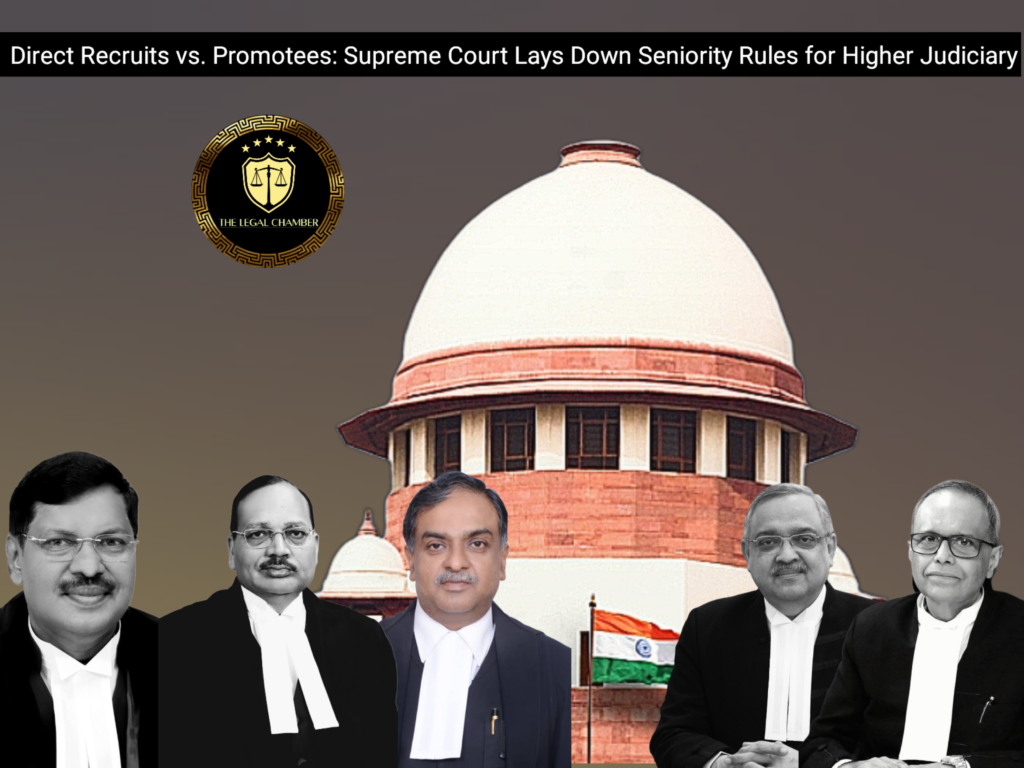
The Supreme Court, exercising its powers under Article 142, upheld the principle that upon entry into the Higher Judicial Service, officers from different recruitment sources lose their “birthmark.” It mandated a uniform 4-point annual roster system for determining seniority, based on merit-cum-seniority within the cadre, and rejected preferential treatment based on prior service in lower judicial ranks.
Facts Of The Case:
The case originated from an interlocutory application filed in the long-pending All India Judges Association writ petition. The application, brought by the Amicus Curiae, highlighted a recurring dispute regarding the criteria for determining inter se seniority among three categories of officers within the Higher Judicial Services (HJS): Regular Promotees (RPs), those promoted via Limited Departmental Competitive Examination (LDCE), and Direct Recruits (DRs) from the Bar. Promotees argued that their extensive prior judicial service in lower courts warranted recognition in seniority within the HJS, contending that direct recruits, by virtue of being younger at entry, gained an unfair career advantage in reaching higher grades and administrative posts. The Amicus proposed mechanisms like quotas and weightage for prior service to address this perceived “heartburn.” In response, the Supreme Court constituted a five-judge Constitution Bench to resolve the issue. The core factual controversy centered on whether service rendered in feeder cadres (Civil Judge positions) should influence seniority, promotions, and financial upgradation after officers from all three streams merge into the common HJS cadre of District Judge.
Procedural History:
The procedural history of this case is rooted in the enduring writ petition (Civil) No. 1022 of 1989, All India Judges Association v. Union of India, which has been retained by the Supreme Court as a continuing mandamus to oversee judicial service reforms. The instant dispute arose specifically from Interlocutory Application No. 230675 of 2025, filed by the Amicus Curiae, which brought to light anomalies in seniority determination within the Higher Judicial Services across states. Upon considering the application, a three-judge bench, vide order dated 07.10.2025, recognized the need for a definitive resolution of the recurring seniority controversy and opined that the issue involved reconsideration of earlier judgments by benches of co-equal strength. Consequently, the bench directed the matter to be placed before the Chief Justice of India for constitution of a larger bench. Hon’ble the Chief Justice thereafter constituted a five-judge Constitution Bench, which heard arguments from states, High Courts, and representatives of the three recruitment streams, culminating in the present judgment dated 19.11.2025.
READ ALSO:Supreme Court: Concluded Land Compensation Agreement is Final, Bars Interest Claim
Court Observation:
The Court made several key observations, beginning with its authority to issue uniform guidelines under Articles 32, 141, and 142, notwithstanding the High Courts’ control under Articles 233-235. It found no constitutional basis for creating artificial classifications or quotas based on the source of recruitment once officers fuse into the common Higher Judicial Service cadre, as they lose their recruitment “birthmark.” The Bench observed that the alleged “heartburn” among promotees, stemming from the faster career progression of younger direct recruits, did not constitute a legal claim or legitimate expectation warranting preferential treatment. It emphasized that career progression within the HJS, including fixation in Selection Grade and Super Time Scale, must be based strictly on merit-cum-seniority as evaluated from service within that cadre, not on prior service in lower judiciary. The Court further noted that existing mechanisms, like accelerated promotions and eligibility for direct recruitment examinations, sufficiently addressed promotional avenues for promotees. Finally, it observed that disparate state-level data did not reveal a nationwide, systemic malady of disproportionate representation that required judicial intervention.
Final Decision & Judgement:
The Supreme Court, in its final decision, dismissed the core prayers of the interlocutory application seeking preferential seniority for promotees. It ruled that no separate quotas or weightage for prior lower judicial service could be created for determining seniority or promotions within the Higher Judicial Service (HJS). The Court mandated a uniform, nationwide 4-point annual roster system (sequence: 2 RP, 1 LDCE, 1 DR) for assigning seniority upon entry, clarifying that seniority once fixed continues for all subsequent career advancements based on merit-cum-seniority within the HJS cadre. It issued specific directions for handling delayed recruitments and unfilled vacancies, allowing carry-forward and diversion to other streams while protecting the roster’s integrity. All states and Union Territories were directed to amend their statutory rules in consultation with their High Courts to implement this roster system within three months, thereby establishing a harmonized framework for seniority determination across the country.
Case Details:
Case Title: All India Judges Association and Ors. v. Union of India and Ors.
Citation: 2025 INSC 1328
Case Number: I.A. No. 230675/2025 in Writ Petition (Civil) No. 1022 of 1989
Date of Judgement: November 19, 2025
Bench (Justices): Justice  B.R. Gavai & Justice Surya Kant & Justice Vikram Nath & Justice K. Vinod Chandran & Justice Joynalya Bagchi
Download The Judgement Here