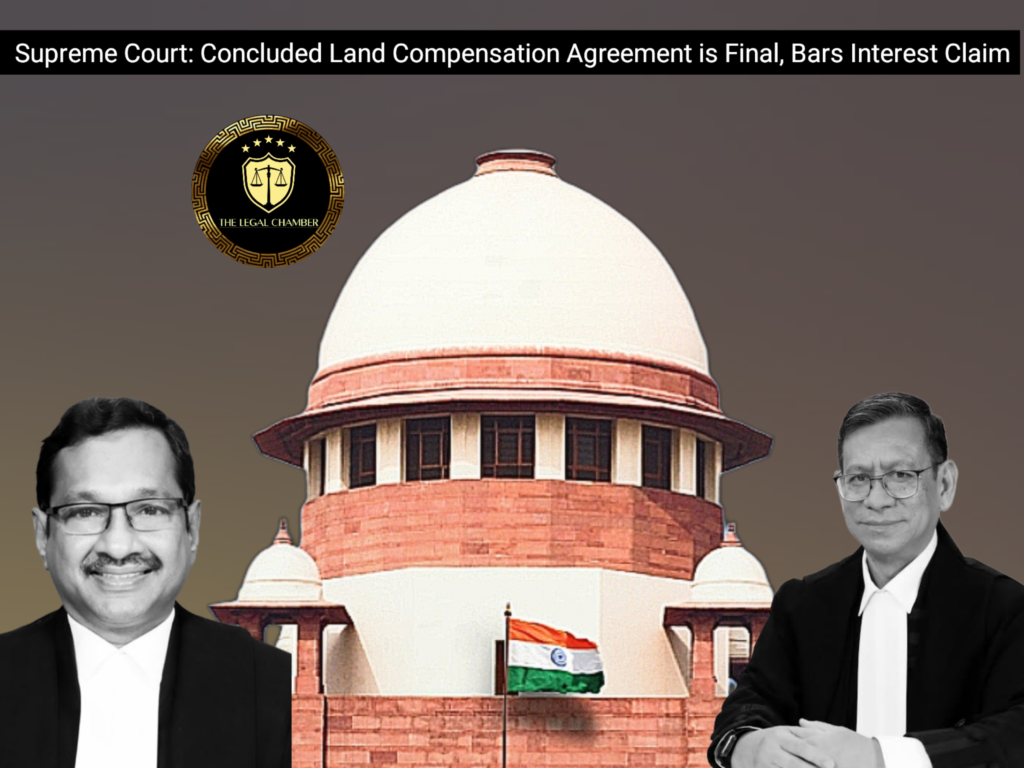
The Supreme Court held that a concluded compensation agreement voluntarily entered into under Section 7 of the Tamil Nadu Acquisition of Land for Industrial Purposes Act, 1997, is a final and binding contract. Such an agreement precludes parties from subsequently invoking statutory provisions, like Section 12 for interest, as the contract subsumes all related claims and disputes.
Facts Of The Case:
The case involved the acquisition of lands in Coimbatore District, initially leased to the Defence Department in 1942, for the expansion of Coimbatore Airport runway. Proceedings under the Tamil Nadu Acquisition of Land for Industrial Purposes Act, 1997 were initiated in 2011. In 2018, a meeting was convened under Section 7(2) of the Act between authorities and landowners, resulting in a consent agreement fixing compensation rates significantly higher than the prevailing guideline value. Many landowners withdrew their legal challenges based on this agreement. The Madras High Court, while upholding the agreement as a complete and binding package, nonetheless directed the payment of statutory interest under Section 12 of the 1997 Act from the date of the acquisition notice. The State Government appealed to the Supreme Court, contesting this award of interest on the grounds that the voluntarily concluded contract, which settled all compensation matters, excluded the application of other statutory provisions.
Procedural History:
The procedural history began with writ petitions filed by landowners in the Madras High Court, challenging the acquisition proceedings under the 1997 Act and simultaneously seeking compensation and arrears of lease rent. After a consent agreement on compensation was reached in 2018, the High Court, in its impugned judgment dated August 18, 2020, upheld the agreement as a binding package but additionally directed payment of statutory interest under Section 12 of the Act. The State of Tamil Nadu and others then filed Special Leave Petitions (SLPs) before the Supreme Court, challenging the interest component. The Supreme Court granted leave, heard the appeals arising from these SLPs, and ultimately allowed them, setting aside the High Court’s direction for payment of interest.
READ ALSO:Judiciary vs Parliament: Supreme Court Repeats Warning on Tribunal Independence
Court Observation:
The Supreme Court observed that Sections 7(2) and 7(4) of the 1997 Act facilitate a negotiated settlement, which, once reached, becomes a concluded and sacrosanct contract under the Indian Contract Act, governing all rights and liabilities of the parties. The Court held that such a voluntarily entered agreement excludes the applicability of other statutory provisions of the Act, including Section 12 for payment of interest, as all potential disputes regarding compensation, rent, and interest are subsumed within the contract’s terms. It further emphasized that allowing a party to resile from the agreement and claim statutory benefits would violate the doctrine of approbation and reprobation, permitting a party to neither accept and reject the same instrument nor blow hot and cold.
Final Decision & Judgement:
The Supreme Court allowed the appeals and set aside the part of the Madras High Court’s judgment that directed payment of interest under Section 12 of the 1997 Act. The Court held that the consent agreement arrived at under Section 7(2) was a final and binding contract, which precluded the landowners from subsequently claiming statutory interest. The agreement constituted a complete package, and reopening it to grant additional relief was impermissible.
Case Details:
Case Title: The Government of Tamil Nadu & Ors. vs. P.R. Jaganathan & Ors. etc.
Citation: 2025 INSC 1332
Appeal No. (Arising out of SLP (C) Nos. 12770-83 of 2020)
Date of Judgment: November 19, 2025
Judges/Justice Name: Justice M. M. Sundresh and Justice Nongmeikapam Kotiswar Singh
Download The Judgement Here