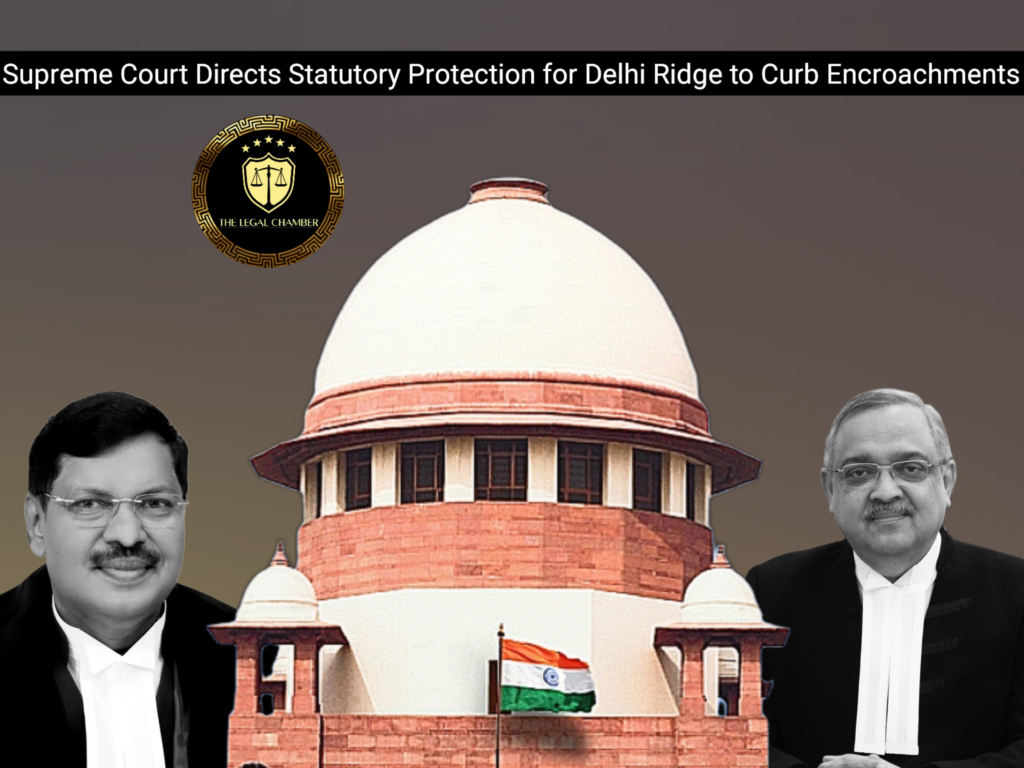
This Supreme Court judgment directs statutory reconstitution of the Delhi Ridge Management Board under the Environment (Protection) Act, 1986, to function as a single-window authority. It mandates the Board to ensure the protection, removal of encroachments, and ecological restoration of both the notified Ridge and the Morphological Ridge, with oversight by the Central Empowered Committee and the Supreme Court.
Facts Of The Case:
The case concerns the long-standing litigation over the protection and management of the Delhi Ridge, a vital ecological area within the National Capital Territory. The primary legal proceedings originate from Writ Petition (C) No. 202 of 1995 (T.N. Godavarman Thirumulpad v. Union of India) and connected matters. The Supreme Court was tasked with adjudicating issues of overlapping jurisdictions and ineffective governance by multiple authorities monitoring the Ridge. Despite a 1994 preliminary notification declaring 7,777 hectares as Reserved Forest under the Indian Forest Act, 1927, only 103.48 hectares received final notification under Section 20, leaving most of the Ridge legally unprotected. Furthermore, the Delhi Ridge Management Board (DRMB), constituted by a 1995 court order, operated without statutory backing, leading to functional inefficacy. Concurrently, the concept of the “Morphological Ridge”—areas with geological features identical to the notified Ridge but falling outside its official boundary—emerged from judicial rulings, requiring equal protection but lacking formal identification. The Court also noted rampant encroachments and the failure of the Delhi government to execute removal directives and final notifications. The central issue was the consolidation of multiple supervising committees into one statutorily empowered body to ensure the Ridge’s preservation.
Procedural History:
The procedural history of this case is defined by prolonged, multi-forum litigation. It originates from the Supreme Court’s 1995 order in M.C. Mehta v. Union of India which led to the creation of the non-statutory Delhi Ridge Management Board (DRMB). Subsequent interventions came from the Delhi High Court in Ashok Kumar Tanwar (2011), which extended protection to the “Morphological Ridge,” and the National Green Tribunal in Sonya Ghosh (2021), directing final forest notification and encroachment removal. Parallel proceedings in the Supreme Court, including T.N. Godavarman and DDA v. Kenneth Builders, addressed construction permissions and morphological ridge identification. To resolve conflicting orders and overlapping jurisdictions from these various courts and tribunals, the Supreme Court, by an order dated 24th July 2024, consolidated all Delhi Ridge matters before a single bench, culminating in the present 2025 judgment.
READ ALSO:Supreme Court Closes Contempt Case, Emphasizes Lawyers’ Responsibility as “Officers of the Court”
Court Observation:
The Supreme Court made several critical observations in its judgment. It noted the failure of the GNCTD to issue a final notification under Section 20 of the Indian Forest Act for over three decades, leaving the Delhi Ridge largely without statutory protection and vulnerable to encroachment. The Court underscored the ecological necessity of protecting not only the notified Ridge but also the “Morphological Ridge,” which shares identical geological features. It observed that the existing Delhi Ridge Management Board (DRMB) was ineffective due to its lack of statutory authority, leading to duplication of work and conflicting orders among multiple supervising bodies. The Court emphasized that environmental governance requires institutional clarity, transparency, and accountability, which can only be achieved by constituting a statutorily-backed, single-window authority under the Environment (Protection) Act, 1986.
Final Decision & Judgement:
The Supreme Court directed the Ministry of Environment, Forest and Climate Change (MoEF&CC) to statutorily constitute the Delhi Ridge Management Board (DRMB) as an authority under Section 3(3) of the Environment (Protection) Act, 1986. The reconstituted DRMB, chaired by the Chief Secretary of GNCTD and including a representative from the Central Empowered Committee (CEC), was mandated to function as a single-window authority for all matters concerning the Delhi Ridge and the Morphological Ridge. Its core functions include the removal of encroachments, completion of the morphological ridge identification, ecological restoration, and submitting periodic reports to the Court. The judgement also directed the DRMB to form a Standing Committee of experts for day-to-day management and upheld the necessity of granting statutory backing to ensure accountability, transparency, and effective preservation of the Ridge.
Case Details:
Case Title: IN RE: DELHI RIDGE (I.A. No. 117204 of 2024 in Writ Petition (C) No. 202 of 1995)
Citation: 2025 INSC 1306
Appeal No.: I.A. No. 117204 of 2024 (in Writ Petition (C) No. 202 of 1995)
Date of Judgment: November 11, 2025
Judges/Justices Name: Justice  B.R. Gavai & Justice K. Vinod Chandran
Download The Judgement Here