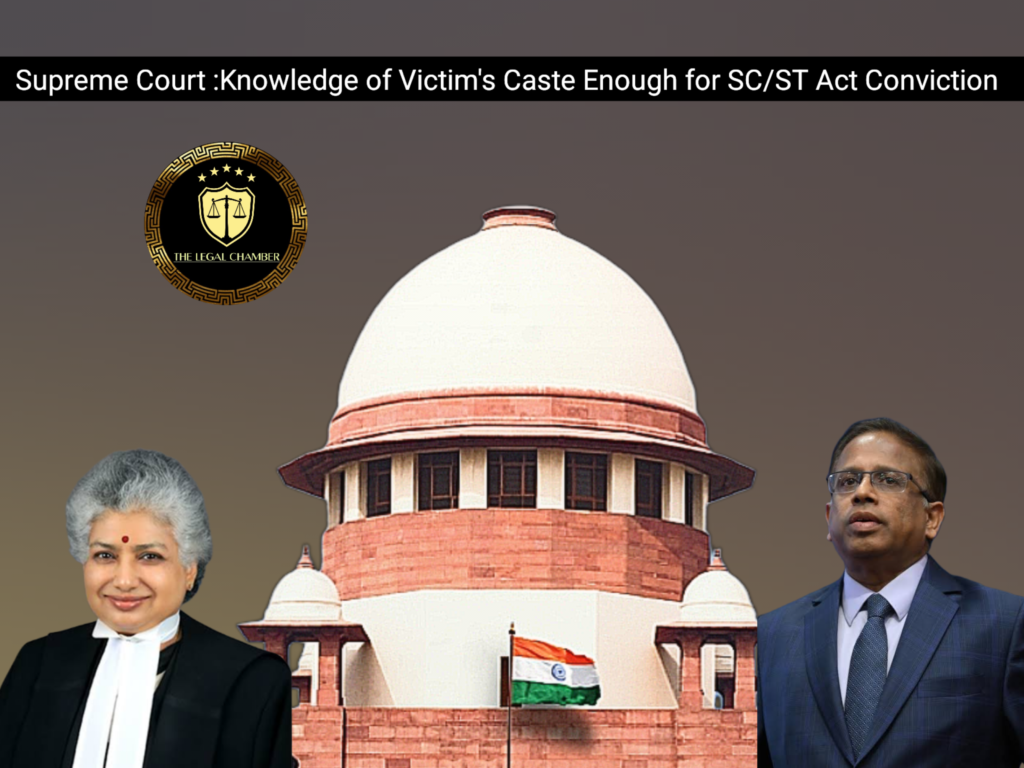
The Supreme Court affirmed that school admission registers are admissible evidence under Section 35 of the Evidence Act to prove a victim’s minority in POCSO cases. It clarified that a witness cannot be declared hostile for minor inconsistencies, reiterating that such a step is an extraordinary measure requiring clear hostility or resiling from a material statement. The Court also held that under the amended SC/ST Act, mere knowledge of the victim’s caste is sufficient to attract Section 3(2)(v), especially when a presumption of such awareness arises under Section 8(c) from prior acquaintance.
Facts Of The Case:
On the night of May 10, 2018, the minor victim left her home to deliver food to her grandfather. Near a Sendhwar tree, the appellant, Shivkumar, allegedly abducted her by force, threatening to kill her if she screamed. He took her to a forest, where he sexually assaulted her after promising marriage. The victim was later left at her maternal uncle’s house, from where the appellant later retrieved her before both were intercepted by police. The victim’s father filed a missing report on May 14, 2018, suspecting the appellant, leading to the registration of offences under the IPC, POCSO Act, and the SC/ST Act, as the victim belonged to a Scheduled Caste. The prosecution relied on the victim’s clear testimony, medical evidence indicating recent sexual intercourse, and school records proving she was a minor on the date of the incident. The Trial Court and High Court convicted the appellant, imposing sentences including life imprisonment under the SC/ST Act. The Supreme Court dismissed the appeal, upholding the convictions after examining the evidence and legal principles regarding hostile witnesses, proof of age, and the applicability of the amended SC/ST Act provisions.
Procedural History:
The procedural history of the case began with the registration of an FIR at Police Station Pratappur on May 14, 2018, under Section 363 of the IPC. Following investigation and the victim’s recovery, charges under Sections 366, 376, 506 IPC, Section 4 of the POCSO Act, and Section 3(2)(v) of the SC/ST Act were added. The Trial Court (Special Judge, SC/ST Act, Surajpur) convicted the appellant on October 22, 2019, and sentenced him to life imprisonment along with other terms. The appellant’s criminal appeal (No. 9/2020) was dismissed by the High Court of Chhattisgarh at Bilaspur on June 16, 2023, which confirmed the conviction and sentence. The appellant then filed a Special Leave Petition (Criminal No. 14625 of 2024) before the Supreme Court, which granted leave, heard the appeal (Criminal Appeal No. 4502 of 2025), and ultimately dismissed it on October 14, 2025, upholding the concurrent findings of the courts below.
READ ALSO:Retired AFC Employees Win Supreme Court Battle for Higher Gratuity Payout
Court Observation:
The Supreme Court made several key observations in dismissing the appeal. It strongly criticized the prosecution for unnecessarily declaring the victim’s father a hostile witness over minor inconsistencies, reiterating that such a step is an “extraordinary phenomenon” permissible only when a witness exhibits clear hostility or resiles from a material statement. The Court affirmed the reliability of the school admission register as admissible evidence under Section 35 of the Evidence Act to conclusively prove the victim was a minor. Regarding the SC/ST Act, the Court held that the amended Section 3(2)(v) only requires proof of the accused’s knowledge of the victim’s caste, not that the crime was specifically committed because of it. It further noted that under Section 8(c) of the Act, the accused’s prior acquaintance with the victim’s family raised a presumption of such knowledge, which remained unrebutted. The Court found the testimonies of the victim and medical evidence reliable and consistent, establishing guilt beyond reasonable doubt under all charged sections.
Final Decision & Judgement:
The Supreme Court, in its final decision, dismissed the criminal appeal and upheld the concurrent convictions and sentences imposed by the Trial Court and the High Court. The Court found no merit in the appellant’s challenges, concluding that the prosecution had successfully proved all charges beyond a reasonable doubt. It affirmed the findings on the victim’s minority based on the school register, the validity of the medical evidence, and the credibility of the victim’s testimony. Critically, the Court upheld the conviction under Section 3(2)(v) of the SC/ST Act, ruling that the appellant’s prior knowledge of the victim’s Scheduled Caste status was sufficiently established, thereby attracting the provision for life imprisonment. Consequently, the sentences under the IPC, POCSO Act, and SC/ST Act were confirmed to run concurrently.
Case Details:
Case Title: Shivkumar @ Baleshwar Yadav vs. The State of Chhattisgarh
Criminal/Civil Appeal No.: Criminal Appeal No. 4502 of 2025
Date of Judgement: 14th October, 2025
Judges/Justice Name: Justice K.V. Viswanathan and Justice B.V. Nagarathna
Download The Judgement Here