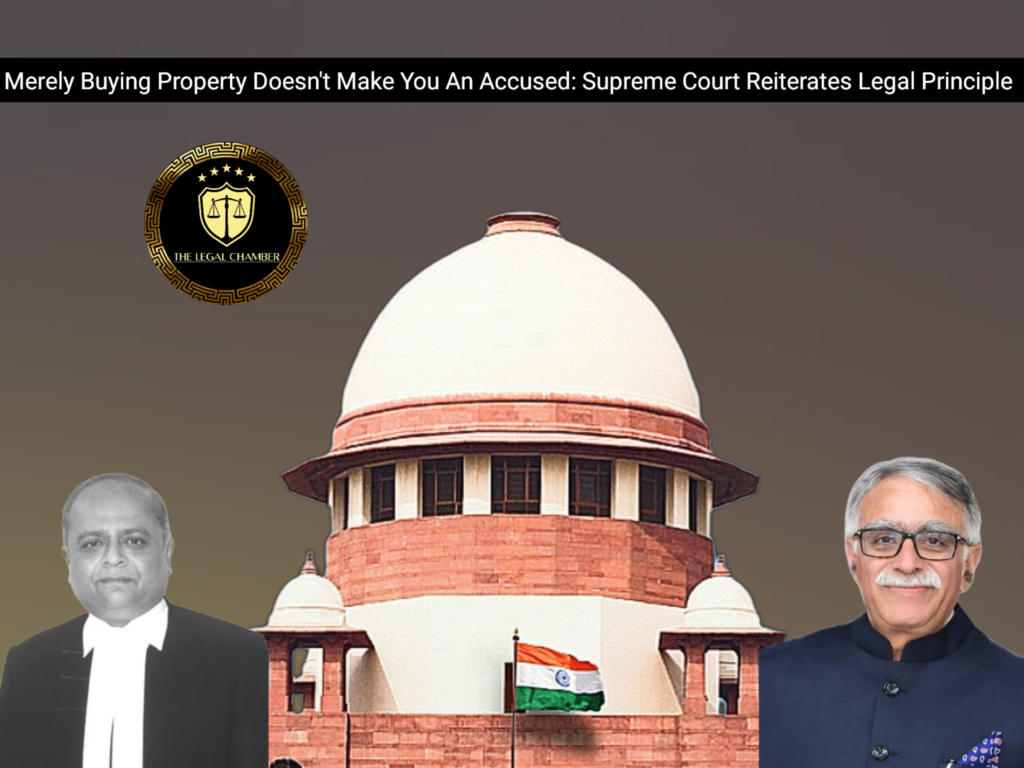
Merely Buying Property Doesn’t Make You an Accused: Supreme Court Reiterates Legal Principle

The Supreme Court quashed criminal proceedings against the accused appellant, holding that no prima facie case was established under Sections 420, 406, and 34 of the IPC. The Court ruled that mere subsequent purchase of property from a co-accused, without allegation of inducement or involvement in the initial fraudulent transaction, does not attract criminal liability for cheating or criminal breach of trust.

Facts Of The Case:

The case originates from an FIR filed by Ms. Amutha in October 2022 against Gunasekaran (Accused No. 1) for offences under Section 420 of the IPC. She alleged that in 2015, Gunasekaran fraudulently represented himself as the owner of a vacant plot, inducing her into an unregistered sale agreement for ₹1.64 crore. She paid substantial sums totaling ₹92 lakhs between 2015 and 2016. It was later discovered he had no valid title. After investigation, a chargesheet was filed implicating both Gunasekaran and his son, G. Prasad Raghavan (the appellant/Accused No. 2). The allegation against the appellant was that in March 2022, knowing his father had not returned the informant’s money, he purchased the same plot from him via a registered sale deed for ₹60 lakhs while being a student with no independent income. The trial court and the High Court rejected the appellant’s discharge petition. The appellant approached the Supreme Court contending he was a minor during the original 2015-2016 transaction and was not involved in any inducement or payment, and his subsequent 2022 purchase alone could not constitute the alleged offences.

Procedural History:

The procedural history of the case commenced with the filing of FIR No. 0032 of 2022 before the CBCID Police Station, Puducherry, against the original accused. Following investigation, a chargesheet was filed against both accused persons. The appellant, along with the co-accused, filed a discharge application under Section 239 of the Code of Criminal Procedure before the Chief Judicial Magistrate, Puducherry, which was dismissed on 15.03.2024. Subsequently, a Criminal Revision Case (No. 1430 of 2024) was jointly filed before the High Court of Judicature at Madras, which was also dismissed vide order dated 15.04.2025. The appellant then approached the Supreme Court by way of a Special Leave Petition (Criminal) No. 12380 of 2025, which was converted into the present Criminal Appeal. The Supreme Court allowed the appeal, quashing the impugned orders and discharging the appellant from the criminal proceedings.

READ ALSO:Supreme Court Upholds Tribunal’s Power to Modify Military Conviction

Court Observation:

The Supreme Court observed that the foundational transaction and alleged cheating occurred solely between the informant and Accused No. 1 during 2015-2016, when the appellant was a minor. The Court noted there was no allegation that the appellant made any fraudulent representation, inducement, received any payment, or issued any threat to the informant. His only connection was purchasing the disputed property from his father in 2022. The Court held that this subsequent act, by itself, did not constitute the essential ingredients of the offences of cheating (Section 420 IPC) or criminal breach of trust (Section 406 IPC), nor did it establish a common intention (Section 34 IPC) for the original fraud. Consequently, it found no prima facie case against the appellant to proceed to trial.

Final Decision & Judgement:

The Supreme Court allowed the appeal and set aside the orders of the courts below. It quashed the criminal proceedings against the appellant, G. Prasad Raghavan (Accused No. 2). The Court held that no prima facie case was made out against him for the offences under Sections 420, 406, 294(b), 506(i) read with Section 34 of the IPC. Consequently, his discharge application under Section 239 of the Code of Criminal Procedure was allowed, and the chargesheet and all consequent proceedings qua the appellant were quashed.

Case Details:

Case Title: G. Prasad Raghavan vs. Union Territory of Puducherry
Criminal Appeal No.:  (Arising from SLP (Crl.) No. 12380 of 2025)
Date of Judgement: October 10, 2025
Judges/Justices Name: Justice Sanjay Karol and Justice Vipul M. Pancholi

Leave a Reply

Your email address will not be published. Required fields are marked *